Given that the uplinker wants to make a certain number of channels on this transponder, he might choose a scheme like:
Movie Preview Channel 3Mb Cable Channel 3.5Mb Sport Channel 4Mb Sport Channel 4Mb Movie Channel 4.5Mb PPV Channel 4.5Mb News Channel 3Mb Audio Channel 128Kb Audio Channel 128Kb Audio Channel 128Kb Audio Channel 128Kb Audio Channel 64Kb Audio Channel 64Kb Audio Channel 64Kb Low-speed Data Service 19.2Kb High-speed Data Service 512Kb DVB-SI (EPG, authorization etc) 630Kb Firmware Update 128Kb Total 27.993Mb Unused (null PID) 7Kb
The problem with TDM is that channels that are given low bandwidth tend to contain lots of overcompression artifacts when there is too much motion, many frame changes or huge differences in luminosity. Additionally, when high bandwidth channels contain very compressable video, their bandwith is lost.
Statistical Multiplexing
Statmux in MPEG-2/DVB systems is very new - the second generation encoders only hit the streets a few months ago. The only service known in North America to be using statmux at this time is DISH Network, where it has made a huge difference to the quality of the video and at the same time allowed all the transponders FEC to be backed down to 3/4, therefore improving rain fade performance.
Statmux encoders in-effect "talk" to each other about the amount of bandwidth required for the video they are currently compressing and they share this information with a central processor that talks to the other encoders and knows some basic rules, like the amount of space to allocate for fixed rate services, like the DVB-SI etc.
The end result is that a particular channel's bandwidth utilization might be 6Mb one second and 2Mb the next, depending on how much bandwidth that particular channel needs at that time. Obviously, there is still an upper limit to the number of channels that can be transmitted on each transponder, but the number is generally increased by going to statmux encoders since the bandwidth is now shared.
When buying an MPEG-2 receiver from Europe, there are a number of terms used there that need to be understood in order to use a receiver designed for that market.
Ku-Band is King
In Europe, the most common way of transmitting feeds and video programming is via Ku-Band and not C-Band as it is here in North America. The reason for this simple - a) Ku-Band dishes are smaller and therefore easier to install b) the geographical distances there are much smaller than in North America c) if a signal is targeted towards say the Balkan states (Bulgaria, Romania, Albania etc.), a beam can be used for these services because generally no-one outside of these areas will want to receive the signals. The beam results in a stronger signal on the ground, which improves signal quality and therefore can also reduce the size of the receiving dish.
C-Band is used in Europe, however, it's typically used for Arabic feeds (again a large geographical area) and for hemispheric feeds (for example, the Deutche Welle feed on Intelsat at 1 west that covers all of Europe and Africa).
Because Ku-band is so popular in Europe, most people use an offset-style dish with a combined LNB and feedhorn (an LNBF). The LNBF uses variation of the supply voltage to switch between horizontal and vertical polarity (14v = vertical, 18v = horizontal). In the US, Echostar and DSS use the same technique to switch between left-hand and right-hand circular polarization.
Frequency Bands
In North America, Ku-Band is split into two bands. The FSS band covers 11.7-12.2 GHz and is used for some DBS services (ex-AlphaStar and Primestar), but also for video feeds between TV stations and data services. The DBS band is designed only for direct to home applications and uses 12.2-12.7GHz.
When DBS started in the Europe, the initial band was 11.2-11.7 GHz, however, this has now been expanded to cover from 10.7 to 12.7 GHz, all for direct to home services.
Intermediate Frequencies and LOs
Initial satellite receivers available in Europe received in the range 950-1450MHz. This meant that the LNB contained a local oscillator frequency of 10.25 GHz (10.25 GHz + 950 MHz = 11.2GHz). When the band was extended down to 10.7GHz, this meant that the receivers had to change in order to receive all the programming. This meant that the IF was extended with the range 950-2100MHz with an LO frequency of 9.75 GHz.
Next, along comes digital TV, which occupies the 11.7 to 12.7 GHz band. Trying build a tuner and LNB that handles the entire range of 10.7 to 12.7 is impossible, so therefore the LNB contains two LOs - one at 9.75GHz and the other at 10.6GHz. This type of LNB is called a Universal and it is switched between the two LO frequencies by the receiver modulating a 22KHz tone onto the power supply for the LNB.
Diseqc and Hot Bird
In Europe, the major orbital location for DBS services (both analog and digital) has always been the Astra slot at 19.2 east. The Astra fleet currently comprises six co-located satellites with more planned. All the satellites are owned by Astra, based in Luxembourg, who then lease the transponder time to programmers.
The other major European satellite consortium is Eutelsat (based in Paris) and they recently decided to also get into the direct to home market, much like Astra has. They currently have three high power satellites (called Hotbird) co-located at 13 east with more on the way.
Because of only a difference of 6.2 degrees between the two satellites, many Europeans that want to receive from both satellites use two LNBs pointed at the same dish with an adaptor to point each at the correct satellite. Obviously, switching between the two LNBs requires either a manual switch or something a bit more high-tech.
Diseqc (DIgital Satellite EQuipment Control) fills this gap by modulating digital commands onto the 22KHz signal that is used to switch between bands. With a Diseqc compatible receiver (like the d-box with its latest version of software), it is possible to have the receiver send a command to a switching device mounted at the dish to switch between the Astra and Hotbird LNBs without the effort of running an extra cable. With the correct external 12v switchbox and a 4 to 1 Diseqc switch box, it's possible to connect up to eight LNB inputs to many modern receivers. In the future, Diseqc will offer bi-directional communications between the receiver and equipment at the dish for features such as dish motorization and switching into circular modes.
The Astra 1D Frequency Extender (ADX)
When Astra 1D launched, it had sixteen transponders that were below the regular direct to home band, i.e. in the 10.2-10.7 GHz range. Because most receivers that were already in use couldn't tune the band, the ADX was invented. It shifts the IF frequency up or down by 500MHz.
In North America, most people use Ku-Band LNBs with a local oscillator frequency of 10.750GHz, which results in the tuning of 11.7-12.2 GHz with an IF frequency of 950-1450MHz. A few satellites (Intelsat K for example) have Ku-Band transponders below the normal North American range, so by using an ADX, the transponders below 11.2 GHz can be received by shifting the 11.2-11.7 GHz band up by 500MHz.
Typically, the maximum extra range that can be reached with a regular LNB is about 150MHz. You can tune down to about 11.55GHz, but that's enough for the transponders on Intelsat K, which include a few SCPC MPEG-2 signals.
Another North American use for ADXes is if you use a wide band LNB for Ku-Band that has a standard LO of 10.75GHz, but an output range of 950-2100 MHz. Here, you use an ADX to shift down the 11.7 to 12.2 GHz band by 500MHz to make it match the 950-1450MHz IF of most North American receivers.
The ADX does cause a couple of band edge spurious signals at the bottom of the band, but generally works very well. I've heard of people using it with a wide band Ku-band LNB on a big dish and getting a signal lock on Echostar 1/2 by shifting down the DBS band at 119 degrees. It's rather weak because of the mismatch of circular versus linear polarization though.
What can be received with Echostar and AlphaStar receivers
Not too much really. Both receivers are package receivers and therefore have fixed SR and FEC values. However, if you peruse Lyngesat, you'll most probably find something that matches.
Info about the Echostar Receiver
The Echostar receiver uses SR 20.000 with automatic FEC. Because it was designed to operate in the DBS band (12.2 to 12.7 GHz), it uses a local oscillator frequency of 11.25 GHz in the LNBF. Remember that the Echostar DBS satellites use circular polarity and uses the 14v and 18v technique to switch between right and left hand.
There are a few signals (other than Echostar's own) that will work with Echostar receivers.
One is the Microspace package on GE-1. Hook the receiver up to an LNB pointing at GE-1 Ku and tune to transponder 16. If you're using an LNB with a feedhorn, set for horizontal polarity. If you're using an LNBF, physically rotate the feedhorn by 90 degrees. You'll get a lock and the program guide will show lots of channels. Sad to say, there are all scrambled.
Echostar receivers will also lock onto ExpressVu on Nimiq Ku-Band. This isn't surprising as ExpressVu buys their receivers and LNB's from Echostar - the hardware is identical. Unfortunately, ExpressVu is scrambled, with the exception of the 30 "Galaxie" music channels. Unfortunately, you won't be able to see the music channels on the channel map unless you subscribe (or use an FTA MPEG2 receiver).
The third option is the SkyVista programming package on Telstar 5. The SkyVista programming package is a joint venture by Loral Skynet and Echostar, using EchoStar hardware. SkyVista requires the use of a KU Band LNB rather than the circular polarity FSS LNB's used by ExpressVu and EchoStar.. Like Microspace and ExpressVu, SkyVista is scrambled, with the exception of a few arabic channels.
Info about the AlphaStar Receiver
This receiver was initially made by Tee-Comm for the AlphaStar DBS service which used a symbol rate of 23.000 and FEC 2/3. Software upgrades since the demise of AlphaStar have made it work with a package uplinked by Spacecom Systems on T5 using the same SR/FEC, but this receiver is also being used for a Chineese package on T5 with SR 20.000 FEC 3/4, so obviously someone knows how to change the SR/FEC on this box by changing the firmware.
It was also used very briefly in Europe where a Dutch distributor re-wrote the firmware to use variable SR/FEC, along with making the menus in Dutch. Since the Tee-Comm 1000 uses the Nokia tuner, it can actually handle SR from 1-45MS/s. It was never sold though, since Multichoice (now Canal+) wouldn't license the CA to the distributor, which does seem rather odd, since AlphaStar used the same IRDETO CA as Multichoice.
Conditional Access - The Key to Private and Pay-TV Systems
Conditional Access (CA) is used to prevent unauthorized access to either private or pay-TV systems.
Note: As you will have read at the start of this document, this site does not provide any information relating to compromising scrambled signals. We do explain how CA systems work in general, but don't expect to find hacking information here.
How is Conditional Access on DVB-systems performed?
In the DVB specification, there are only a few of the stream types that must be transmitted without scrambling. Obviously, these only include some of the Systems Information streams such as the Program Association Tables (points to more info about each channel) and the Network Information Table (points to the other transponders used by the service). These streams must be transmitted without scrambling so that any DVB compliant receiver can at least tell "what's there". However, everything else (including the program guide streams in the EIT) can be scrambled.
Scrambling of the appropriate streams is performed at the uplink site. The MPEG-2 packets are encrypted by the usual techniques, based on a common key known to both the scrambling and decryption devices. The actual scrambling technique, i.e. how the bits are rearranged to make them nonsensical, is obviously kept a secret, as are the keys contained in both the scrambling computer and the decryption device (typically, a smartcard in DBS applications).
When a scrambled packet arrives, before it passed through to the demultiplexor, it's first sent through the CAM or Conditional Access Module. The CAM is the descrambling engine and can be either built directly into the receiver or inserted into the receiver via a PC Card (aka PCMCIA) connector. At the start of each MPEG-2 packet is a 2-bit field called the TSF or Transport Scrambling Flags - if zero or one, the packet is passed through the CAM onto the demux for display since this value indicates an un-scrambled stream. If the TSF is set to either two or three, then the packet is passed through to the CAM, which takes the key obtained from the smartcard and uses it to turn the packet packet back into an MPEG-2/DVB transport packet which can then be processed by the rest of the system.
Many people think the smartcard and CAM are the same thing. These are two different entities - the DVB transport cannot be sent through the serial card - the serial interface it way too slow! Instead, based on the card receiving authorization from the service provider (using the DVB EMM and ECM tables), the card will emit the keys required by the CAM which are in turn used to descrambled the program stream. Most smartcard's serial interfaces operate in the 9,600 to 38,400 bps range.
Obviously, the key used to scramble the channel changes over time. If you look at the serial communications between the CAM and the smart card with an oscilliscope, you will see a burst of data every few seconds. This is the CAM asking the smart card for the next set of decryption keys for the next few second's worth of video. This also explains why, on most systems, if you pull out the smart card, you'll often see a second or two worth of programming before the picture blanks out.


 ABC-ului receptiei prin satelit!


 .de
.de
 Reply With Quote

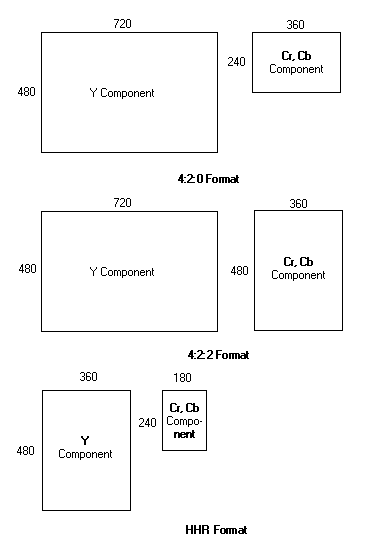
 What you see
  But as you can see, the horizontal resolution isn't full frame. Dish Network uses 480x480 resolution.
  The luminance is sent at the same 480x480 resolution.
  But the resolution of the blue signal is much lower
  As is the red component The MPEG-2 Transport Stream
 The SI is responsible for telling the receiver all kinds of useful information about the data stream, so that the receiver can write the appropriate data into its program guide. The first part of the SI is called the Program Association Table or PAT. The PAT is always transmitted on PID 0000 and contains a list of Program Map Tables or PMTs that are part of the data stream. For example:
 Time Division Multiplexing
 Some observations on the afforementioned diagram : DAC = Digital-to-analogue converter ADC = Analogue-to-digital converter The video encoder typically contains 4 or more DACs which run at video rates & quality. This infers 8 bit video DAC's (not cheap). 3 are needed for RGB; another is needed for composite video out (PAL or SECAM). Some use 10 bit DAC's & the difference *may* be visible by viewing sharp transitions like black to white -hint : have a look at the On Screen Display if you want to try to spot this effect. I have not included the conditional access module for simplicity. See section 5 for more detail on this (including a digram). Complex IC's are needed for many of these blocks. A qpsk demodulator/ADC/Viterbi decoder can easily cost around $7-$13 in manufacturers volumes! The mpeg transport demultiplexer & decoders cost even more!I haven't included the CPU & memory (usually around 1-3Meg. is needed & some of this may be fast,expensive SRAM). Perhaps you can now see why the digital receivers cost a lot more than the analogue ones!!! It's worth noting that on Astra,a Network Information Table (NIT) is transmitted every 10 seconds on every DVB/mpeg transponder. The information sent includes the FEC,S/R,frequencies etc.


