


 Re: ABC-ului receptiei prin satelit!
What are PIDs?
MPEG-2 transmits its data in packets of 188 bytes each. At the start of each packet is a package identifier (or PID) that tells the receiver what to do with the packet. Because the MPEG-2 data stream might be in MCPC mode, the receiver has to decide which packets are part of the current channel being watched and therefore pass them onto the video decoder for further processing. Those packets that aren't part of the current channel are simply discarded.
There are typically four types of PIDs used by satellite receivers. The VPID is the PID for the video stream and the APID is the audio stream. Occasionally, a PCR PID (program clock reference) is used to synchronize the video and audio packets, however, most of the time, this data is embedded into the video stream. The forth data PID is used for data such as the program guide, information about other frequencies that make up the total package etc. This data is called the System Information and uses a PID value of between 0000 and 0014 (hex).
The System Information stream
SI packets tell the receiver about the format of the transmission along with information such as multiple language selections, program guide information and other transponders that are related to the current transponder.
The primary reason that MPEG-2/DVB receivers cannot handle Digicipher 2 and ATSC signals is because the SI packets are totally different between the two standards. In theory, it should be possible to make an MPEG-2 receiver receive DCII/ATSC, however, this would either require access to the source code of the MPEG-2 receiver's firmware (and probably a license from General Instrument) or the DCII/ATSC signal being transmitted using both DCII/ATSC and MPEG-2/DVB SI packets. This is possible (see the ATSC technical documentation page for information on how this is done), however, the audio will either have to be sent twice or the receiver will need to handle both Musicam and Dolby AC3 as this is another big difference between the systems.
What's 4:2:2 and HHR MPEG-2?
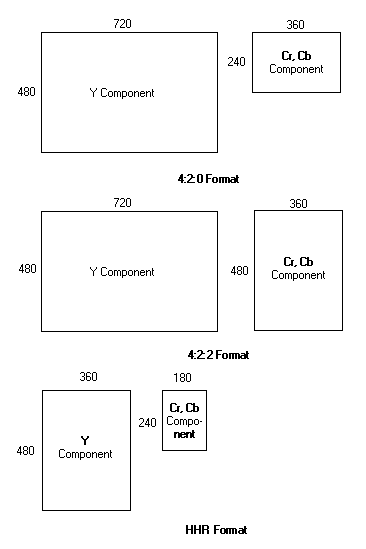
When MPEG-2 encodes color and picture information, it samples the analog picture at certain resolution both as horizontal and vertical pixels, but seperately as color (chrominance/hue) and brighness (luminance). The DVB specification calls for 4:2:0 encoding which put simply means that the resolution of the color information is one quarter of the resolution of the video information.
Since studios need better quality than DVB offers, an extension to MPEG-2 has come about that isn't part of the DVB spec but has its own specialized defintion within the MPEG-2 standard. This is called 4:2:2 format or MP@4:2:2SP meaning "Main Profile 4:2:2 Studio Profile". In this system, double the amount of vertical color information is transmitted.
Another format exists that is in very common use today. Called HHR for half horizontal resolution, this part of the MPEG-2/DVB standard transmits only half of the normal 720 pixel horizontal resolution while maintaining normal vertical resolution of 480 pixels (although, since it's 4:2:0 format, the color information is only encoded at 240 pixels vertically and 176 pixels horizontally. A lot of the smaller DBS (like the ethnic packages on T5 etc) use HHR format since it dramatically reduces the bandwidth needed for channels - of course at the expense of picture quality. Special logic in the video decoder chip in the set top box, re-expands the picture to its normal horizontal size by interpolation prior to display.
4:2:2 video at Standard Definition looks just as good as the NBC analog feeds on GE-1 Ku. High bandwidth 4:2:0 video like the NBC digital feeds on GE-1 Ku come very close to studio quality and the low bandwidth stuff encoded in HHR format, looks a lot like VHS quality.
The following diagram shows the ratios of 4:2:0, 4:2:2 and HHR resolutions. I could explain why the ratio used for 4:2:0 is written as 4:2:0 but that gets mega-complex and is beyond the scope of this document.

 .de
.de
 Reply With Quote

