-
Robot
Most Wanted

- Rep Power
- 84
-
Robot
Most Wanted
- Rep Power
- 84
 (PR) Supermassive's Directive 8020 Gets New Live-Action Couch Co-Op Tr
Supermassive Games unveiled a brand-new live-action couch co-op trailer for its upcoming sci-fi survival horror adventure, Directive 8020, during today's Future Games Show. The trailer showed a group of friends playing couch co-op Movie Night Mode, intercut with in-game moments of split-second quick-time actions, narrative decisions, and alien mimics.
Survive Together, Don't Play Alone
Complementing its gripping single-player experience, Directive 8020 allows up to five players to play through the story together in local couch co-op via the returning Movie Night Mode. Each player takes control of a crew member aboard the Cassiopeia, passing a single controller between each other as the story unfolds. It's up to the player and their friends on who lives and who dies; every choice matters, every mistake can be fatal, so players must work together to survive alien infiltrators, deadly dilemmas, and catastrophic system failures! Don't Play Alone, and trust no one - not even your friends! Directive 8020 will also support five-player online multiplayer in a free post-launch update, mirroring the couch co-op experience and bringing it online, with more information coming soon.
Read full story
More...
-
Robot
Most Wanted
- Rep Power
- 84
(PR) Global Top Five Enterprise SSD Vendors Post Over 50% QoQ Revenue
The widespread adoption of AI inference workloads in 4Q25 significantly raised requirements for data storage systems, according to TrendForce's latest findings on the enterprise SSD market. Meanwhile, enterprises accelerated upgrades to their general-purpose servers, while shortages in HDD supply pushed some demand toward SSD solutions. These factors together drove combined revenue for the world's top five enterprise SSD vendors up 51.7% QoQ to more than US$9.9 billion.
Among leading vendors, Samsung retained its top position, reporting nearly $3.66 billion in revenue in 4Q25, up 49.7% QoQ. The company demonstrated the strength of its vertically integrated business model. As concerns grew over potential DRAM shortages, many customers turned to Samsung because it can rely on its own DRAM and NAND Flash production to ensure stable SSD supply.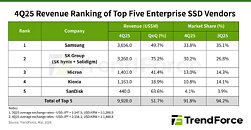
Read full story
More...
-
Robot
Most Wanted
- Rep Power
- 84
-
Robot
Most Wanted
- Rep Power
- 84
Glorious Revives Original 69 g Model O Gaming Mouse With 19K Optical S
Glorious Model O was once held in high regard in the realm of gaming peripherals, but that design has since been surpassed by more modern designs with lighter shells and more responsive, accurate sensors. Apparently there is still a market for the original Glorious Model O gaming mouse, at least according to Glorious, who recently announced the Glorious Model O Classic. The Model O Classic is a rehash of the 2019 Glorious Model O design, replete with the RGB strips, original sensor hardware, and even the original honeycomb design that's largely fallen out of use except for in the most lightweight gaming mouse designs.
The Glorious Model O classic features the same BAMF sensor, based on the Pixart PAW 3370, as the original—although it's now simply called the "19K Optical Gaming Sensor," which means it has a maximum wireless polling rate of 1 kHz, tops out at 19,000 DPI, 400 IPS, and 40 G acceleration. Despite the honeycomb shell, the Model O Classic still weighs in at 69 g, whereas many solid-shell gaming mice released in the last year or two come in at 40-50 g, with some, like the Corsair Sabre V2 Pro even dipping into the mid-30s. Glorious also still uses the Glorious Core software to customize the Model O Classic, meaning customization requires installing software that is only available on Windows. The Model O Classic wireless gaming mouse is available on the Glorious online store at $89.99.



More...
-
Robot
Most Wanted
- Rep Power
- 84
PEGI Updates Game Ratings To Address Loot Boxes and Potentially Addict
Hot on the heels of Valve's critical public response to the New York State attorney general's lawsuit against the gaming giant over its in-game monetization and loot boxes, the Pan European Game Information (PEGI) ratings body has updated its rating system to address similar concerns over in-game monetization and "interactive risk categories." As of June 2026, new games registered in Europe and rated by PEGI will be subject to additional scrutiny surrounding "purchases of in-game content, paid random items, communication features, and features that incentivize players to continue playing," according to the announcement. In essence, this will examine daily rewards, loot boxes, in-game cosmetics and premium currency purchases, and in-game chat moderation and content control. Chair of the PEGI Council, Beate Våje, says that "with the updated set of age rating criteria, PEGI aims to make parents aware that certain features in games should be carefully assessed, and that parental tools can be a very helpful assistant when doing that."
Under the new criteria, games that feature in-game purchases, specifically those with quantity- or time-limited sale mechanics, will be rated 12+, while games that use NFTs and other blockchain tech will be rated PEGI 18. Games with "random items" will be PEGI 16 by default, although they will be PEGI 18 in some cases. Games with what the ratings body calls "play-by-appointment" mechanics—things like daily quests or login rewards—will be rated PEGI 7, while games that punish players for not playing daily will receive a PEGI 12 rating. Lastly, PEGI is enforcing age restrictions on "safe online gameplay," which will result in games with entirely unrestricted communication receiving a PEGI 18 rating. Conceivably, games with proximity voice chat that cannot be disabled will also fall into this last box, although PEGI specifies that there needs to be a way to block or report users, so it's possible that being able to mute proximity chat may not be enough to escape a PEGI 18 rating on the grounds of online safety.

More...
-
Robot
Most Wanted
- Rep Power
- 84
Crimson Desert Gets Denuvo DRM Ahead of Launch, Dev Confirms Day-One P
Pearl Abyss's Crimson Desert is just over a week away from its March 20 launch, and in a recent Steam News post, the studio behind the game has provided additional information about the release, while the Steam Store page now reflects that the game will launch with Denuvo DRM. The news update confirms that players jumping into the world of Pywel will be able to preload the game 24-48 hours ahead of the official launch, starting on March 17 or 18, depending on which part of the world they're in—the game goes live on March 19 at 10 PM UTC, so the exact launch date differs by region. Pearl Abyss also confirmed that Crimson Desert will not support cross-platform save, and there appears to be no plan to add it in at a later date. While Crimson Desert will be playable completely offline, Pearl Abyss warns that the game will need an internet connection on day one in order to install a day-one patch.
It's unclear how the addition of Denuvo DRM will affect gameplay, especially since Pearl Abyss set a pretty low barrier to entry with the minimum hardware requirements that it published earlier this week. Denuvo, and other DRM services, have, in the past, been known to cause performance degradation, even on higher-end hardware, but if the game was tested for the minimum requirements with the DRM in place, players can likely expect little to no performance hit. While Denuvo doesn't necessarily lock Linux users out of Crimson Desert, its use is generally frowned upon by the Linux gaming community. Pearl Abyss has not mentioned Steam Deck or Linux compatibility in any of its communications surrounding Crimson Desert.

Read full story
More...
-
Robot
Most Wanted
- Rep Power
- 84
Chinese Laptop Maker Chuwi Advertised AMD Ryzen 5 7430U SoC, but Shipp
Imagine buying a laptop, thinking you're getting a model with your desired CPU specifications, only to find a completely different model inside, cleverly concealed so you wouldn't notice without further investigation. According to an investigation by Notebookcheck, the Chinese electronics maker Chuwi is engaging in specification fraud. Users have discovered a different CPU SKU compared to what was advertised. In a review of the Chuwi CoreBook X and CoreBook Plus, Notebookcheck found that Chuwi had listed these laptops with an AMD Ryzen 5 7430U processor, but they actually come with an AMD Ryzen 5 5500U. This means that Chuwi is actively advertising these models on their website, on the laptop box, with laptop stickers, and even with BIOS modifications to make it seem as if they feature the newer Ryzen 5 7430U SoC with "Zen 3" CPU microarchitecture and Radeon "Vega 6" SoC. In reality, the company is shipping a processor that is a few generations old, with "Zen 2" CPU cores and Radeon Graphics 448SP.
Notebookcheck discovered this during a review of the Chuwi CoreBook X. The unit's performance was rather lackluster, prompting further investigation. Initially, they thought single-channel RAM was causing the subpar performance. To determine the true cause, they opened the unit and found the older Ryzen 5 5500U SoC with its corresponding part number 100-000000375. Additionally, other differences were noted in the SoC specifications, such as the L3 cache. Chuwi even went a step further by using a modified BIOS version to show that the unit features the AMD Ryzen 5 7430U. This led software diagnostic tools to display the advertised specification, while the lower-tier SoC was actually inside. This issue didn't occur just once with the Chuwi CoreBook X but also with a separate CoreBook Plus, which Notebookcheck also confirmed to feature the older SoC. Instead of the newer AMD Ryzen 5 7430U processor, both of these laptop models actually come with the AMD Ryzen 5 5500U, as verified through performance testing, and the OPN number that corresponds to a specific AMD chip.

Read full story
More...
-
Robot
Most Wanted
- Rep Power
- 84
(PR) Optical Scale-up Consortium Established to Create an Open Specifi
The Optical Compute Interconnect (OCI) Multi-Source Agreement (MSA) group today announced its formation, led by founding members AMD, Broadcom, Meta, Microsoft, NVIDIA and OpenAI. This industry consortium marks a pivotal shift toward a hyperscaler-driven open ecosystem to enable the development of a multi-vendor supply chain for optical scale-up interconnects. By aligning on an open specification, the OCI MSA members are promoting a robust optical ecosystem which will ensure that the future of AI interconnects is built with a flexible, multi-vendor foundation to meet the optical interconnect needs of modern AI infrastructure.
The Physics and Power Mandate
As large language models (LLMs) advance toward super intelligence, traditional copper-based connectivity is reaching limitations in physical reach which are impacting AI cluster scale-up domain architectures. OCI will enable migration from copper-based to optical-based scale-up architectures, alleviating copper interconnect bottlenecks.
Read full story
More...
-
Robot
Most Wanted
- Rep Power
- 84
Chinese Lisuan LX 7G106 GPU Arrives June 18 with Support for Major AAA
Last year, Lisuan Technology introduced its Lisuan LX 7G106 graphics card, one of the most promising GPU technologies for gamers emerging from China. Today, during the AWE 2026 stream on the Chinese BiliBili platform, the company announced that its GPUs will ship on June 18, with pre-orders starting on March 17. The 7G106 GPU is powered by a monolithic die manufactured at TSMC's facilities using the older 6 nm DUV node. This N6 node is approved for Lisuan to utilize TSMC's mature node capacity. Designed for gaming, this GPU accelerates games and 3D applications with broad API support, including DirectX 12, Vulkan 1.3, and OpenGL 4.6. While it supports DirectX 12, it does not include ray tracing, meaning there is no DirectX 12 Ultimate. However, it will support DirectX 12 games, and Lisuan notes that some of these titles include popular games on Steam, such as Cyberpunk 2077, Black Myth: Wukong, and Resident Evil 4 Remake.
Underneath the 7G106 features a SIMD engine capable of running calculations with FP32 and the new INT8 data type. The GPU has a maximum throughput of 24 TeraFLOPS in FP32, placing it high in compute. The primary compute language is OpenCL 3.0. Internally, the SIMD engine is supported by a large raster graphics pipeline, with up to 192 TMUs and 96 ROPs on the silicon. In terms of memory, it offers 12 GB of GDDR6 across a 192-bit wide memory bus, although the company has not yet finalized the exact memory frequencies. The 7G106 is equipped with a modern video acceleration engine, capable of hardware-accelerated AV1 and HEVC decoding at resolutions up to 8K at 60 FPS. It also supports hardware-accelerated AV1 encoding at 4K at 30 FPS and HEVC encoding at 8K at 30 FPS. For monitor connectivity, it includes four DisplayPort 1.4 outputs with support for DSC 1.2b. The GPU does not feature HDMI outputs, likely due to the licensing costs required by the HDMI Consortium for each installed HDMI port.


Read full story
More...
-
Robot
Most Wanted
- Rep Power
- 84
-
Robot
Most Wanted
- Rep Power
- 84
Jeff Kaplan's Kintsugiyama Announces "The Legend of California" Skills
Jeff Kaplan, of former Blizzard fame, having worked on Overwatch and World of Warcraft, has officially announced the first game in development at his newly formed Kintsugiyama studio. The Legend of California is a Western shooter with online co-op and PvP gameplay. The Legend of California is set in an alternate timeline version of California in which the state is discovered as an uninhabited island off the coast of the mainland USA. It will feature a hand-crafted world featuring real-world landmarks, like Yosemite and Death Valley, but interspersed with dynamic points of interest that will move around depending on the generated world seed.
In a recent appearance on the Lex Fridman podcast, Kaplan explains that he wants the game to feel like a world that you can live in, with gameplay mechanics often limited to survival games, like mining, exploration, crafting, and hunting. He says that the goal of the game is not to be historically accurate, but that the development team wanted to remain authentic to the aesthetic and feel of the historical gold rush time period. In terms of gameplay, Kaplan commented that the map will feature four difficulty levels, with different regions and POIs each getting a difficulty level assigned each time the world is generated anew. The Legend of California will launch in Steam Early Access in 2026, and it's so far unclear if there will be a console version.
Read full story
More...
-
Robot
Most Wanted
- Rep Power
- 84
Unity Officially Gets Steam, SteamOS, and Linux Support
Unity game engine is finally getting native integration and support across more gaming platforms, according to James Stone. What we are getting now is the first actual native port instead of the emulation we've been dealing with until now. Game developers using the Unity engine have been shipping Unity games on Steam. However, Steam was never an official Unity platform, and developers used Steamworks in the past to make it happen. That's now a thing of the past, as Unity is officially supporting one of the biggest gaming platforms in existence. Additionally, we are seeing ports to Steam Deck and Steam Machine, which run on the SteamOS operating system; these previously relied on the Wine and Proton translation layers to transform Unity's API calls and make Unity games work.
Now Unity is enhancing its Linux integration further to create native runtimes and reduce reliance on the translation layers that have been doing the heavy lifting. This is a positive sign for the growing recognition of the Linux gaming world, which has been steadily rising as gamers encounter Windows-related issues. Adding native integration with the Valve ecosystem is helping Unity extend its influence across the gaming community, alongside Valve hardware such as the Steam Deck, Steam Machine, and the Steam Controller. For more details and updates from Unity at GDC 2026, check out the video below.
Read full story
More...
-
Robot
Most Wanted
- Rep Power
- 84
Meta Unveils Four MTIA Chips Focused on High-Perfomance Inference
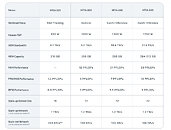
Meta has laid out an aggressive, inference-first roadmap for its in-house accelerators, announcing four Meta Training and Inference Accelerator (MTIA) generations developed with Broadcom and due to be integrated into its data centers over the next two years. The family spans MTIA 300, 400, 450, and 500, with early units already running ranking and recommendation workloads and later designs optimized for real-time model serving. Since Meta runs some of the largest social platforms on the web, developing a fast inference accelerator is required to make social media browsing and recommendation algorithms instant. Rather than pursuing raw peak arithmetic alone, Meta emphasizes memory throughput and inference efficiency. According to the specification table, HBM bandwidth and capacity rises substantially across the series while compute grows more linearly. This means that Meta's point is increasing on-package bandwidth and capacity which can cut latency and power costs for production inference.
The MTIA chips also include hardware support for attention primitives and mixture-of-experts layers, along with low-precision formats tailored to inference to reduce conversion overhead. Software compatibility was a stated priority. Meta says the stack runs natively on common frameworks, so existing production models can be deployed on both GPUs and MTIA without major rewrites, which should ease adoption. Multiple MTIA generations are built to share the same chassis, rack, and networking, allowing upgrades by swapping modules rather than refitting data center infrastructure. That modularity helps explain Meta's fast release cadence compared with the industry norm, considering that Meta's data centers span millions of chips. MTIA chips are already running at kilowatt power budgets and PetaFLOPS of compute, so MTIA accelerators are also competing with industry-leading solutions from NVIDIA, AMD, and other hyperscalers.


Read full story
More...
-
Robot
Most Wanted
- Rep Power
- 84
 Posting Permissions
- You may not post new threads
- You may not post replies
- You may not post attachments
- You may not edit your posts
-
Forum Rules


