-
Robot
Most Wanted

- Rep Power
- 82
 NVIDIA Plans GeForce RTX 5080 "Blackwell" Availability on January 21,
Hong Kong tech media HKEPC report indicates that NVIDIA's GeForce RTX 5080 graphics card will launch on January 21, 2025. The release follows a planned announcement event on January 6, where CEO Jensen Huang will present the new "Blackwell" architecture. Anticipated specifications based on prior rumors point to RTX 5080 using GB203-400-A1 chip, containing 10,752 CUDA cores across 84 SM. The card maintains 16 GB of memory but upgrades to GDDR7 technology running at 30 Gbps, while other cards in the series are expected to use 28 Gbps memory. The graphics card is manufactured using TSMC's 4NP 4 nm node. This improvement in manufacturing technology, combined with architectural changes, accounts for most of the expected performance gains, as the raw CUDA core count only increased by 10% over the RTX 4080. NVIDIA is also introducing larger segmentation between its Blackwell SKUs, as the RTX 5090 has nearly double CUDA cores and double GDDR7 memory capacity.
NVIDIA is organizing a GeForce LAN event two days before the announcement, marking the return of this gathering after 13 years, so the timing is interesting. NVIDIA wants to capture gamer's hearts with 50 hours of non-stop gameplay. Meanwhile, AMD currently has no competing products announced in the high-end graphics segment, leaving NVIDIA without direct competition in this performance tier. This market situation could affect the final pricing of the RTX 5080, which will be revealed during the January keynote. While the January 21 date appears set for the RTX 5080, launch dates for other cards in the Blackwell family, including the RTX 5090 and RTX 5070 series, remain unconfirmed. NVIDIA typically releases different models in their GPU families on separate dates to manage production and distribution effectively.
More...
-
Robot
Most Wanted
- Rep Power
- 82
AMD to Launch Mid-range SKUs of the Radeon RX 9000 Series in March
AMD is expected to have a rather lean lineup of next-generation gaming GPUs powered by the RDNA 4 graphics architecture. The series is expected to debut at AMD's 2025 International CES keynote address, with product launches of the series-leading Radeon RX 9070 XT and RX 9070 performance-segment GPUs later this month. The RX 9070 should be available by late-January, although add-in board partners from China expect availability to ramp in February 2025. The series will see expansion with more announcements in March.
The RDNA 4 generation is driven mainly by two chips—the larger "Navi 48," and the smaller "Navi 44." The "Navi 48" will power the RX 9070 series, which are performance-segment and designed to compete with the NVIDIA GeForce RTX 5070 series; but cut-down variants of the chip are also expected to power certain upper mid-range SKUs that go up against the RTX 5060 series. The "Navi 44" chip is expected to power certain high performance/price SKUs in the mid-range, which AMD will use to target price-points well under the $300-mark. This segment is expected to heat up as NVIDIA has current-generation RTX 4060 series, Intel just made a stab with the Arc B580, and is expected to launch a faster Arc B700-series SKU based on a maxed-out "BMG-G21" silicon.
More...
-
Robot
Most Wanted
- Rep Power
- 82
TSMC Is Getting Ready to Launch Its First 2nm Production Line
TSMC is making progress with its most advanced 2 nm (N2) node, a recent report from MoneyDJ quoting industry sources indicates that the company is setting up a test production line at the Hsinchu Baoshan fab (Fab 20) in Taiwan. In the early stages, TSMC aims for small monthly outputs with about 3,000-3,500 wafers. However, the company has big plans to combine production from two factories in Hsinchu and Kaohsiung, TSMC expects to deliver more than 50,000 wafers monthly by the end of 2025 and by the end of 2026 projecting a production of around 125,000 wafers per month. Breaking it down by location, the Hsinchu factory should reach 20,000-25,000 wafers monthly by late 2025, growing to about 60,000-65,000 by early 2027. Meanwhile, the Kaohsiung factory is expected to produce 25,000-30,000 wafers monthly by late 2025, also increasing to 60,000-65,000 by early 2027.
TSMC's chairman C.C. Wei says there's more demand for these 2 nm chips than there was for the 3 nm. This increased "appetite" for 2 nm chips is likely due to the significant improvements this technology brings: it uses 24-35% less power, can run 15% faster at the same power level, and can fit 15% more transistors in the same space compared to the 3 nm chips. Apple will be the first company to use these chips, followed by other major tech companies like MediaTek, Qualcomm, Intel, NVIDIA, AMD, and Broadcom.
More...
-
Robot
Most Wanted
- Rep Power
- 82
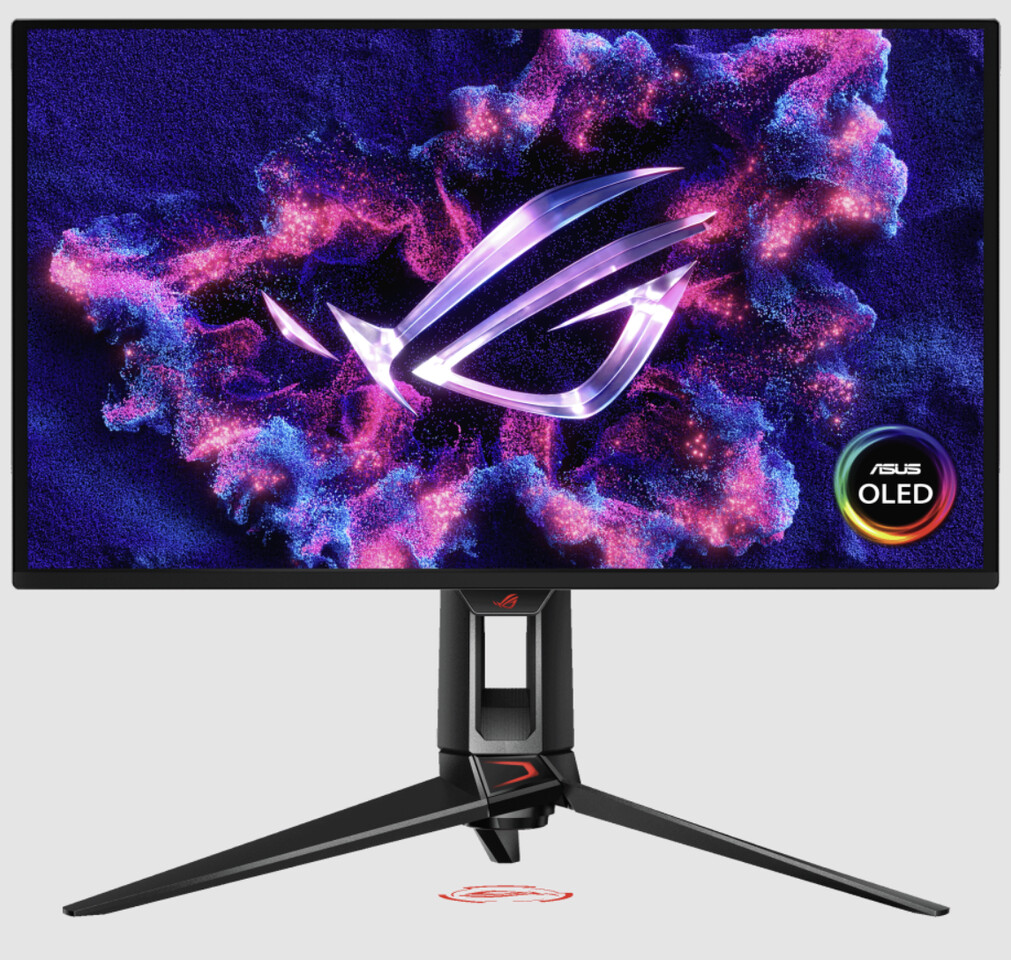
ASUS Upcoming ROG Swift OLED PG27UDCM is a 27-inch 4K 240 Hz Gaming Mo
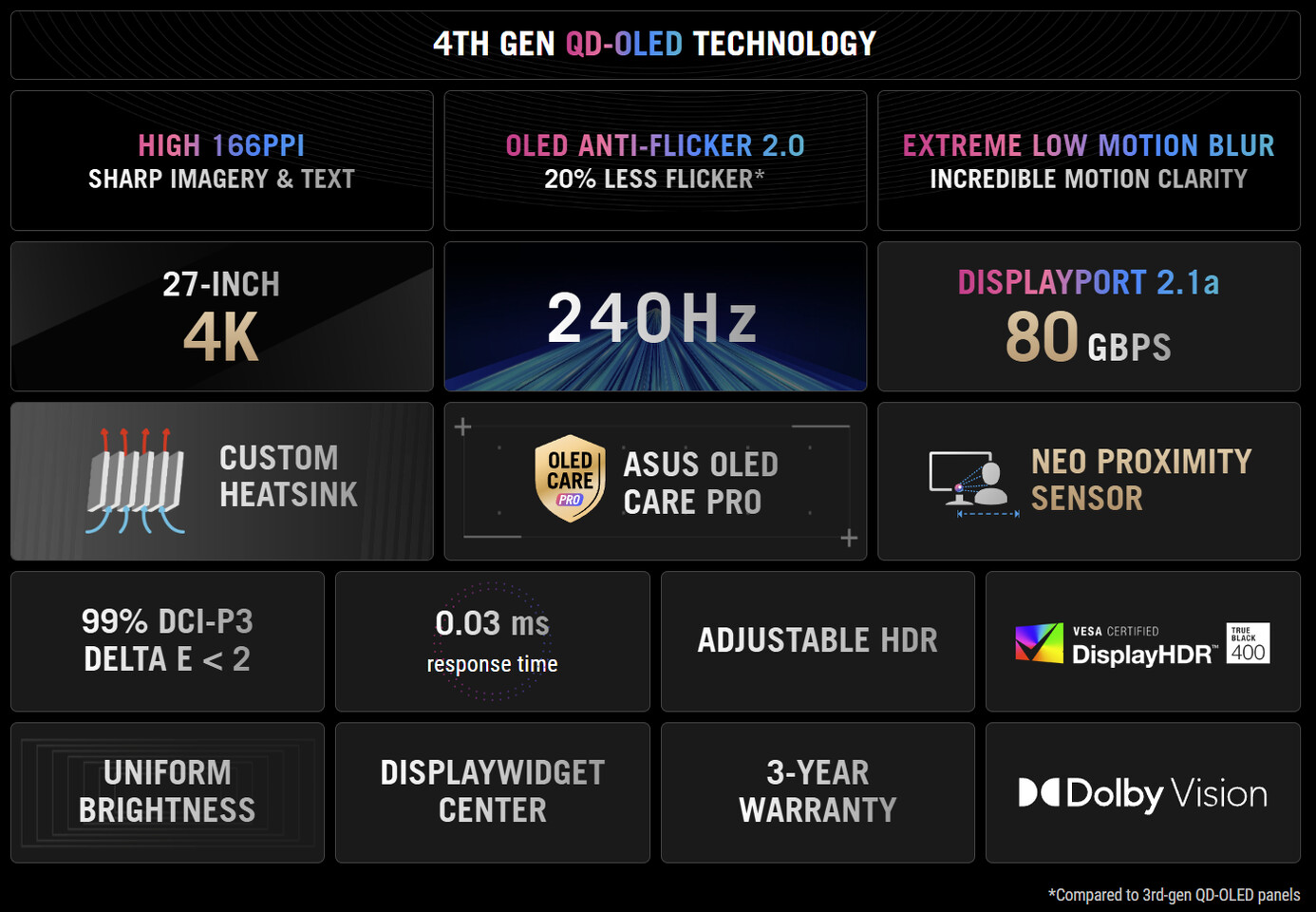
ASUS has published the product page for its upcoming ROG Swift OLED PG27UDCM gaming monitor, which will go head to head with the MSI MPG272URX on which will hit retail as the first 27-inch 4K 240 Hz display. The PG27UDCM sports a 26.5-inch panel using what ASUS refers to as 4th gen QD-OLED technology, which the company claims offer longer lifespan compared to previous generations of OLED panels. The panel sports typical OLED features such as a 0.03 ms response time, a peak brightness of 1,000 cd/m², 99 percent DCI-P3 colour space coverage and VESA DisplayHDR 400 True Black. The display also supports AMD FreeSync Premium Pro and NVIDIA G-Sync compatible, as well as a host of ASUS specific gaming features such as ELMB, GameFast Input Technology, Shadow Bost and a DisplayWidget.
Inputs consist of a DisplayPort 2.1 port with UHBR20 (80 Gbps) support, a USB Type-C with DP-Alt mode and USB PD up to 90 W and a pair of HDMI 2.1 ports. There's also a three port USB 3.2 Gen 1 (5 Gbps) USB hub with what we presume is a USB Type-B input and a headphone jack. The reason for the presumed USB Type-B input, is that the specs claim KVM support and this would only be possible if there was a USB input of some kind, but this isn't mentioned in the tech specs. The stand is your typical higher-end model with tilt, swivel, pivot and height adjustment, as well as ASUS' Aura Sync lighting and a tripod mount at the top. ASUS claims a power consumption of around 80 Watts, although this doesn't include USB PD. A big plus is that ASUS will bundle a DisplayPort 2.1 DP80 cable in the box, something for example Sony decided not to include with their INZONE M9 II which launched in September last year. There's no word on pricing for the ROG Swift OLED PG27UDCM, but expect it to be on the expensive side of US$1,000.


Read full story
More...
-
Robot
Most Wanted
- Rep Power
- 82
AMD Ryzen 7 9800X3D CPU Sales Surpass Entire Ryzen 9000 Series at Germ
Recent sales data (nicely complied by VideoCardz) from one of the largest German retailers, Mindfactory, has revealed that the AMD Ryzen 7 9800X3D processor has achieved higher unit sales than all Ryzen 9000 processors combined. Despite its later market entry, the eight-core 9800X3D CPU has reached 8,650 units sold, surpassing the combined sales of the earlier-released standard Ryzen 9000 processors. For comparison, the entire non-X3D Ryzen 9000 lineup, including the Ryzen 9 9950X, 9900X, Ryzen 7 9700X, and Ryzen 5 9600X, has accumulated fewer total sales through the same retailer. The flagship Ryzen 9 9950X alone accounts for just 780 units, while the Ryzen 9 9900X and Ryzen 5 9600X have moved 810 and 890 units, respectively, while the second-best selling 9000 series SKU was Ryzen 7 9700X with 2,510 units sold. However, the 9800X3D's market performance still falls significantly short of its predecessor. The previous generation Ryzen 7 7800X3D maintains a massive lead with 78,420 units sold through the same retailer.
AMD is preparing to expand its X3D lineup with several new models. The six-core Ryzen 5 9600X3D is scheduled for release, along with 12-core Ryzen 9 9900X3D and 16-core Ryzen 9 9950X3D variants expected later this month. Based on previous generation sales patterns, where higher-core models saw lower adoption rates, these upcoming high-end processors may face similar market dynamics. Of course, these sales figures are only a part of the story as Mindfactory is only a single retailer across a diverse set of sellers, so the complete market picture is unknown to anyone but AMD. PC upgrade cycles are a common bottleneck in new CPU sales, especially as consumers don't tend to upgrade their PCs every year with new CPUs and platforms. We have to wait and see how the market adapts to new X3D SKUs, and if the Zen 5 X3D CPUs can reach the previous generation fame among consumers.
More...
-
Robot
Most Wanted
- Rep Power
- 82
Nintendo Switch 2 PCB Leak Reveals an NVIDIA Tegra T239 Chip Optically
Nintendo Switch 2 promises to be this year's big (well small) gaming platform launch. It goes up against a growing ecosystem of handhelds based on x86-64 mobile processors running Windows, its main play would have to be offering a similar or better gameplay experience, but with better battery life, given that all of its hardware is purpose-built for a handheld console, and runs a highly optimized software stack; and the SoC forms a big part of this. Nintendo turned to NVIDIA for the job, given its graphics IP leadership, and its ability to integrate it with Arm CPU IP in a semi-custom chip. Someone with access to a Switch 2 prototype, likely an ISV, took the device apart, revealing the chip, a die-shrunk version of the Tegra T239 from 2023.
It's important to note that prototype consoles physically appear nothing like the final product, they're just designed so ISVs and game developers can validate them, and together with PC-based "official" emulation, set up the ability to develop or port games to the new platform. The Switch 2 looks very similar to the original Switch, it is a large tablet-like device, with detachable controllers. The largest chip on the mainboard is the NVIDIA Tegra T239. Nintendo Prime shared more details about the chip.


Read full story
More...
-
Robot
Most Wanted
- Rep Power
- 82
-
Robot
Most Wanted
- Rep Power
- 82
MSI GeForce RTX 5080 Gaming Trio "Blackwell" Box Leaked
Here are some of the first pictures of the MSI GeForce RTX 5080 Gaming Trio "Blackwell" graphics card. The box art provides the first look at what the actual product will look like. It remains over 2 slots thick, and is fairly long; with a trio of what look like 100 mm fans. As with all past generation Gaming X series graphics cards from MSI, this product will feature extensive RGB LED lighting, and a fairly generous factory overclock among its base and premium tiers (Gaming and Gaming X); although historically, MSI's Suprim series has had the company's highest factory tuning.
The back-side of the box lists out MSI-specific and NVIDIA "Blackwell" specific features. The RTX 50-series will see MSI debut the new StormForce fan, which appears to have greater impeller depth than the previous-generation TorX 3.0 fan. The impellers are webbed for axial airflow, the fan blades have ridges. The box also says that the cooler features a nickel-plated copper base-plate, which makes contact with the GPU, which probably has mirror finish. This baseplate will be backed by Core Pipes, which are the cooler's copper heatpipes made square near the baseplate for better contact with it. Lastly, the card comes with a metal backplate—no surprises there. NVIDIA is looking to debut the GeForce RTX 5080 on January 21.

More...
-
Robot
Most Wanted
- Rep Power
- 82
-
Robot
Most Wanted
- Rep Power
- 82
(PR) MSI Unveils World's First 27" 4K 240Hz and 27" QHD 500Hz QD-OLED
MSI, the world's leading manufacturer of true gaming hardware, is proudly expanding the hardware possibilities for all gamers. While OLED panels have become the preferred choice for high-end gaming, the OLED burn-in issue has consistently been a major concern for all users. MSI is proud to introduce an exceptional solution that effectively addresses the dreaded OLED problem.
The world's first DisplayPort 2.1a (UHBR20) 27" 4K 240 Hz QD-OLED monitor, the MPG 272URX QD-OLED, is equipped with a 5-layer tandem OLED panel featuring the EL Gen 3 technology. This new material composition improves efficiency up to 30%. This monitor offers stunning clarity with 166 PPI, which enhances text sharpness and significantly reduces color fringing, setting a new standard for daily visuals. Recognized for its design and innovation, it has earned the CES 2025 Innovation Award. ith G-SYNC Compatible support, the monitor delivers smoother, tear-free gaming with reduced lag and fully compatibility with future hardware. This monitor is also perfect for all AAA game titles, ensuring an exceptional gaming experience with flawless performance and visuals.
Read full story
More...
-
Robot
Most Wanted
- Rep Power
- 82
-
Robot
Most Wanted
- Rep Power
- 82
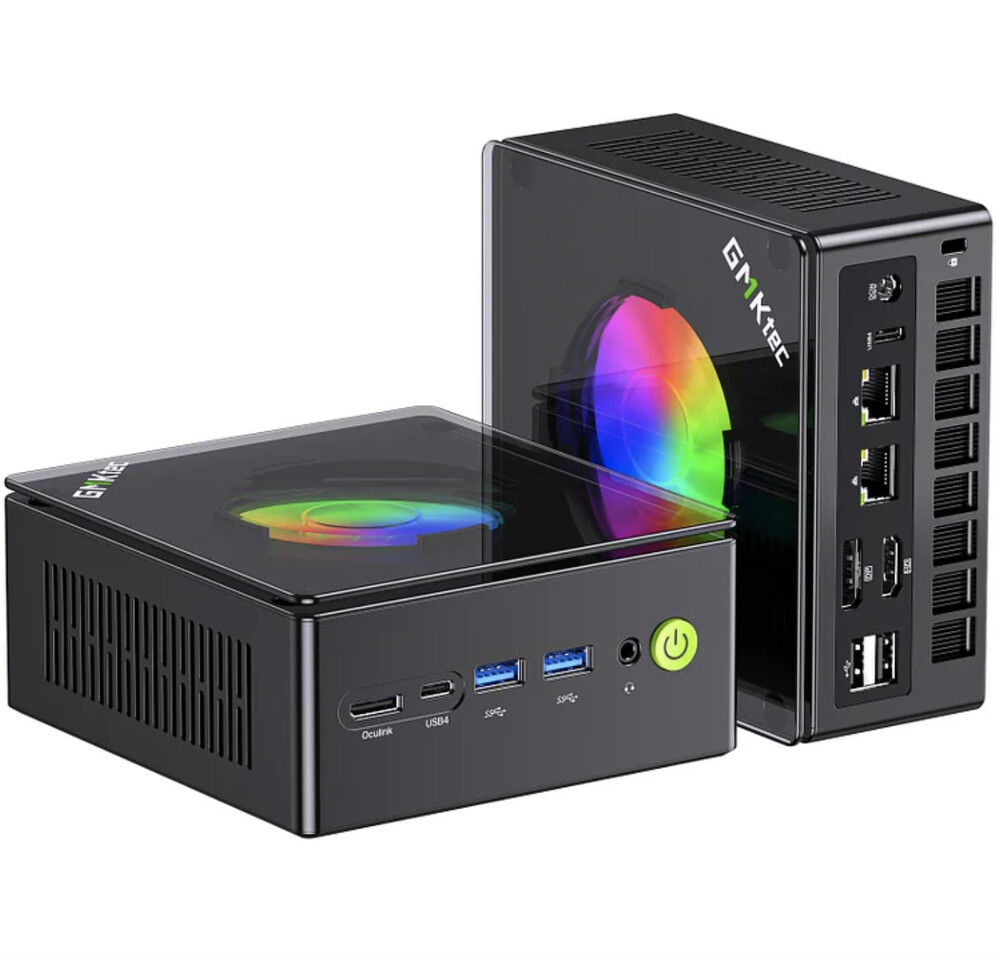
GMKTec K11 Mini PC Unveiled With up to 96 GB of Memory, Ryzen 9, and O
GMKTec is a relatively well-known brand of mini PCs that ships internationally from its official online store. The brand's latest offering, the K11, is an RGB-fied mini PC that sports adequately powerful internals for almost any task. At its core, the K11 is powered by the Ryzen 9 8945HS "Hawk Point" APU with eight Zen 4 cores and 16 threads. The system comes pre-installed with up to 32 GB of memory and a 2 TB SSD, both of which can be upgraded down the line.
The memory can be upgraded to a whopping 96 GB, whereas the storage can be upgraded to 8 TB via the dual M.2 slots. The integrated Radeon 780M GPU is decently powerful for most non-intensive workloads, but pushing it any further might be futile. For such cases, the OCuLink port will definitely come in handy, offering speedy eGPU connections that far outshine USB-based solutions. The cooling solution appears to be sufficient on paper, allowing the system to draw up to 70 watts.


Read full story
More...
-
Robot
Most Wanted
- Rep Power
- 82
(PR) Sansui to Showcase AI Gaming Monitor at CES 2025
Sansui is thrilled to announce its presence at CES 2025, where it will showcase the award winning AI Gaming Monitor, recently named a CES Innovation Awards 2025 Honoree. This cutting-edge gaming monitor highlights Sansui's dedication to redefining the gaming experience with advanced AI technology and user-focused innovation.
"CES is the ultimate stage for innovation, and we're excited to showcase a product that represents the future of gaming," said Victor, Senior Vice President of Marketing at Sansui. "Our AI Gaming Monitor combines top-tier performance with features that enhance health and energy efficiency, delivering a truly next-level experience for gamers." Attendees can experience this innovation firsthand at Booth 19840, Central Hall, LVCC, in Las Vegas from January 7-10, 2025.

Read full story
More...
-
Robot
Most Wanted
- Rep Power
- 82
-
Robot
Most Wanted
- Rep Power
- 82
New Year, but Same Great Prices on Software from GoDeal24
 Posting Permissions
- You may not post new threads
- You may not post replies
- You may not post attachments
- You may not edit your posts
-
Forum Rules