-
Robot
Most Wanted

- Rep Power
- 82
 AMD's Pain Point is ROCm Software, NVIDIA's CUDA Software is Still Sup
The battle of AI acceleration in the data center is, as most readers are aware, insanely competitive, with NVIDIA offering a top-tier software stack. However, AMD has tried in recent years to capture a part of the revenue that hyperscalers and OEMs are willing to spend with its Instinct MI300X accelerator lineup for AI and HPC. Despite having decent hardware, the company is not close to bridging the gap software-wise with its competitor, NVIDIA. According to the latest report from SemiAnalysis, a research and consultancy firm, they have run a five-month experiment using Instinct MI300X for training and benchmark runs. And the findings were surprising: even with better hardware, AMD's software stack, including ROCm, has massively degraded AMD's performance.
"When comparing NVIDIA's GPUs to AMD's MI300X, we found that the potential on paper advantage of the MI300X was not realized due to a lack within AMD public release software stack and the lack of testing from AMD," noted SemiAnalysis, breaking down arguments in the report further, adding that "AMD's software experience is riddled with bugs rendering out of the box training with AMD is impossible. We were hopeful that AMD could emerge as a strong competitor to NVIDIA in training workloads, but, as of today, this is unfortunately not the case. The CUDA moat has yet to be crossed by AMD due to AMD's weaker-than-expected software Quality Assurance (QA) culture and its challenging out-of-the-box experience."
Read full story
More...
-
Robot
Most Wanted
- Rep Power
- 82
NVIDIA GB300 "Blackwell Ultra" Will Feature 288 GB HBM3E Memory, 1400
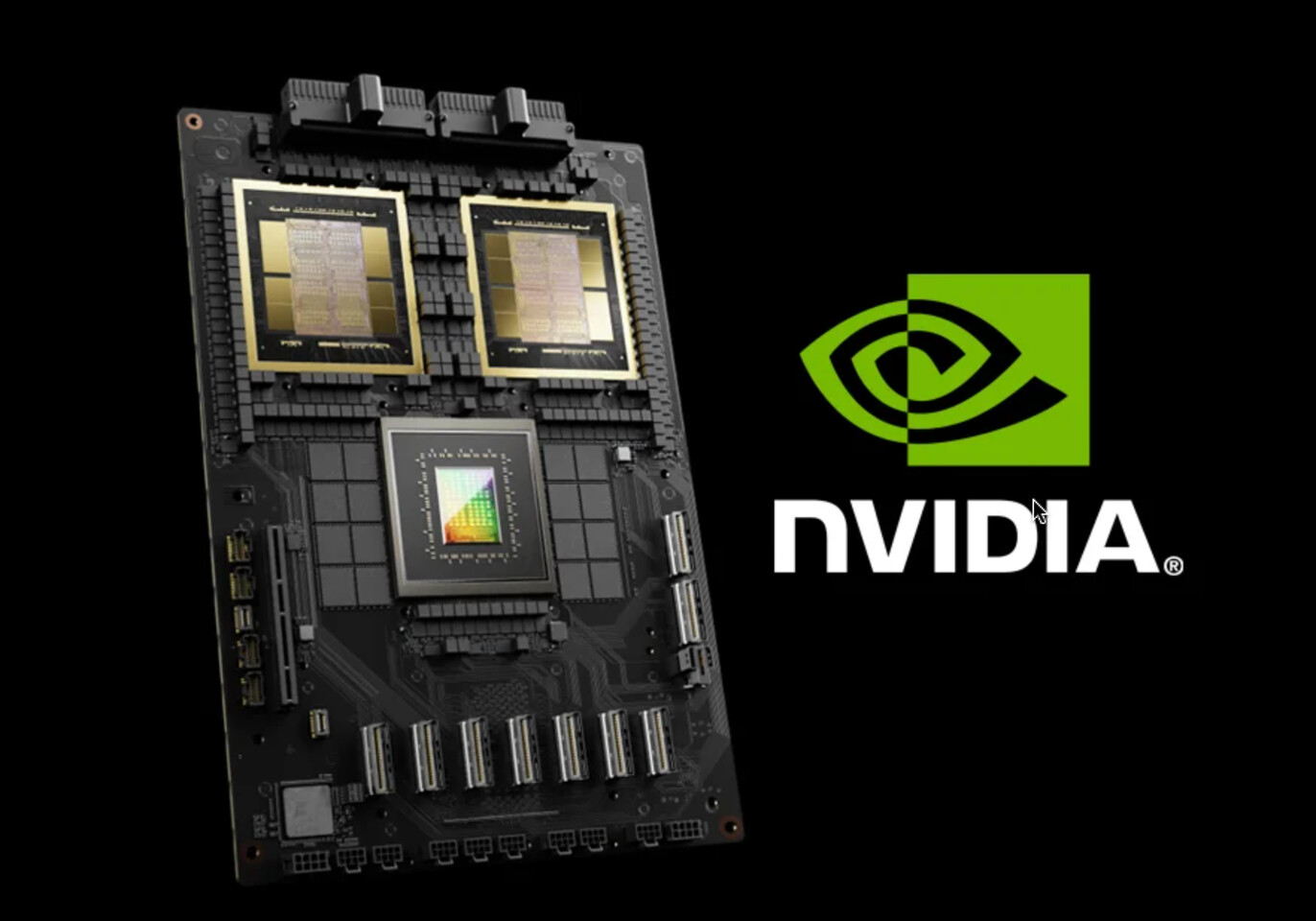
NVIDIA "Blackwell" series is barely out with B100, B200, and GB200 chips shipping to OEMs and hyperscalers, but the company is already setting in its upgraded "Blackwell Ultra" plans with its upcoming GB300 AI server. According to UDN, the next generation NVIDIA system will be powered by the B300 GPU chip, operating at 1400 W and delivering a remarkable 1.5x improvement in FP4 performance per card compared to its B200 predecessor. One of the most notable upgrades is the memory configuration, with each GPU now sporting 288 GB of HBM3e memory, a substantial increase from the previous 192 GB of GB200. The new design implements a 12-layer stack architecture, advancing from the GB200's 8-layer configuration. The system's cooling infrastructure has been completely reimagined, incorporating advanced water cooling plates and enhanced quick disconnects in the liquid cooling system.
Networking capabilities have also seen a substantial upgrade, with the implementation of ConnectX 8 network cards replacing the previous ConnectX 7 generation, while optical modules have been upgraded from 800G to 1.6T, ensuring faster data transmission. Regarding power management and reliability, the GB300 NVL72 cabinet will standardize capacitor tray implementation, with an optional Battery Backup Unit (BBU) system. Each BBU module costs approximately $300 to manufacture, with a complete GB300 system's BBU configuration totaling around $1,500. The system's supercapacitor requirements are equally substantial, with each NVL72 rack requiring over 300 units, priced between $20-25 per unit during production due to its high-power nature. The GB300, carrying Grace CPU and Blackwell Ultra GPU, also introduces the implementation of LPCAMM on its computing boards, indicating that the LPCAMM memory standard is about to take over servers, not just laptops and desktops. We have to wait for the official launch before seeing LPCAMM memory configurations.
More...
-
Robot
Most Wanted
- Rep Power
- 82
AMD Ryzen 9 9950X3D and 9900X3D to Come with Clock Speeds Resembling n
The AMD Ryzen 7 9800X3D launched this November remains the fastest processor for PC gaming, but with just an 8-core/16-thread configuration, its performance in multithreaded productivity pales in comparison to the alternatives, including from AMD's own camp, such as the Ryzen 9 7950X3D. The company is planning to expand the Zen 5 X3D line of desktop processors in Q1-2025, with the introduction of its high core-count Ryzen 9 series SKUs, the Ryzen 9 9950X3D, and the Ryzen 9 9900X3D. HXL, a reliable source with hardware leaks, says that the Ryzen 9 X3D SKUs will lack the kind of "frequency debuff" we've seen with the older generation Ryzen 9 X3D chips such as the 7950X3D and 7900X3D.
On the 7950X3D, only one of the two 8-core CCDs comes with 3D V-Cache, the other is a regular CCD with 32 MB on-die L3 cache. The CCD with the 3D V-Cache has its frequency "debuffed" compared to the other CCD, mainly to deal with the thermal limitations of the way the 3D V-Cache is stacked on top of the CCD. With the Ryzen 9000 X3D generation, AMD has redesigned this CCD + L3D stacking such that the CCD is now above, directly interfacing with the STIM and IHS; with no conductive structural silicon along the way. This means that the CCD now thermally behaves like a regular Zen 5 CCD; and for this reason, not only will the CCD with 3D V-Cache on the 9950X3D/9900X3D have the same clock speeds and boosting behavior as the one without 3D V-Cache; but also the 9950X3D and 9900X3D are expected to ship with similar, if not identical clock speeds to the 9950X and 9900X.
Read full story
More...
-
Robot
Most Wanted
- Rep Power
- 82
Qualcomm Wins Partial Victory in Arm Licensing Dispute, Retrial Possib
A Delaware jury has delivered a mixed verdict in the high-stakes licensing dispute between Qualcomm and Arm, with Qualcomm securing a significant but incomplete victory. The jury unanimously found that Qualcomm's use of Oryon cores in its Snapdragon X processors for client PCs did not violate its licensing agreements with Arm. The case centered on Qualcomm's $1.4 billion acquisition of Nuvia in 2021 and subsequent use of Nuvia's processor designs. Arm had alleged that Nuvia's licensing terms couldn't transfer automatically to Qualcomm and demanded renegotiation of the agreements. When Qualcomm proceeded with development, Arm insisted the designs be destroyed. During the trial, Gerard Williams III, the lead developer of Oryon cores and former Apple engineer, testified that the final design contained less than 1% of Arm technology.
This testimony supported Qualcomm's position that its existing architecture license covered products designed by its subsidiaries. While Qualcomm celebrated the verdict allowing continued development of its Snapdragon X processors, the jury deadlocked whether Nuvia violated its original agreement with Arm, specifically about permitting server processor development. This impasse has prompted Arm to announce its intention to seek a retrial on this unresolved count. "We are disappointed that the jury was unable to reach consensus across the claims," Arm stated, wanting to protect its intellectual property and ecosystem. Meanwhile, Qualcomm expressed satisfaction with the decision, stating the verdict "vindicated Qualcomm's right to innovate." The stakes remain high for both companies. Qualcomm relies on its Oryon cores to compete in the PC market, where it currently holds a 0.8% share of Q3 2024 shipments, while Arm derives approximately $300 million annually from Qualcomm, representing 10% of its revenue.
More...
-
Robot
Most Wanted
- Rep Power
- 82
Ryzen AI 9 HX 370-powered GMKTec EVO X1 Mini PC Goes on Sale
AMD's recently announced Strix Point APU lineup has received favorable reviews from critics and consumers alike. Especially for SFF/Mini PC enthusiasts, Strix Point brings commendable efficiency and performance to the table - both of which are absolutely essential for a high-end mini PC. The GMK EVO-X1 is surely among those, and the system is now available for purchase from GMKTec's official online store.
The EVO X1 sports a 110.19 x 107.3 x 63.2 mm chassis, which is decently compact for its class. As mentioned previously, the system is powered by the 12-core (4x Zen 5 + 8x Zen 5c) Ryzen AI 9 HX 370 APU with the shockingly potent RDNA 3.5-based Radeon 890M iGPU with 16 CUs. For most CPU-centric workloads, the EVO X1 should easily suffice. The iGPU, as mentioned, is potent enough to handle most graphically demanding tasks, including some lightweight gaming, but expecting anything more from it would be futile. Thankfully, an OCuLink port is present, which should allow for extremely fast eGPU connections courtesy of its 64 Gbps bandwidth.

Read full story
More...
-
Robot
Most Wanted
- Rep Power
- 82
HAVN x TechPowerUp Giveaway: Entries Close Soon, Hurry!
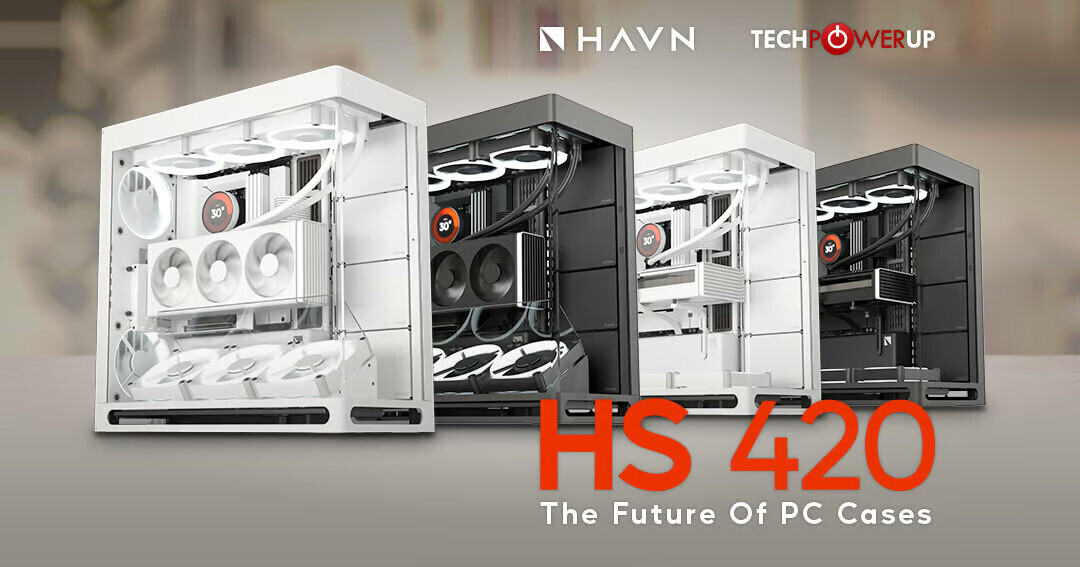
HAVN and TechPowerUp bring our readers from the US and most of Europe a fantastic chance to bring home a cutting-edge HAVN HS 420 series PC case, designed to maximize the visual impact of your gaming hardware, without compromising on cooling performance. The Giveaway has been up for a week now, but entries close in two days! If you haven't dropped in your hat yet, hurry! Here's what's up for grabs: a HAVN HS 420 VGPU Black, a HAVN HS 420 VGPU White, a HAVN HS 420 Black, and a HAVN HS 420 White. In all, there will be four lucky winners. Our Giveaway is hosted on Gleam, so you not only have four prizes to win from, but can increase your chances of winning by sharing the Giveaway on your social media accounts. What are you waiting for?
For more information, and to participate, visit this page.
More...
-
Robot
Most Wanted
- Rep Power
- 82
(PR) Himax to Showcase Industry-Leading 400K Nits Ultra-Luminous Color
Himax Technologies, Inc. ("Himax" or "Company"), an industry leader in fabless display driver ICs and other semiconductors, today announced it will present its next-generation, proprietary ultra luminous 400K nit Color Sequential Front-lit LCoS Microdisplay solution at CES 2025, the largest consumer electronics show in Las Vegas, U.S.A. from January 7 - 10, 2025. The unparalleled brightness of the LCoS solution reaffirms Himax's market leadership in LCoS and its steadfast commitment to advancing AR applications, catering to the critical demands of leading tech innovators in AR technology.
Himax's proprietary Color Sequential Front-lit LCoS Microdisplay sets a new benchmark in brightness performance for microdisplays. With an industry-leading 400K nits of brightness and typical power consumption of just 300 milliwatts, this breakthrough ensures superior eye-level brightness even in high ambient light environments, making it a perfect fit for outdoor usability. The integration of 2D waveguides further enhances its ability to deliver clear, vibrant visuals, making it ideal for next-generation see-through goggles. In addition to its brightness, the microdisplay boasts a lightweight, ultra-compact form factor of less than 0.5 c.c., exceptional vibrant color performance, and low power consumption, all essential factors for all-day wearable devices. This makes the Color Sequential Front-lit LCoS Microdisplay a perfect solution for the evolving needs of AR goggle devices.
Read full story
More...
-
Robot
Most Wanted
- Rep Power
- 82
CXMT Achieves 80% Yield for DDR5 Chips, HBM2 Production and Capacity E
According to a recent Citigroup analysis, CXMT, China's domestic memory chipmaker, is demonstrating significant progress in its DDR5 production yields. The company's DDR5 yield rates had reached approximately 80%, marking a substantial improvement from its initial 50% yields when production began. This progress builds on CXMT's experience with DDR4 manufacturing, where the company has achieved yields of around 90%. The company currently operates two fab facilities in Hefei, with Fab 1 dedicated to DDR4 production on 19 nm process technology and a 100,000 wafer per month capacity. Fab 2 focuses on DDR5 production using 17 nm technology, with a current capacity of 50,000 wafers per month. CXMT's DDR5 yields could improve further to approximately 90% by the end of 2025.
Despite these improvements, CXMT faces technological challenges compared to industry leaders. The company's current production process is 19 nm for DDR4 and 17 nm for DDR5, lagging behind competitors like Samsung and SK Hynix, which manufacture 12 nm DDR5 chips. This technology gap results in higher power consumption and less favorable form factors for CXMT's products. The company primarily targets domestic Chinese smartphone and computing OEM customers. Looking ahead, CXMT plans to expand its DDR5 and HBM capabilities, with a potential additional capacity of 50,000 wafers per month at Fab 2 in 2025, if market conditions prove favorable. The company is also making progress on HBM2 development, with customer sampling underway and low-volume production expected to begin in mid-2025.

More...
-
Robot
Most Wanted
- Rep Power
- 82
Mid-January Launches for AMD B850 and B840; and Intel B860 and H810 Mo
In the first week of the 2025 International CES, Intel and AMD are expected to expand their desktop processor product stacks, with the introduction of 65 W models; and with them, more affordable motherboard chipset models. AMD is expected to launch the AMD B850 and AMD B840; while Intel debuts the Intel B860 and H810. Board Channels, a site that tracks hardware launches at the retail channel level, says that AMD is expected to set January 15 as the market availability date for motherboards based on the AMD B850 and B840. The chipset will be announced at AMD's January 7th event.
Meanwhile, Intel is expected to announce its mid-range Intel B860 and entry-level Intel H810 on its own event slated for January 7, but with product availability on January 13. The AMD B850 is essentially a rebadged B650, but motherboard vendors can optionally enable Gen 5 PEG instead of Gen 4, at which point the platform would essentially be an AMD X870, but without the mandatory discrete USB4 host controller. The AMD B850 supports CPU overclocking. The AMD B840 lacks this, and is functionally similar to the AMD B550 chipset from the Socket AM4 platform, except that it lacks CPU overclocking support. Meanwhile, the Intel B860 is expected to feature a similar I/O as the Intel B760 from the Socket LGA1700 platform. The H810 is expected to be a lean entry-level option. Both the Intel B860 and H810 are expected to lack CPU overclocking support, but the B860 probably retains memory overclocking capability.
More...
-
Robot
Most Wanted
- Rep Power
- 82
NVIDIA GeForce RTX 5090 Features 16+6+7 Phase Power Delivery on 14-Lay
Fresh details have surfaced about NVIDIA's upcoming flagship "Blackwell" graphics card, the GeForce RTX 5090, suggesting power delivery and board design changes compared to its predecessors. According to Benchlife, the new Blackwell-based GPU will feature a new 16+6+7 power stage design, departing from the RTX 4090's 20+3 phase configuration. The report confirms earlier speculation about the card's power requirements, indicating a TGP of 600 watts. This specification refers to the complete power allocation for the graphics subsystem, though the actual TDP of the GB202 chip might be lower. The RTX 5090 will ship with 32 GB of next-generation GDDR7 memory and utilize a 14-layer PCB, possibly due to the increased complexity of GDDR7 memory modules and power delivery. Usually, GPUs max out at 12 layers for high-end overclocking designs.
The upcoming GPU will fully embrace modern connectivity standards, featuring PCI Express 5.0 x16 interface compatibility and implementing a 12V-2×6 power connector design. We spotted an early PNY RTX 5090 model with 40 capacitors but an unclear power delivery setup. With additional power phases and more PCB layers, NVIDIA is pushing the power delivery and signal integrity boundaries for its next-generation flagship. While these specifications paint a picture of a powerful gaming and professional graphics solution, questions remain about the broader RTX 50 series lineup. The implementation of the 12V-2×6 connector across different models, particularly those below 200 W, remains unclear, so we have to wait for the CES-rumored launch.
More...
-
Robot
Most Wanted
- Rep Power
- 82
FSP MEGA TI 1350W ATX 3.1 Power Supply Launched
FSP launched the MEGA TI line of premium gaming PC power supplies, led by a 1350 W model. It offers 80 Plus Titanium rated switching efficiency, and meets the latest standards, including ATX 3.1 and PCIe 5.1. This particular variant puts out two 12V-2x6 connectors, each capable of 600 W continuous power delivery. Under the hood, the MEGA TI comes with a single +12 V rail design, with a single 112.5 A rail for the 1350 W model. Other features include active PFC, DC-to-DC switching, and most common electrical protections, against over/under voltage, overload, overheat, and short-circuit. The 18 cm-long fully-modular PSU uses a 135 mm fluid dynamic bearing fan to keep cool, and comes with an "ECO mode" switch that engages a passive fanless mode. The company is backing this with a 10-year product warranty.


More...
-
Robot
Most Wanted
- Rep Power
- 82
NVIDIA and AMD Rush to Ship Next-Generation GPUs Ahead of Trump Admini
NVIDIA and AMD have launched an acceleration of their next-generation GPU production and shipping schedules, racing to beat impending Trump administration tariffs that could inflate prices by up to 60%. The companies are prioritizing delivery to US warehouses before January 20, when the new trade measures are supposed to take effect. This aggressive timeline represents a significant departure from traditional GPU rollout strategies, which typically maintain controlled production rates during initial manufacturing phases. The urgent push aims to protect both consumer prices and profit margins, with manufacturers breaking from their usual conservative supply approach to ensure maximum inventory reaches American shores before the tariff deadline. NVIDIA is boosting shipments of its next-gen GeForce RTX 50 series, while AMD is busy with Radeon RX 9000 series.
The impact of these tariffs could reshape the GPU market prices, with flagship products like NVIDIA's GeForce RTX 5090 potentially seeing price increases from the rumored $1,799 to approximately $2,500. Following similar moves by Microsoft, Dell, and HP, this strategic rush to beat tariff implementation shows the technology sector's response to evolving trade policies. These price hikes could trigger a surge in the secondary GPU market as consumers seek more affordable options. While manufacturers work to shield customers from immediate price impacts through pre-tariff stockpiling, the long-term outlook for GPU pricing and availability remains uncertain as the industry adapts to these new trade dynamics. Increasing the prices dramatically will result in a rapid fall in demand, so the supply chain is working overtime to assess and address the potential tariff issue.
More...
-
Robot
Most Wanted
- Rep Power
- 82
AMD Ryzen 9 9950X3D Carries 3D V-Cache on a Single CCD, 5.6 GHz Clock
Recent engineering samples of AMD's upcoming Ryzen 9 9950X3D reveal what appear to be the finalized specifications of the top-tier AM5 chip. The 16-core, 32-thread processor builds upon the gaming success of the Ryzen 7 9800X3D while addressing its core count limitations. The flagship processor features AMD's refined cache design, combining 96 MB of 3D V-Cache with 32 MB of standard L3 cache. Unlike its predecessor, the 7950X3D, the new Zen 5 architecture incorporates a redesigned CCD stacking method. The CCD now sits above the cache, directly interfacing with the STIM and IHS, eliminating thermal constraints that previously required frequency limitations. The processor features asymmetric cache distribution across its dual CCDs—one die combines 32 MB of base L3 cache with a 64 MB stacked V-Cache layer, while its companion die utilizes a standard 32 MB L3 cache configuration. In total, there is a 128 MB of L3 cache, with 16 MB of L2.
This architectural advancement enables the 9950X3D to achieve a 5.65 GHz boost clock across both CCDs, matching non-X3D variants. The processor maintains a 170 W TDP, suggesting improved thermal efficiency despite the additional cache. AMD's software-based OS scheduler will continue to optimize gaming workloads by directing them to the CCD with 3D V-Cache. Early leaks indicate the 9950X3D matches the base 9950X in Cinebench R23 scores, both in single and multi-threaded tests—a significant improvement over the 7950X3D, which lagged behind its non-X3D counterpart due to frequency limitations. AMD plans to expand the Zen 5 X3D lineup in Q1-2025 with both the 9950X3D and 9900X3D models. Full performance benchmarks and pricing details are expected at CES 2025, where AMD will officially unveil these processors alongside their RDNA 4 GPUs.
More...
-
Robot
Most Wanted
- Rep Power
- 82
-
Robot
Most Wanted
- Rep Power
- 82
YMTC 3D TLC NAND Flash with Xtacking 4.0 Tested: up to 14.5 GB/s Seque
An SSD from Chinese manufacturer Zhitai has demonstrated impressive performance metrics, reaching sequential read speeds of up to 14.5 GB/s. Under the hood, the TiPro9000 2 TB SSD combines domestic YMTC 5th Generation 3D TLC NAND technology with Silicon Motion's SM2508 controller. The drive's architecture features a 2 GB LPDDR4X DRAM chip and two 3D TLC NAND dies utilizing 232-layer YMTC's Xtacking 4.0 architecture. While initial testing revealed peak sequential read and write speeds of 14,527 MB/s and 13,869 MB/s respectively, these rates are sustained through the SLC cache for approximately 24 seconds. Performance testing showed distinct operational phases. After the initial burst speed period, transfer rates stabilize at around 4,000 MB/s for 325 seconds before dropping to 1,700-1,800 MB/s. The drive then demonstrates recovery capabilities, returning to 4,000 MB/s after 259 seconds.
Random performance specifications are equally impressive, with the manufacturer claiming up to 2 million IOPS for reads and 1.6 million IOPS for writes. The TiPro9000's performance metrics position it competitively among top-tier PCIe 5.0 x4 drives. This shows the capabilities of Chinese-manufactured YMTC NAND memory technology paired with Silicon Motion's controller expertise, putting a lot of faith in China-made NAND Flash. With growing needs for AI and big data applications, performant storage systems are becoming key to many systems. However, Chinese companies still need a solid (pun intended) controller to compete with Western technology to complete storage manufacturing. Alibaba is working on a RISC-V-based controller, while InnoGrit has also been sampling controllers. We have yet to see commercial applications based on these two.

More...
 Posting Permissions
- You may not post new threads
- You may not post replies
- You may not post attachments
- You may not edit your posts
-
Forum Rules