-
Robot
Most Wanted

- Rep Power
- 82
 GUNNIR Outs 16GB Arc A770 Photon Graphics Card with Triple-Fan Cooler
GUNNIR, the Chinese Intel Arc board partner, unveiled a 16 GB version of its Arc A770 Photon graphics card with specs that partially match Intel's A770 16 GB Limited Edition. Custom-design versions of the A770, such as the one from ASRock Phantom Gaming, only come with 8 GB of memory. The card comes with GUNNIR's heaviest dual-slot, triple-fan cooling solution. While the card offers an overclocked GPU, with the A770 running at 2.40 GHz (compared to 2.10 GHz reference), the memory runs at the same 16 Gbps GDDR6-effective speed as the A770 8 GB version, and not the 17.5 Gbps that the A770 16 GB Limited Edition comes with. This leaves you with a still-respectable 512 GB/s of memory bandwidth on tap. The card draws power from two 8-pin PCIe power connectors. GUNNIR is pricing the card at RMB ¥3,199 ($470).
More...
ASRock Returns to its Roots with Wacky X670 Upgrade Card
For those that don't remember the early days of ASRock, the company started out making some rather unusual motherboards, often with some wild and wacky upgrade paths, such as both a slot and a socket for a CPU or both AGP and PCIe graphics card slots. Since then, ASRock has become a much more mainstream motherboard maker, but the company appears to have gone back to its roots with what the company calls the X670 Xpansion Kit. Right now, the expansion card appears to be working with the B650 LiveMixer motherboard and it's unknown if it's compatible with other models from ASRock. It seems to be limited to ASRock motherboards only, due to the fact that the add-in card requires not only a x4 PCIe slot with all lanes attached, on the motherboard, but also a custom cable that is most likely for "low-speed" I/O's such as I2C, SPI and so on.
As the name suggests, the X670 Xpansion Kit allows B650 motherboards to be turned into X670 motherboards, more or less. The card is home to a second chipset, which enables not only two additional M.2 slots for PCIe 4.0 NVMe SSDs, but it also features two SATA ports, a 10 Gbps USB-C port, three USB-A ports and—maybe most interestingly—a 10 Gbps Ethernet interface. It's unclear if this will be a retail product, but the card provided to Level1Techs doesn't appear to be an engineer unit, but a full retail ready product. It's definitely an interesting upgrade path for those that have invested in a B650 motherboard and there's no real reason why this shouldn't work as well as having the second chipset on the motherboard, especially as ASRock appears to have fitted a signal re-driver on the add-in card to make sure the PCIe signals are handled properly.
More...
(PR) Alphacool Unveils Core Distro Plate Series
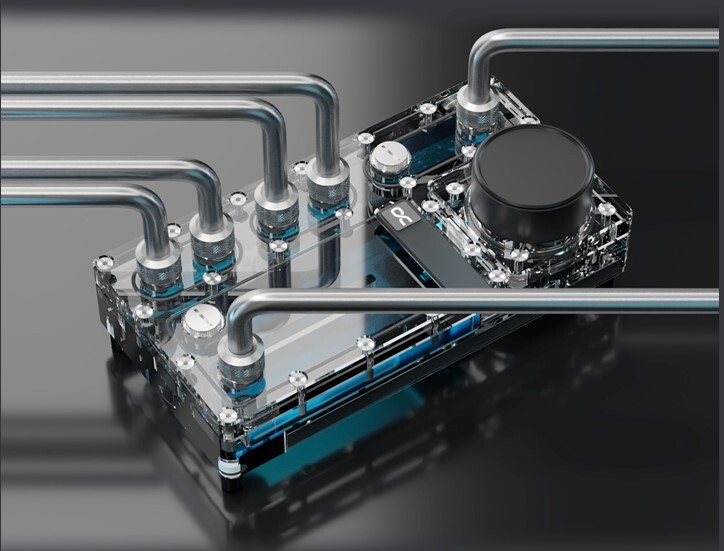
The new Core Distro Plate from Alphacool is a must-have for every performance-oriented custom water cooling system. It greatly simplifies the planning, construction and maintenance of complex water loops. The Distro Plate features an integrated reservoir with pump top for VPP/D5 pumps. Due to the arrangement of the G1/4" connections, confusing and complicated tubing paths will be a thing of the past. Therefore, the Core Distro Plate is ideally suited for custom water loops in which CPU and graphics card(s) are to be cooled simultaneously.
A beautiful and elegant element of the Core Distro Plate are the chrome-plated, brass G1/4" connectors. Recessed into the acrylic and fitted with an O-ring, the connectors are absolutely leak-proof and support the clean and functional look of the Alphacool Core Design series. The connections are not screwed directly into the acrylic to prevent cracking and resulting leakage.
More...
(PR) Foundry Revenue is Forecasted to Drop by 4% YoY for 2023, TrendForce Notes
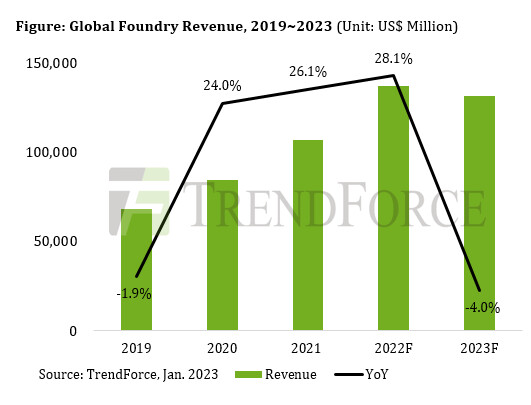
TrendForce's recent analysis of the foundry market reveals that demand continues to slide for all types of mature and advanced nodes. The major IC design houses have cut wafer input for 1Q23 and will likely scale back further for 2Q23. Currently, foundries are expected to maintain a lower-than-ideal level of capacity utilization rate in the first two quarters of this year. Some nodes could experience a steeper demand drop in 2Q23 as there are still no signs of a significant rebound in wafer orders. Looking ahead to the second half of this year, orders will likely pick up for some components that underwent an inventory correction at an earlier time. However, the state of the global economy will remain the largest variable that affect demand, and the recovery of individual foundries' capacity utilization rates will not occur as quickly as expected. Taking these factors into account, TrendForce currently forecasts that global foundry revenue will drop by around 4% YoY for 2023. The projected decline for 2023 is more severe when compared with the one that was recorded for 2019.
More...
About 300 MSI Motherboard Models Have a Faulty Secure Boot Implementation with Certain UEFI Firmware Versions
The UEFI Secure Boot feature is designed to prevent malicious code from executing during the system boot process, and has been a cybersecurity staple since the late-2000s, when software support was introduced with Windows 8. Dawid Potocki, a New Zealand-based IT student and cybersecurity researcher, discovered that as many as 300 motherboard models by MSI have a faulty Secure Boot implementation with certain versions of their UEFI firmware, which allows just about any boot image to load. This is, however, localized to only certain UEFI firmware versions, that are released as beta versions.
Potocki stumbled upon this when he found that his PRO Z790-A WiFi motherboard failed to verify the cryptographic signature boot-time binaries at the time of system boot. "I have found that my firmware was… accepting every OS image I gave it, no matter if it was trusted or not." He then began examining other motherboard models, and discovered close to 300 MSI motherboard models with a broken Secure Boot implementation. He clarified that MSI laptops aren't affected, and only their desktop motherboards are. Potocki says that affected MSI motherboards have an "always execute" policy set for Secure Boot, which makes the mechanism worthless, and theorized a possible reason. "I suspect this is because they probably knew that Microsoft wouldn't approve of it and/or that they get less tickets about Secure Boot causing issues for their users."
More...
NVIDIA GeForce RTX 4060 Ti Possible Specs Surface—160 W Power, Debuts AD106 Silicon
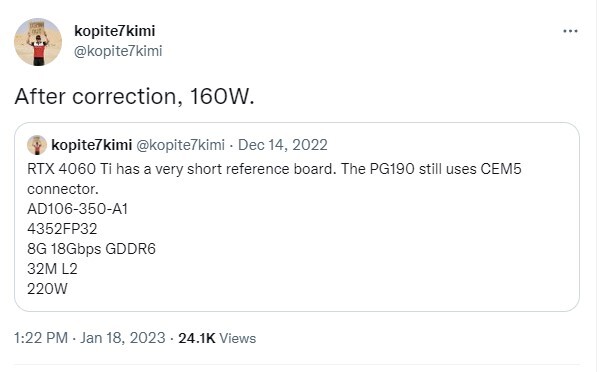
NVIDIA's next GeForce RTX 40-series "Ada" graphics card launch is widely expected to be the GeForce RTX 4070 (non-Ti), and as we approach Spring 2023, the company is expected to ramp up to the meat of its new generation, with xx60-segment, beginning with the GeForce RTX 4060 Ti. This new performance-segment SKU debuts the 4 nm "AD106" silicon. A set of leaks by kopite7kimi, a reliable source with NVIDIA leaks, shed light on possible specifications.
The RTX 4060 Ti is based on the AD106 silicon, which is expected to be much smaller than the AD104 powering the RTX 4070 series. The reference board developed at NVIDIA, codenamed PG190, is reportedly tiny, and yet it features the 16-pin ATX 12VHPWR connector. This is probably set for 300 W at its signal pins, and adapters included with graphics cards could convert two 8-pin PCIe into one 300 W 16-pin connector. The RTX 4060 Ti is expected to come with a typical graphics power value of 160 W.
More...
AMD RX 7900 XTX OC Does Cross 3 GHz Barrier, But in Non-Gaming Workloads
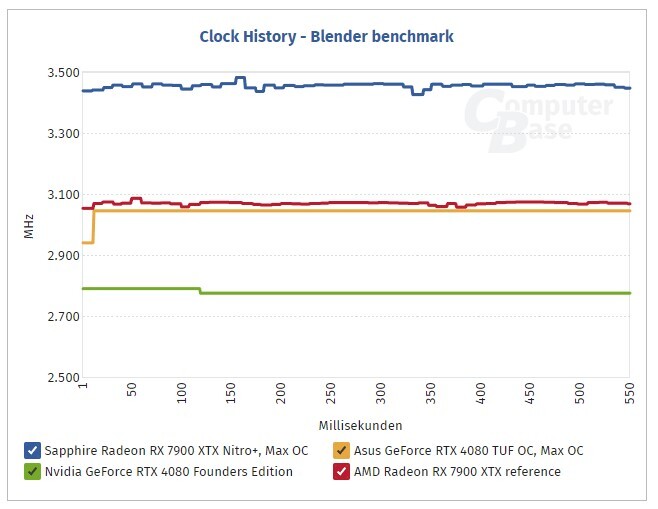
AMD's Radeon RX 7900 XTX RDNA3 graphics card does cross the 3 GHz engine clocks barrier, but not in gaming use-cases, finds a ComputerBase.de article, in which the German publication compares the overclocking experience between the RX 7000-series RDNA3 and NVIDIA RTX 40-series "Ada" architectures. The RX 7900 XTX was found to hit engine clock speeds as high as 3455 MHz, but when handling the Blender rendering benchmark, and not typical gaming workloads.
The GPU could even be pushed to 3548 MHz with a power-draw of around 400 W, but it wasn't stable, the article notes. The top frequencies the GPUs could hit with gaming workloads were around 2.90 GHz. We could be happening with games is that more of the GPU's hardware resources are tapping into its power-limit (such as the memory controllers, caches, and other special SIMD functions, which could be impacting the engine clock boosting headroom. ComputerBase.de used a Sapphire RX 7900 XTX NITRO+ custom-design graphics card in its testing, which comes with three 8-pin PCIe power connectors, and a higher overclocking headroom than what the reference-design cards are capable of.
More...
Chips are the New Oil with Geopolitics: Intel CEO
Intel CEO Pat Gelsinger, in an interview with CNN at WEF Davos, stated that semiconductor chip supply chains will have a greater influence on geopolitics than oil supply-chains over the next 50 years. Modern civilization is increasingly digitized, and most modern conveniences are "chipped" and connected in some form, which would put the chip-producing nations, or entities producing/supplying the chips at a distinct geopolitical advantage, similar to the oil-producing ones today. The location of "oil reserves [has] defined geopolitics for the last five decades," Gelsinger said; "where the technology supply chains are, and where semiconductors are built, is more important for the next 5 decades," he added.
We caught a taste of exactly what he meant when global semiconductor supply chains buckled around 2020-onward, hitting a multitude of other industries, including automobiles, construction, remote-work, consumer electronics, and much more. Unlike oil, which is a geographically constrained being a natural resource, chips can be manufactured almost anywhere, dictated only by geopolitical, trade, and IP barriers. Gelsinger calls for a much wider geographic spread of chip-production, so the supply-chains get resilient to disruptions due to unforeseen events. "We need this geographically balanced, resilient supply chain," he said. Gelsinger is at the forefront of advocating semiconductor manufacturing on U.S. soil to not only meet local demand, but also contribute to global supply-chain resilience. The CHIPS Act passed by U.S. Congress in 2022 will oversee more than $200 billion in public investments on semiconductor manufacturing and tech-research in the U.S.
More...
(PR) Synology Announces Highly Scalable SA6400 Storage System
Synology today announced the availability of the 12-bay SA6400, its most versatile general-purpose storage system designed to provide enterprises and large studios with lightning-fast data transfer speeds and on-demand capacity expansion. "SA6400 is the ideal solution to tackle today's ever-increasing amounts of unstructured data," said Julien Chen, Product Manager at Synology. "Its ability to quickly scale as data demands grow makes it suitable to serve as file or backup storage in agile and dynamic environments, getting businesses ready for future data growth."
Storage capacity is seamlessly expandable by adding up to 8 RX1223RP expansion units for a total of 108 drive bays, making room for over 1.9 petabytes on a single system—9 times the original capacity. With a throughput of over 6,500/4,000 MB/s sequential read/write, SA6400 ensures smooth operations even in the most demanding scenarios, including enterprise data centers, large production studios, and applications in the retail or hospitality sectors. Performance can be further boosted to accommodate more streams or tackle specialized applications by upgrading the built-in 10 GbE networking to 25 or even 40 GbE.
More...
 Posting Permissions
- You may not post new threads
- You may not post replies
- You may not post attachments
- You may not edit your posts
-
Forum Rules