-
Robot
Most Wanted

- Rep Power
- 82
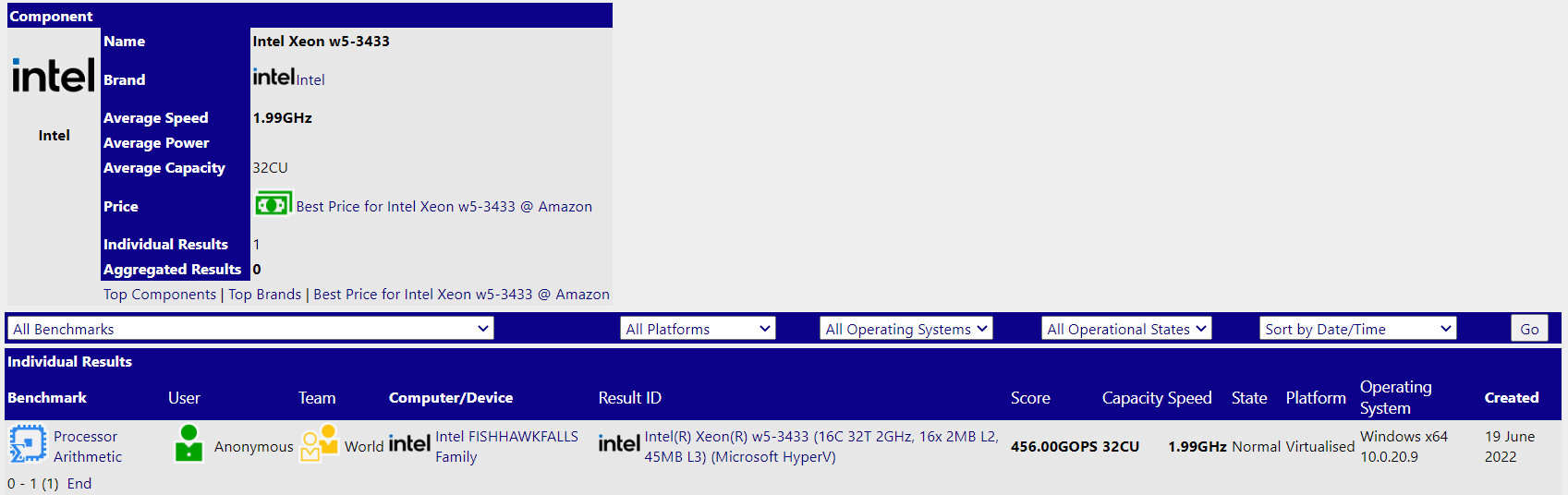
 Intel Sapphire Rapids "FishHawk Falls" HEDT Processor Spotted in a 16C
Intel's high-end desktop (HEDT), usually reserved for workstation and enterprise applications, is due for an update, and the company is readying an entire family of updated products. Today, we found a leak of what appears to be an Intel Sapphire Rapids design made for desktops. Called Xeon W5-3433, the CPU appears in the SiSoftware Sandra benchmark database. It carries a configuration of 16 cores and 32 threads and is equipped with 32 MB of L2 cache and 45 MB of L3 cache. Having 2 MB of L2 cache per core suggests that the design is not an Alder Lake variation. This specific SKU is clocked at 1.99 GHz, meaning an early engineering sample.
The Sapphire Rapids HEDT platform is codenamed FishHawk Falls. Intel is supposed to offer Alder Lake-X processors with higher core counts and the FishHawk Falls. Both will be running on the same W790 chipset; however, the Sapphire Rapids implementation will carry more cores in a Xeon package designed for professionals. There was an Ice Lake-X Xeon processor called Xeon W-3335 with 16 cores and 32 threads, meaning that the leaked Xeon W5-3433 is its direct successor.
More...
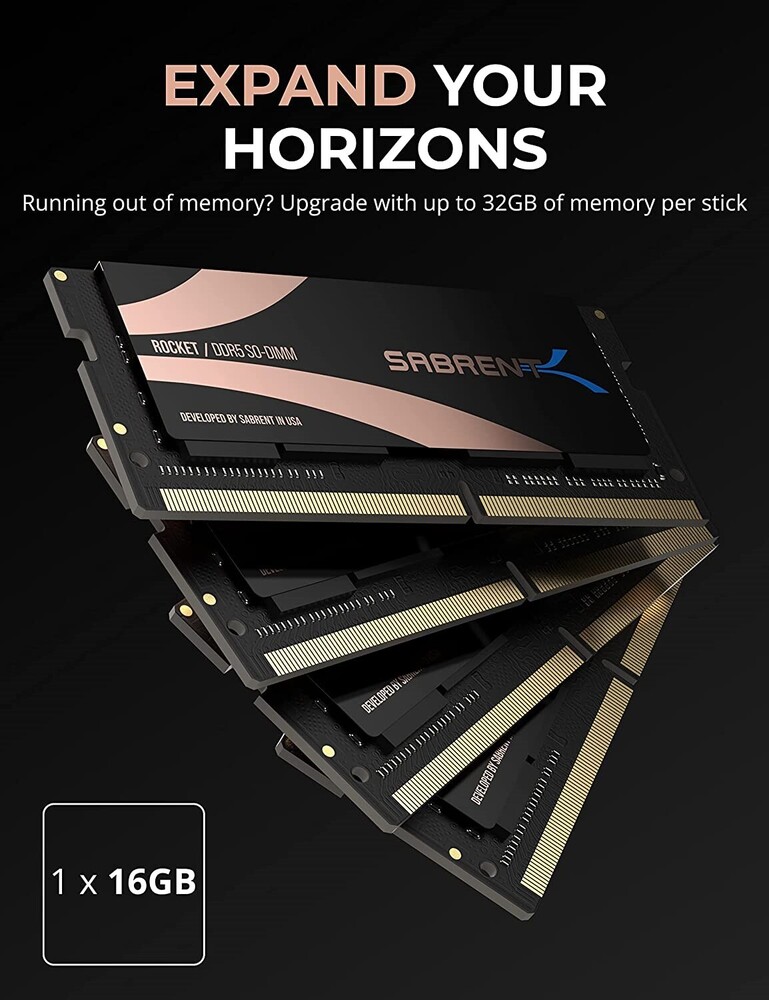
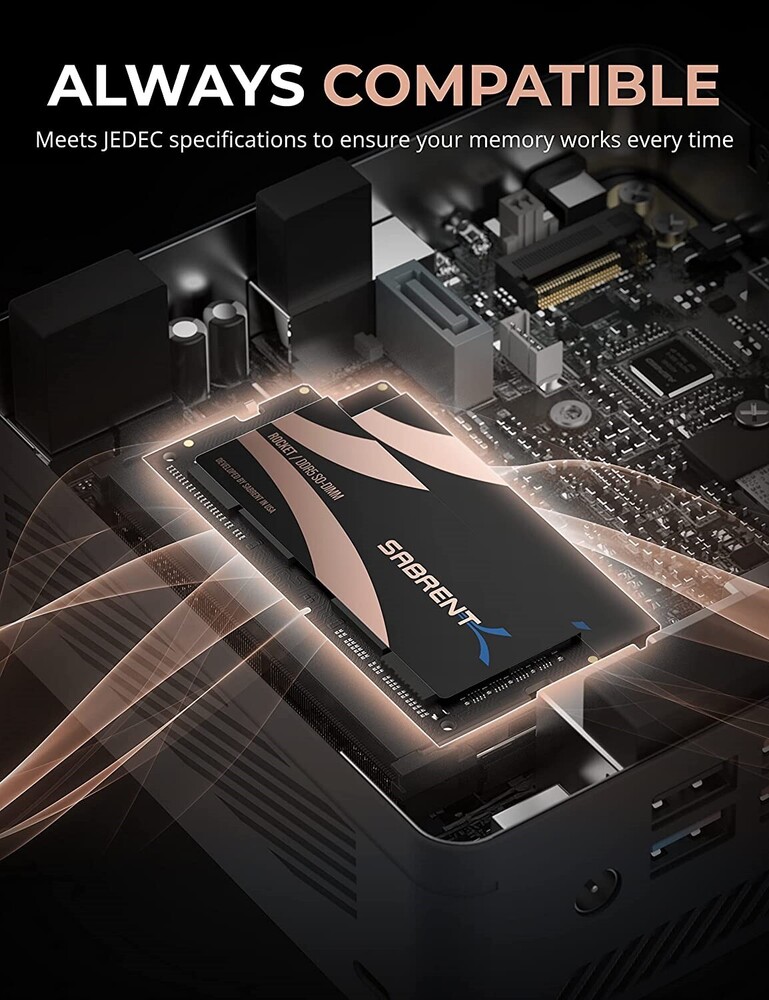
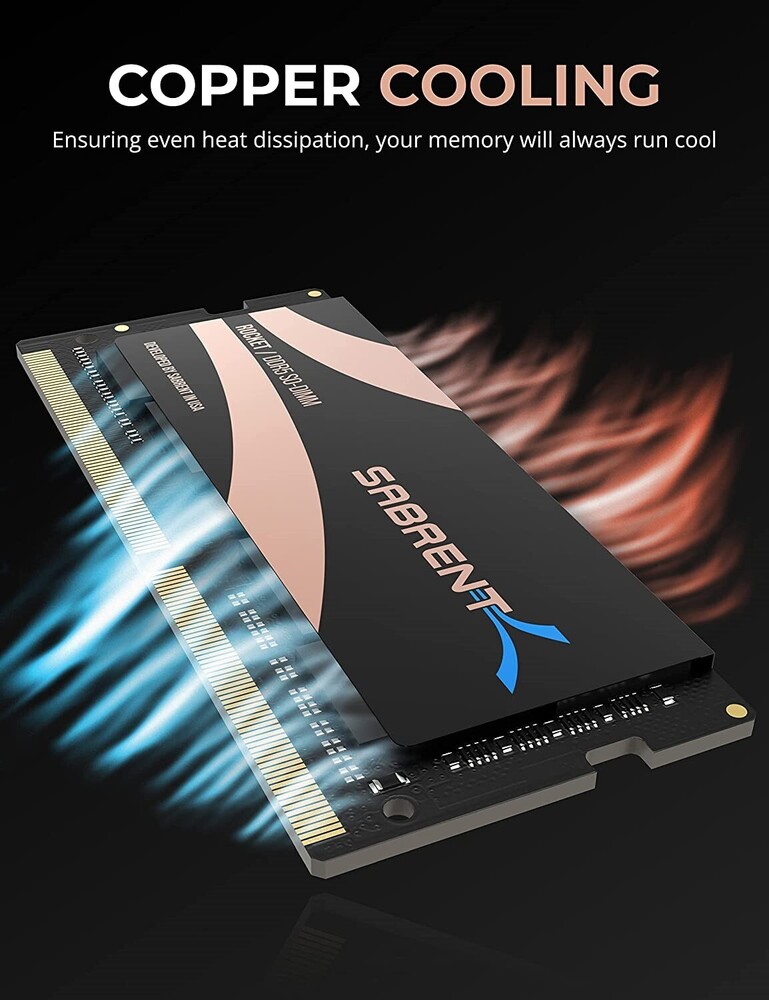
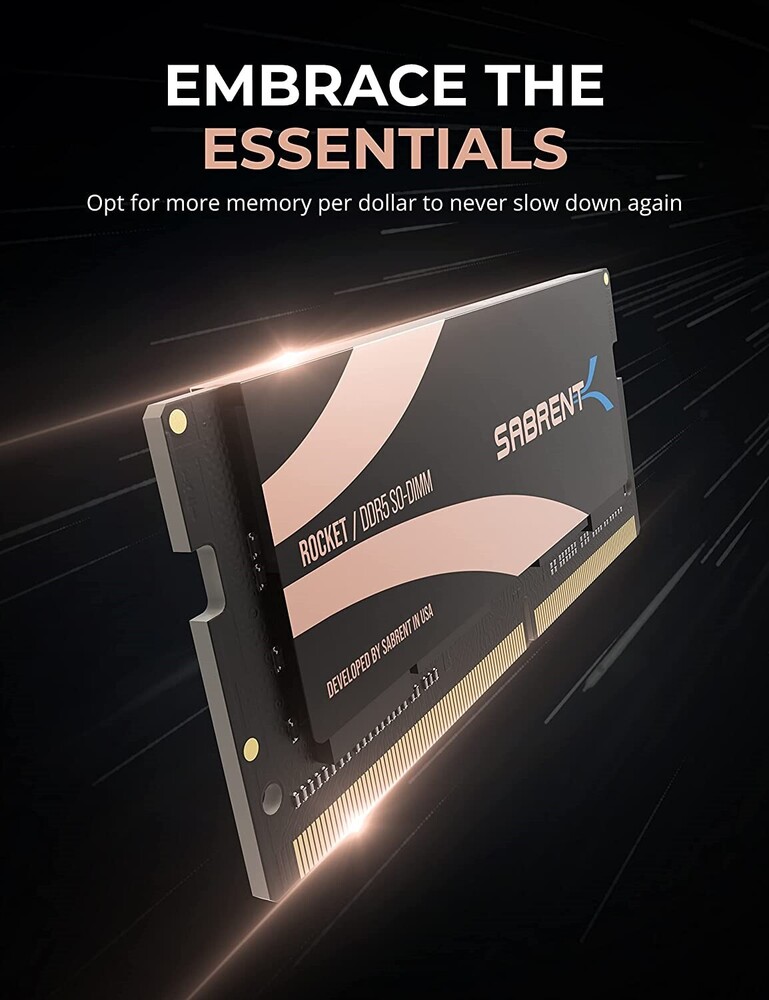
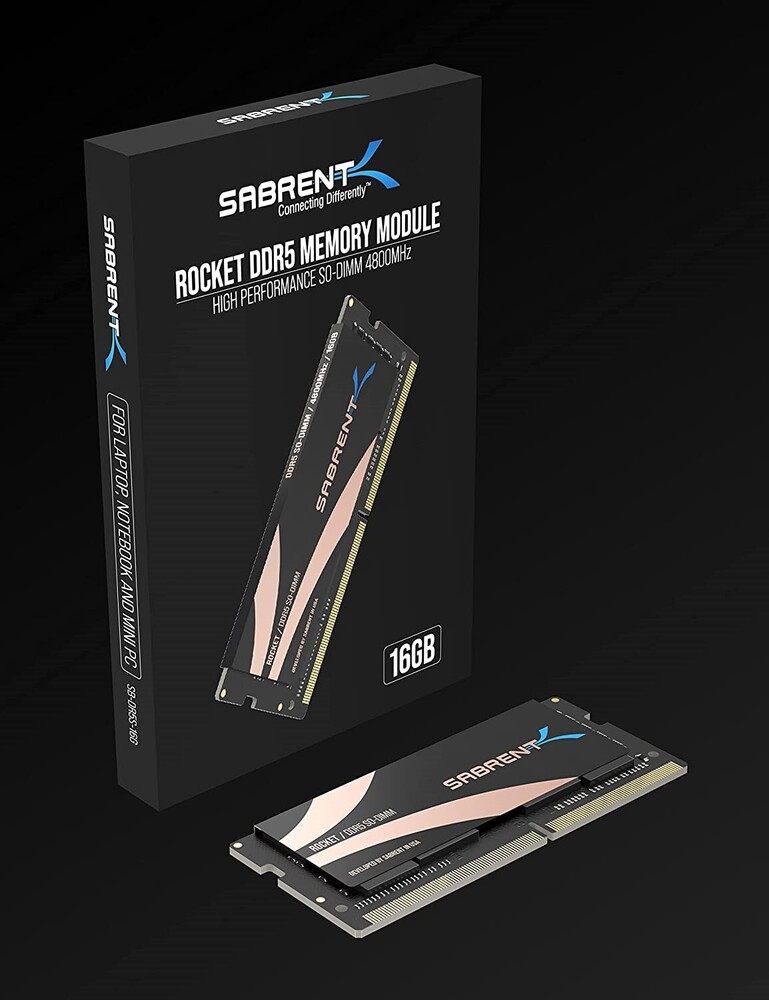
(PR) Sabrent announces High-Performance DDR5-4800 SO-DIMM CL40 Memory Modules
It seems like DDR4 has ruled the roost forever. Finally, new motherboards and architectures have allowed memory to grow wings with the advent of DDR5. Improved clock speeds promise up to twice the bandwidth of DDR4, all with lower voltage for better efficiency. To further help with that last bit, DDR5 has on-board power management to reduce motherboard cost and complexity. This is particularly nice for all-new, powerful laptops and embedded devices.
Reliability has also been improved by the introduction of on-die error-correction technology. Memory availability is improved by splitting the internal 64-bit (72-bit with ECC) channel into two independent, 32-bit channels (40-bit with ECC) and the addition of the same bank refresh. Combined with other features, including those that allow for up to four times the module capacity with consumer DRAM, DDR5 ensures your multi-core CPU won't be memory starved. You can pack more memory than ever into your portable machine and take it on the go.
More...
AMD GPU Prices Fall Below MSRP in Europe, NVIDIA GPUs Approach the Baseline
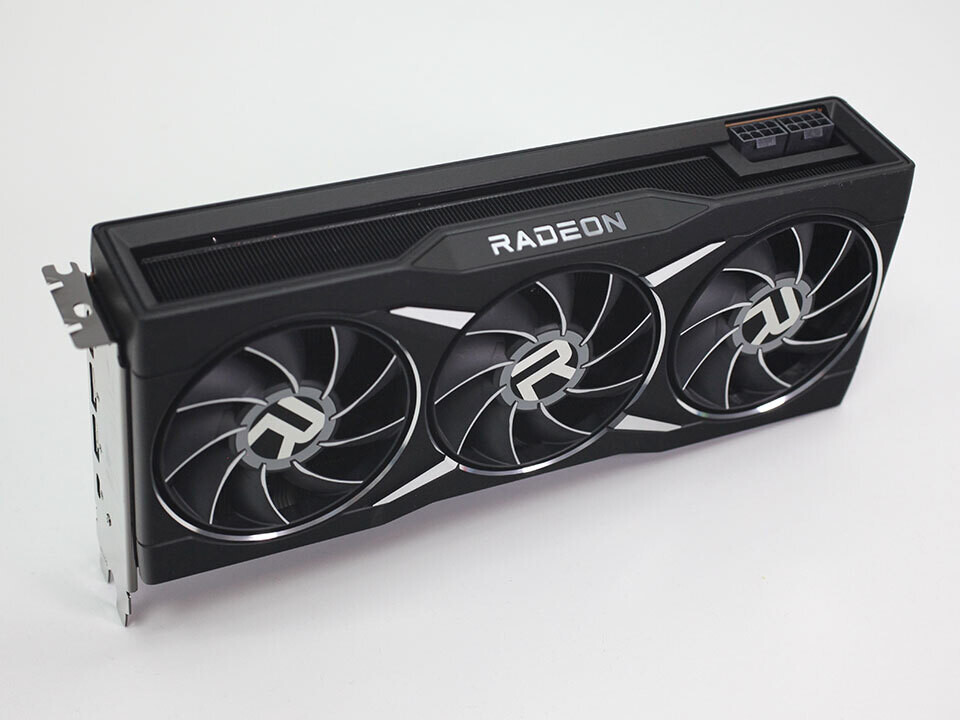
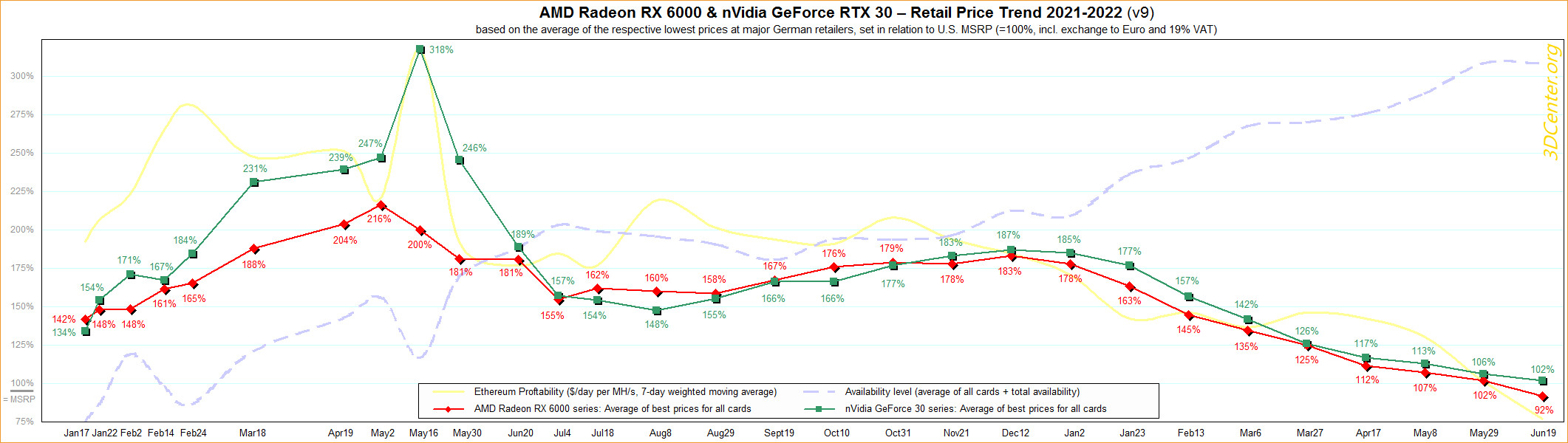
Graphics card prices have been on a steady decline in the past few months, following their peak in May of last year when we saw double and triple pricing compared to the baseline MSRP value. According to the 3DCenter.org report, which tracks graphics card prices in Germany and Austria, we have information that AMD GPU prices have dipped below MSRP, while NVIDIA GPUs are very close to baseline listed prices. The report tracks Ethereum mining profitability and displays it in the yellow line. As the line is declining, so are the GPU prices. For AMD, the prices are now 8% below the 100% of MSRP. At 92%, consumers can find AMD GPUs at a slight discount. While AMD cards are slightly cheaper, NVIDIA GPUs are now at 102% of the MSRP, the lowest price point since the launch.
More...
Nanya Kicks Off Construction of US$10 Billion Fab in New Taipei City
Nanya Technology, part of the Formosa Plastics Group, which is one of the largest conglomerates in Taiwan, will hold a ground-breaking ceremony for its new 12-inch fab that will be built in New Taipei City later this week. It'll be the biggest investment Nanya has done in the past decade, as the company is investing US$10.1 billion into building the new fab. This is obviously a lot less than TSMC is investing, but DRAM is made on different nodes to those that TSMC makes its customers products on, since DRAM doesn't benefit as much from node shrinking as other types of semiconductors.
The new fab will be located near one of Nanya's current fabs, in the Taishan district. Mass production is scheduled to start some time in 2025 and the fab is said to have a monthly capacity of around 45,000 wafers. Right now it's scheduled for a 10 nm technology node, but this might change by the time that the fab is up and running, especially considering that Nanya is already producing a range of 10 nm based products in some of its current fabs. Nanya's goal is to develop its next generation of 10 nm DRAM independently from other DRAM makers, as to avoid having to pay patent licence fees to its competitors.
More...
(PR) CHERRY Announces Cherry MX Ultra Low Profile Tactile Switches
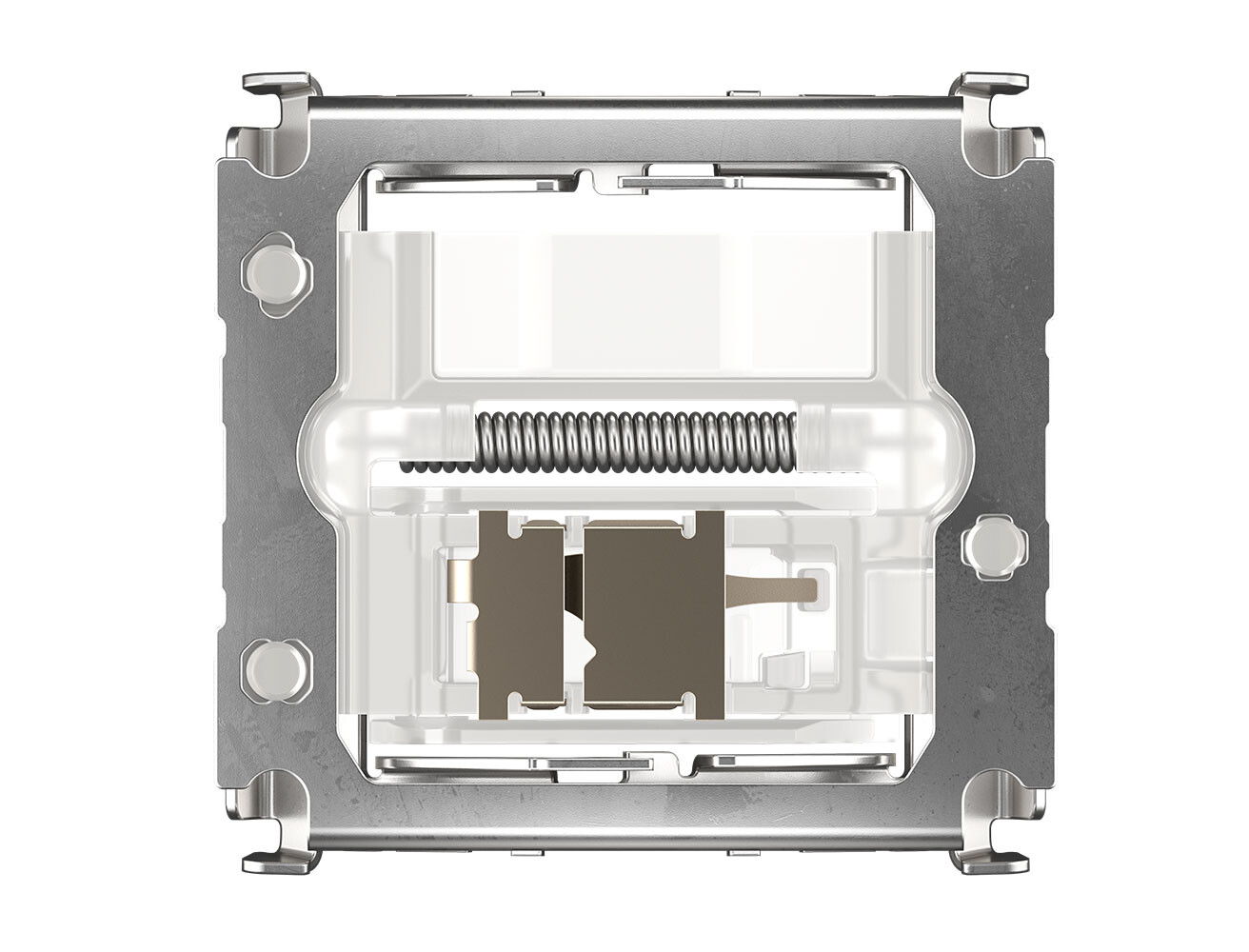
CHERRY MX, the market leader and expert for mechanical switches in keyboards, is expanding the MX Ultra Low Profile series (ULP) with a tactile version without an audible click. The manufacturer of innovative switches thus offers end customers another option in the areas of "high-end laptop keyboards" and "ultra-thin desktop keyboards". The CHERRY MX Ultra Low Profile Tactile comes with all the unique features and distinctive characteristics for which the series is known worldwide. Since the ULP switch is not only an absolute technical masterpiece but has also set a patented standard and allows new technical possibilities for designing ultra-low profile laptop and desktop keyboards within the premium segment, the product received the "German Innovation Award". This makes CHERRY MX an award-winning innovation leader.
In March 2021, the MX Ultra Low Profile switch was introduced as a completely new development and a milestone in switch development: With an overall height of just 3.5 millimeters, CHERRY MX unveiled the shallowest model in its product range. Particularly for laptops, this allows the realization of fully mechanical high-end keyboards that clearly stand out from previous solutions in terms of pleasant tactile feel, intensive feedback during gaming or typing, and increased reliability as well as greater durability without changing the format. The CHERRY MX ULP also opens up new possibilities for desktop keyboards that were previously technically unfeasible. The exclusive and patented switch design incorporates the feature set of CHERRY MX switches that have been proven for decades, ensuring maximum precision and perfect function even in the new design.
More...
(PR) Memory Prices Going Down by Up to 8% in this Quarter, Says TrendForce
According to TrendForce research, despite the significance of peak season and rising DDR5 penetration, the 3Q22 DRAM market still succumbed to the negative impact of weak consumer electronics demand resulting from the Russian-Ukrainian war and high inflation, which in turn led to an increase in overall DRAM inventory. This is the primary reason for a 3-8% drop in DRAM prices in 3Q22 and a more than 8% pricing dip in certain DRAM products for PCs and smart phones cannot be ruled out.
In terms of PC DRAM, sustained weakening of demand has led to PC OEMs adjusting their annual shipment targets and also caused DRAM inventories to soar rapidly. In 3Q22, PC OEMs remain focused on adjusting and destocking DRAM inventories, making a rebound in purchasing momentum unlikely. At the same time, since the overall DRAM industry remains oversupplied, even if PC demand is sluggish, suppliers still experienced difficulties in reducing their PC DRAM supply, resulting in a slight quarterly increase in the number of supplied bits. Therefore, PC DRAM pricing is forecast to drop by 3~8%
More...
NVIDIA RTX 40 Series Could Reach 800 Watts on Desktop, 175 Watt for Mobile/Laptop
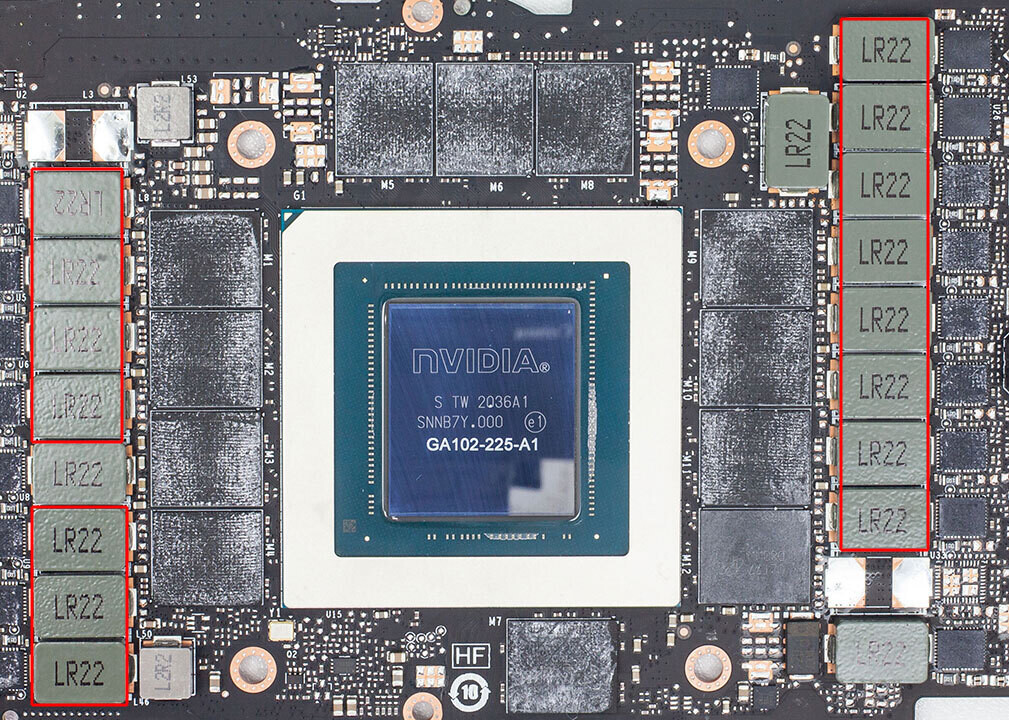
Rumors of NVIDIA's upcoming Ada Lovelace graphics cards keep appearing. With every new update, it seems like the total power consumption is getting bigger, and today we are getting information about different SKUs, including mobile and desktop variants. According to a well-known leaker, kopite7kimi, we have information about the power limits of the upcoming GPUs. The new RTX 40 series GPUs will feature a few initial SKUs: AD102, AD103, AD104, and AD106. Every SKU, except the top AD102, will be available as well. The first in line, AD102, is the most power-hungry SKU with a maximum power limit rating of 800 Watts. This will require multiple power connectors and a very beefy cooling solution to keep it running.
Going down the stack, we have an AD103 SKU limited to 450 Watts on desktop and 175 Watts on mobile. The AD104 chip is limited to 400 Watts on desktop, while the mobile version is still 175 Watts. Additionally, the AD106 SKU is limited to 260 Watts on desktop and 140 Watts on mobile.
More...
Apple Reportedly Captures 90% of Arm PC Revenue Share
With the launch of Apple Silicon for Mac computers, Apple has established itself as a great user of the Arm instruction set. Starting with M1, the company released an entirely new family of products running Apple Silicon. Today, thanks to the research of Strategy Analytics company, we have information that Apple is capturing as much as 90% of the revenue share present in the Arm PC market. The Arm PC market is a tiny subset of the entire PC market, mainly equipped with one-off Windows-on-Arm devices, Chromebook PCs, and Apple Macs. With the naturally low prices of the remaining Arm PCs, Apple Arm PCs offer a relatively high price point and a much more incredible selection of products.
On the global scale, Arm PCs now account for 9% of the total PC market share, where x86 vendors are dominating the field. "Apple's M-series family of processors set the benchmark and gave Apple a 2-3-year lead over the rest of the Arm-based PC processor vendors. Qualcomm captured just 3% revenue share in the Arm-based notebook PC processor market in 2021 and lags Apple in CPU performance," said Sravan Kundojjala, Director of Handset Component Technologies service at Strategy Analytics. This points to a particular case of Apple's better product and feeding the demand with higher-performing processors. Qualcomm's acquisition of Nuvia should yield different results in the coming years, as the new IP is yet to appear in Qualcomm SoCs.
More...
AMD Reportedly Preparing Next Generation Steam Deck Processor
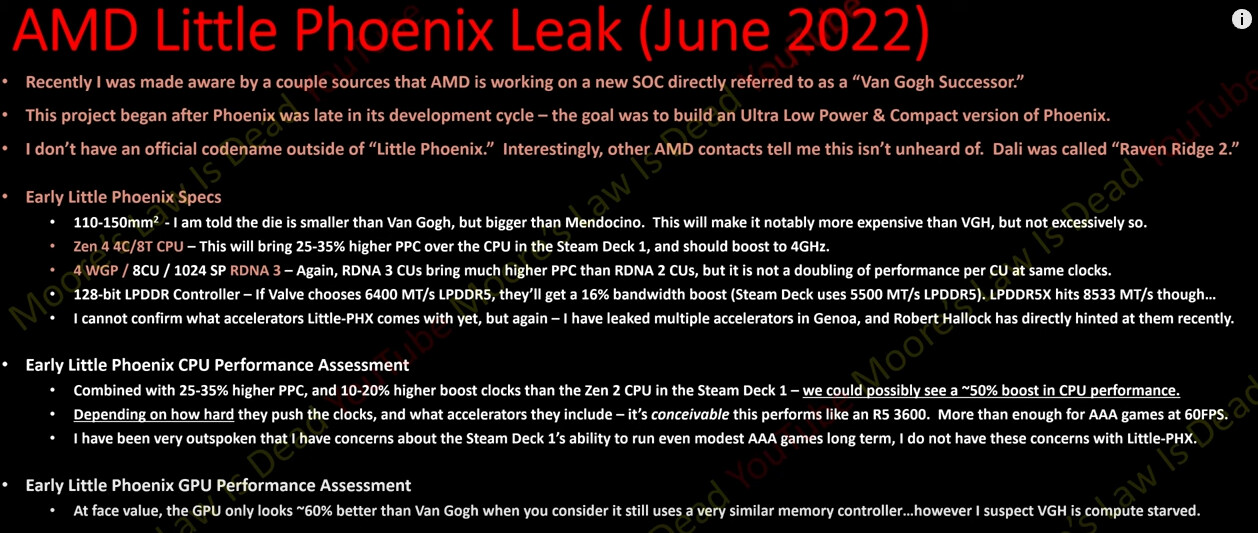
AMD is allegedly preparing an upgraded quad-core APU with Zen 4 and RDNA3 architectures for a next-generation Steam Deck device according to Moore's Law is Dead. The report claims that the chip is referred to as a "Van Gogh Successor" internally with a die size between 110 mm² and 150 mm² resulting in an increased production cost. The chip should feature 4 Zen 4 cores and 8 threads offering 25% - 35% higher performance per clock (PPC) with a maximum boost of 4 GHz. The RDNA3 graphics will include 8 Compute Units with significantly higher PPC compared to their RDNA2 counterparts which combined with the updated CPU could see a performance improvement up to 50%. These rumors have not been confirmed with any potential Steam Deck processor far from being announced or released anytime soon.
More...
Intel Lists Resizable BAR Support as an Arc GPU Requirement for Optimal Performance
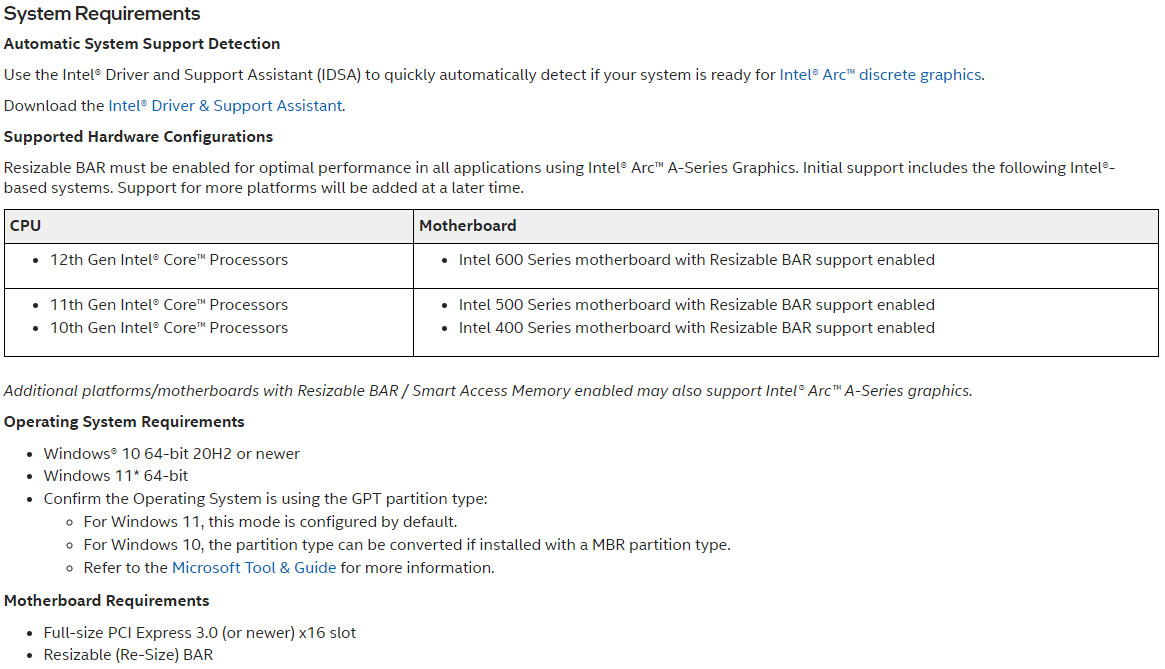
Intel has recently published a document outlining the requirements for Arc GPU support on desktop including the supported platforms. The guide states that supported processors are limited to 12th Gen Core "Alder Lake", 11th Gen Core "Rocket Lake", and 10th Gen Core "Comet Lake" with Resizable BAR support enabled on the motherboard. The document also notes that other platforms supporting Resizable BAR / Smart Access Memory may work with Intel Arc graphics cards indicating potential unofficial support for AMD platforms also. Intel has also specified that only Windows 10/11 is supported and installations must be using the GPT partition type. The page contains instructions to enable Resizable BAR support and switch to a GPT partition but no information is provided as to whether the cards will work without this functionality.
More...
 Posting Permissions
- You may not post new threads
- You may not post replies
- You may not post attachments
- You may not edit your posts
-
Forum Rules