Page 1 of 3 123 LastLast
Results 1 to 15 of 37

Thread: ABC-ului receptiei prin satelit!

  1. #1
    Standard RSP member gessle's Avatar
    Join Date
    31 Jan 2007
    Location
    tg ocna;jud. BACAU
    Posts
    719
    Mentioned
    0 Post(s)
    Rep Power
    74

    Default ABC-ului receptiei prin satelit!

    It is illegal to view European PAY-TV channels within Europe Without a subscription! The information and freeware on this site is meant for educational purposes only! The webmaster, designers and owner of this domain can and will not be held responsible for any damage done by illegal use of the information that could be provided on this site. By entering this site you agree to these terms!


    In curand ,voi incepe acest topic!
    FOCUS SAT-UPC;RCS-digital cablu;ADSL;BAYERN MUNCHEN&AC MILAN;
    .de

  2. #2
    Standard RSP member gessle's Avatar
    Join Date
    31 Jan 2007
    Location
    tg ocna;jud. BACAU
    Posts
    719
    Mentioned
    0 Post(s)
    Rep Power
    74

    Default Re: ABC-ului receptiei prin satelit!

    Pt un inceput:lexicon


    A/B Switch:
    A switch that selects one of two inputs (A or B) for routing to a common output while providing adequate isolating between the two signals.

    Access Control System - ACS:
    Access Control System/s, comprising all conditional access components such as S/1, IDAC, ISAC, minicons, etc...

    ACS number:
    This is the version number of the cards software.
    There are several different software versions: 1.2, 1.4, 1.6 en 3.82, 3.83.
    Versions 1.4 and 1.6 are almost identical.

    Adaptation Header:
    A block of data that forms an extension to a transport packet header. It may be of fixed format and/or of general data

    Adjacent Channel:
    An adjacent channel is immediately next to another channel in frequency. For example, PAL channels 5 and 6 as well as 8 and 9 are adjacent.

    Alignment:
    The process of fine tuning a dish or an electronic circuit to maximize its sensitivity and signal receiving capability.

    Alphacrypt:
    The Irdeto successor, decodes both Irdeto and Betacrypt.

    AM:
    An abbreviation for amplitude modulation.

    Analog:
    A system in which signals vary continuously in contrast to a digital system in which signals vary in discrete steps.

    Analogue-to-Digital Converter:
    A circuit that converts analogue signals to an equivalent digital form. The varying analogue signal is sampled at a series of points in time. The voltage at each of these points is then represented by a series of numbers, the digital value of the sample. The higher this sampling frequency, the finer are the gradations and the more accurately is the signal represented

    Antenna:
    A device that collects and focuses electromagnetic energy, i.e., contributes an energy gain. Satellite dishes, broadband antenna and cut-to-channel antennas are some types of antennas encountered. In the case of satellite dishes, gain is proportional to the surface area of the microwave reflector.

    Antenna Efficiency:
    The percentage of incoming satellite signal actually captured by an antenna system.

    Aperture:
    The collection area of a parabolic dish.

    Aperture Blocking:
    An obstruction such as the feed assembly which causes a blocking of the incoming signal.

    Asciiserial:
    The number that identifies the card. It is also printed on the card in bar-code.
    Although it is accessible by software, to my knowledge it is never really used.
    It only serves identification purposes.

    Aspect Ratio:
    The ratio of television screen width to height. The standard aspect ratio is 4 to 3.

    Aston Seca:
    Although the real name for the coding system is Mediaguard, it is often referred to as Seca or Aston Seca. Mediaguard is developed by Seca, so the also used name Seca Mediaguard is more suitable. Aston is a company that builds the CAM's (among others) that are used to decode the Mediaguard system.
    The Seca Mediaguard coding is used by the Canal + organization which is no wonder. Canal + is shareholder in the Seca organization and it also takes part in the development of the Mediaguard coding system. Because of the influence of Canal +, the Seca Mediaguard system is very popular in France.

    Attenuation:
    The decrease in signal power that occurs in a device or when a signal travels to reach a destination point (path loss).

    Attenuator:
    A passive device which reduces the power of a signal. Attenuators are rated according to the amount of signal attenuation.

    ATR:
    Answer To Reset, or ATR for short, is the string a smart card sends to the receiver upon every reset. The ATR of each smart card conforms to the ISO7816-3 specifications. The ATR contains information about the card, for instance information on how the receiver should communicate with the card: Voltage, Amp, Baudrate, Synchronous or Asynchronous communication etc.

    Audio Subcarrier:
    The carrier wave that transmits audio information within a video broadcast signal. Satellite transmissions can relay more than a single audio subcarrier in the frequency range between 5 and 8.5 MHz.

    Auto Update:
    The auto update (AU) technique makes sure the card is kept up to date in order to provide the correct keys to the CAM when requested. Providers will regularly change their operational keys and unless you have a valid set of management keys, you will soon be left with a black screen. For different coding systems, the actual keys that are used for decoding, have different names. For instance, in Irdeto they are called Plainkeys and for Seca they are called Operational Keys.

    Automatic Brightness Control:
    A television circuit used to automatically adjust picture tube brightness in response to changes in background or ambient light.

    Automatic Fine Tuning:
    A circuit that automatically maintains the correct tuner oscillator frequency and compensates for drift and for moderate amounts of inaccurate tuning. Similar to AFC.

    Automatic Frequency Control - AFC:
    A circuit that locks an electronic component to a chosen frequency, so that the the tuning will not drift from that chosen frequency.

    Automatic Gain Control - AGC:
    A circuit that uses feedback to maintain the output of an electronic component at a constant level. This is achieved by locking the gain onto a fixed value and thus compensating for varying input signal levels keeping the output constant.

    Azimuth-Elevation (Az-El) Mount:
    A dish mount that tracks satellites by moving in two directions: the azimuth in the horizontal plane and elevation up from the horizon.

    Azimuth:
    A compass bearing expressed in degrees of rotation clockwise from true north. It is one of the two coordinates, azimuth and elevation, used to align a satellite dish.

    Band:
    A range of frequencies.

    Band Separator:
    A device that splits a group of specified frequencies into two or more bands. Common types include UHF/VHF, Hi/Lo-band and FM separators. This device is essentially a set of filters.

    Bandpass Filter:
    A circuit or device that allows only a specified range of frequencies to pass from input to output.

    Bandwidth:
    The frequency range allocated to any communication circuit.

    Baseband:
    The raw audio and video signals prior to modulation and broadcasting. Most satellite headend equipment utilizes baseband inputs. More exactly, the composite unclamped, non-de-emphasized and unfiltered receiver output. This signal contains the complete set of FM modulated audio and data subcarriers

    Beamwidth:
    A measure used to describe the width of vision of a dish. Beamwidth is measured as degrees between the 3 dB half power points

    Betacrypt:
    A coding system very similar to Irdeto and used by the German provider Premiere World.

    Bit Error Rate - BER:
    The number of errors in a data stream usually expressed a ratio to the total number of bits in which an error occurs. For example, 1 in 10 7 or 10 -7

    Bits per Second - BPS:
    The number of bits transmitted each second

    Blanking Pulse Level:
    The reference level for video signals. The blanking pulses must be aligned at the input to the picture tube.

    Blanking Signal:
    Pulses used to extinguish the scan illumination during horizontal and vertical retrace periods.

    Block Downconversion:
    The process of lowering the entire band of frequencies in one step to some intermediate range to be processed inside a satellite receiver. Multiple block downconversion receivers are capable of independently selecting channels because each can process the entire block of signals.

    Blocker:
    Every now and then, some providers will send signals that will effect pirate cards only. The intention of these signals is to disable pirate cards. In order to make sure these unwanted signals don't reach and disable your original card, you can use a blocker. There are 2 ways to block signals: software- and hardware blockers.

    Bootloader:
    A bootloader is the first program, executed whenever you turn your receiver on. The bootloader will ensure that the receivers operating system is started. The operating system of a satellite receiver is usually called the firmware.

    Bouquet:
    A group of services offered. The operator may also market a bouquet as a product such as `The Basic Bouquet.'

    Broadband:
    A device that processes a signal(s) spanning a relatively broad range of input frequencies

    C-Band:
    The 3.625 to 4.2 GHz band of frequencies at which some broadcast satellites operate.

    Card doubler:
    A device that enables you to use 2 cards in 1 CAM simultaneously.

    Card group:
    A card group is just another name for provider group.

    Carrier:
    A pure-frequency signal that is modulated to carry information. In the process of modulation it is spread out over a wider band. The carrier frequency is the center frequency on any television channel.

    Carrier-to-Noise Ratio - C/N:
    The ratio of the received carrier power to the noise power in a given bandwidth, expressed in decibels. The C/N is an indicator of how well an receive system will perform in a particular location, and is calculated from satellite power levels, dish gain and the system noise temperature.

    Cassegrain Feed System:
    A dish feed design that includes a primary reflector, the dish, and a secondary reflector which redirects microwaves via a waveguide to a low noise amplifier.

    CB20 selection:
    A smart card can be addressed and modified in 3 ways:
    1. By using the hex serial, individual cards can be addressed
    2. Through the card group number, all 256 cards in that group can be addressed simultaneously
    3. Within a card group a selection of individual cards can be addressed by means of a CB20 selection (max. 256 cards)

    CCD:
    Charge coupled device. In this device charge is stored on a capacitor which are etched onto a chip. A number of samples can be simultaneously stored. Used in MAC transmissions for temporarily storing video signals.

    Channel:
    A segment of bandwidth used for one complete communication link.

    Channel ID:
    Is used to select a channel.
    The correct combination of key and channel ID will activate the key.

    Characteristic Impedance:
    The impedance in ohms of a device in the path of a communication signal such as a cable, a connector or the input of an amplifier.

    Chrominance:
    The hue and saturation of a color. The chrominance signal is modulated onto a 4.43 MHz carrier in the PAL television system and a 3.58 MHz carrier in the NTSC television system.

    Chrominance Signal:
    The color component of the composite baseband video signal assembled from the I and Q portions. Phase angle of the signal represents hue and amplitude represents color saturation.

    Circular Polarity:
    Electromagnetic waves whose electric field uniformly rotates along the signal path. Broadcasts used by Intelsat and other international satellites use circular, not horizontally or vertically polarized waves as are common in North American and European transmissions

    Clamp Circuit:
    A circuit that removes the dispersion waveform from the downlink signal.

    Clamped Outputs:
    Satellite receiver outputs that have the energy dispersal waveform removed. Unclamped outputs are often required as input to a decoder.

    Clarke Belt:
    The circular orbital belt at 35 786 kilometers above the equator, named after the writer Arthur C. Clarke, in which satellites travel at the same speed as the earth's rotation. Also called the geostationary orbit.

    Coaxial Cable:
    A cable for transmitting high frequency electrical signals with low loss. It is composed of an internal conducting wire surrounded by an insulating dielectric which is further protected by a metal shield. The impedance of coax is a product of the radius of the central conductor, the radius of the shield and the dielectric constant of the insulation. In most satellite and SMATV systems, coax impedance is 75 ohms.

    Color Sync Burst:
    A burst of 8 to 11 cycles in the 4.43361875 MHz (PAL) or 3.579545 MHz ( NTSC) color subcarrier frequency. This waveform is located on the back porch of each horizontal blanking pulse during color transmissions. It serves to synchronize the color subcarrier's oscillator with that of the transmitter in order to recreate the raw color signals.

    Common Interface:
    Common Interface (CI) is a PCMCIA slot in the satellite receiver in which CAM'scan be put. All multicryptreceivers use Common Interfaces.

    Common Scrambling Algorithm :
    This is the coding algorithm as specified by DVB. The CSA was designed to make transmitted signals safe from hackers. For the provider the real advantage is that CSA is universal to several types of CAM's. This means that a provider who for instance broadcasts in both Seca and Viaccess, can send EMM'sand ECM's with the transmission, but each CAM will only react to the commands which are meant for that CAM. All other commands are ignored.

    Composite Baseband Signal:
    The complete audio and video signal without a carrier wave. Satellite signals have audio baseband information ranging in frequency from zero to 3400 Hertz. NTSC video baseband is from zero to 4.2 MHz.
    PALvideo basebandranges from 0 to 5.5 MHz.

    Composite Video Signal:
    The complete video signal consisting of the chrominance and luminance information as well as all sync and blanking pulses.

    Companding:
    A form of noise reduction using compression at the transmitting end and expansion at the receiver. A compressor is an amplifier that increases its gain for lower power signals. The effect is to boost these components into a form having a smaller dynamic range. A compressed signal has a higher average level, and therefore, less apparent loudness than an uncompressed signal, even though the peaks are no higher in level. An expander reverses the effect of the compressor to restore the original signal.

    Compressor:
    A unit that accepts uncompressed video, audio and data and then digitizes and compresses these signals

    Compression System:
    A collection of compressors, multiplexers and modulators that generate one multiplex signal

    Conax:
    A coding system which is used a lot in the Scandinavian countries.

    Conditional Access:
    Conditional Access (CA) is a technology, used for coding and authorizing in DVBsystems. The control mechanism is used to limit access by decoders to only the subscribed or free services on a multiplex.
    A Conditional Access System (CAS) contains a few basic elements: SMSand SAS.

    Conditional Access Module (CAM):
    A Conditional Access Module (CAM) is the module into which the CA system is built in. CAM's can be found as separatemodules to put into the CIof your receiver, but they are also sometimes built fix into the receiver. In that case they are called embedded CAM.
    The CAM contains all software, needed to decode a certain scrambling system and also the necessary software to enable it to communicate with your smart card.

    Conditional Access Table (CAT):
    Conditional Access Table. A table that relates entitlement management message ( EMM) data streams to the conditional access ( CA) vendor(s) managing the decoder base.

    Control Word:
    A Control Word (CW) is a data package containing the coded key for the coding algorithm of your smart card.

    Countrycode (COCO):
    A 3 digit code, used to inform the CAM/receiver which group of channels should be validated.

    Crd's:
    You can regard Crd files as a kind of macro files. They contain command strings, used to update your smart card.

    Cross Modulation:
    A form of interference caused by the modulation of one carrier affecting that of another signal. It can be caused by overloading an amplifier as well as by signal imbalances at the headend.

    Cross Polarization:
    Term to describe signals of the opposite polarity to another being transmitted and received. Cross-polarization discrimination refers to the ability of a feed to detect one polarity and reject the signals having the opposite sense of polarity

    Crosstalk:
    Interference between adjacent channels often caused by cross modulation. Leakage can occur between two wires, PCB tracks or parallel cables.

    Cryptedkey (Key) & Plainkey:
    These are respectively a coded and a uncoded form of the same key.
    To make things even more complicated than they already are, the cryptedkey is often simply referred to as key.
    The cryptedkey contains a combination of the date, that key was sent, the plainkey and the Plainmasterkey, all coded into 1 key. The cryptedkey is sent to the card on a regular basis. It validates the subscription of the user, therewith enabling the user to view certain channels. The cryptedkey ensures correct decoding of a validated channel. The plainkey is the uncoded version of the cryptedkey.

    Crypto Works:
    A relative newcomer among the coding systems is Crypto Works. This system is developed by the Dutch based Philips.

    Customer Word Pointer:
    The 4th byte in the PPUAstring is called the CWP (or Customer Word Pointer). It is used to address individual cards. The CWP is used only in MOSC cards.

    Date:
    The date on a card is used by the provider to activate or deactivate channels.

    De-emphasis:
    A reduction of the higher frequency portions of an FM signal used to neutralize the effects of pre-emphasis. When combined with the correct level of pre-emphasis, it reduces overall noise levels and therefore increases the output S/N ratio

    Declination Offset Angle:
    The adjustment angle of a polar mount between the polar axis and the plane of a satellite antenna used to aim at the geosynchronous arc. Declination increases from zero with latitude away from the equator.

    Decoder:
    A circuit that restores a signal to its original form after it has been scrambled.

    Decoder Management:
    A sub-system on the BS, managing all decoder/smartcard related information such as function testing, keysafing information, etc...

    Decoding Time Stamp - TS:
    A 90 kHz referenced time stamp indicating when the contents of a packetized elementary stream (PES) packet should be decoded

    Demodulator:
    A device which extracts the baseband signal from the transmitted carrier wave.

    Digital:
    Describes a system or device in which information is transferred by electrical [on-off], [high-low], or [1/0] pulses instead of continuously varying signals or states as in an analog message.

    Direct Broadcast Satellite (DBS):
    A term commonly used to describe Ku-band broadcasts via satellite directly to individual end-users. The DBS band ranges from 11.7 to 12.75 GHz.

    Direct programming lines:
    If the eeprom on a card is directly connected to the cards contacts, then the eeprom can be programmed independently from the processor. When this is the case, those direct connections are called the direct programming lines. You will find DPL on SMD or HMD cards only. Goldwafers don't utilize DPL and will therefor always need a loader file in the processor chip in order to program the eeprom on the card.

    Downconverter:
    A circuit that lowers the high frequency signal to a lower, intermediate range. There are three distinct types of downconversion used in satellite receivers: single downconversion; dual downconversion; and block downconversion.

    Downlink Antenna:
    The antenna on-board a satellite which relays signals back to earth.

    DPSC:
    DPSC is short for Digital Pirate SatelliteCard. These cards are sold with working keys. Prices can be up to several hundreds of Euros for multi provider cards. Usually these cards contain a sort of timing routine which ensures that the cards are disabled after a certain period of use. But these cards will also be closed by provider attacks through the use of ECM's.

    Drifting:
    An instability in a preset voltage, frequency or other electronic circuit parameter.

    DTH:
    Direct-To-Home satellite broadcasts.

    Dual-Band Feed:
    A feed which can simultaneously receive two different bands, typically the C and Ku-bands.

    DVB:
    DVB is short for Digital Video Broadcasting, or digital satellite TV.

    DVB Bouquet:
    The DVB SI tables includes a Bouquet Association Table (the BAT). The DVB definition for a "bouquet" is "a group of services logically grouped together". The intention of the DVB Bouquet is usually to group services that are managed by one entity together. "DVB" is added before the name to distinguish it from the "SMS" bouquet.
    FOCUS SAT-UPC;RCS-digital cablu;ADSL;BAYERN MUNCHEN&AC MILAN;
    .de

  3. #3
    Standard RSP member gessle's Avatar
    Join Date
    31 Jan 2007
    Location
    tg ocna;jud. BACAU
    Posts
    719
    Mentioned
    0 Post(s)
    Rep Power
    74

    Default Re: ABC-ului receptiei prin satelit!

    Earth Station:
    A complete satellite receiving or transmitting station including the dish, electronics and all associated equipment necessary to receive or transmit satellite signals. Also known as a ground station.

    ECM:
    ECM is short for Entitlement Control Message. These are commands which are used to control the working of your card. ECM's are always sent as packets. Such a packet is called a Control Word(CW) and it contains coded keys, ID's etc. needed to decode the signal. In other words, the ECM identifies the service and the conditions that have to be met in order to use that service. Providers will also use fake ECM's to disable pirate cards. That is why a lot of people translate ECM as Electronic Counter Measure.

    Effective Isotropic Radiated Power (EIRP):
    A measure of the signal strength that a satellite transmits towards the earth below. The EIRP is highest at the center of the beam and decreases at angles away from the boresight.

    Electronic Program Guide (EPG):
    The Electronic Program Guide is broadcasted along with all other data.

    Elementary Stream (ES):
    A stream carrying a single stream of, typically of presentation data, such as a single audio or video data stream

    Elementary Stream Clock Reference (ESCR):
    Elementary Stream Clock ReferenceA 42-bit counter clocked at 27 MHz which is used for synchronizing data

    Elevation Angle:
    The vertical angle measured from the horizon up to a target satellite.

    EMM:
    EMM is short for Entitlement Management Messages. EMM's are composed of the information, contained in the SASand will always be sent together with the ECM. EMM's contain information about the subscriber and the status of the subscription. They are used to transfer information about authorization, but they will also carry new keys, or modify or delete existing keys.

    Encoder:
    An entity that compressed a single data stream

    Energy Dispersal:
    The modulation of an uplink carrier with a triangular waveform. This technique disperses the carrier energy over a wider bandwidth than otherwise would be the case in order to limit the maximum energy compared to that transmitted by an unclamped carrier. This triangular waveform is removed by a clamp circuit in a satellite receiver.

    EPG:
    EPG is short for Electronic Program Guide.

    Equalizing Pulses:
    A series of six pulses occurring before and after the serrated vertical sync pulse to ensure proper interlacing. The equalizing pulses are inserted at twice the horizontal scanning frequency.

    Event:
    An event is one particular transmission of a program. An event is known by its name, the service on which it is transmitted, the date and time of its broadcast and possibly additional information such as a part number. Events may be re-broadcast if the events are different

    F-connector:
    A standard RF connector used to link coax cables with electronic devices.

    f/D Ratio:
    The ratio of a dish's focal length to diameter. It describes dish depth.

    Feed:
    A device that collects microwave signals reflected from the surface of a dish. It is mounted at the focus of all prime focus parabolic dishes.

    Field:
    One half of a complete TV picture or frame, composed of 325 scanning lines. In the PAL broadcast system there are 50 fields per second.

    File set:
    A file set is a complete package of software and keys, needed to program a smart card. How the file set is composed, is dependent on the type of card it is made for. For PIC cards, a file set contains 2 files (the PIC file and the eeprom file). For AVR type cards like the Fun- and Jupiter cards, the file set contains 2 or 3 files (a flash file for the processor, an external eeprom file and sometimes an internal eeprom file).

    Filter:
    A device used to reject all but a specified range of frequencies. A bandpass filter allows only those signals within a given band to be communicated. A rejection filter, the mirror image of a bandpass filter, eliminates those signals within a specified band but passes all other frequencies.

    Firmware:
    The firmware is the operating system software for the receiver

    FM:
    An abbreviation for frequency modulation Focal Length - The distance from the reflective surface of a parabola to the point at which incoming satellite signals are focused, the focal point. Footprint - The geographic area towards which a satellite downlink antenna directs its signal. The measure of strength of this footprint is the EIRP.

    Forward Error Correction (FEC):
    FEC is a technique for improving the accuracy of data transmission. Excess bits are included in the out-going data stream so that error correction algorithms can be applied upon reception. On satellite links this is in the form of Reed-Solomon and convoluted Viterbi coding implemented at modulator/demodulator level.

    Frame:
    One complete TV picture, composed of two fields and a total of 525 and 625 scanning lines in NTSCand PAL systems, respectively.

    Frequency:
    The number of vibrations per second of an electrical or electromagnetic signal expressed in cycles per second or Hertz. Front-end Processor - FEP

    Gain:
    The amount of amplification of input to output power often expressed as a multiplicative factor or in decibels.

    Gain-to-Noise Temperature Ratio (G/T):
    The figure of merit of a dish and LNA. The higher the G/T, the better the reception capabilities of an earth station.

    Ghosting:
    A term used to describe the appearance of multiple TV images that is usually caused by reception of a signal via two different paths.

    GigaHertz (GHz):
    1000 MHz or one billion cycles per second.

    Global Beam:
    A footprint pattern used by communication satellites targeting nearly 40% of the earth's surface below. Many Intelsat satellites use global beams.

    Ground Noise:
    Unwanted microwave signals generated from the warm ground and detected by a dish.

    Hall Effect Sensor:
    A semiconductor device in which an output voltage is generated in response to the intensity of a magnetic field applied to a wire. In an actuator, the varying magnetic field is produced by the rotation of a permanent magnet past a thin wire. The pulses generated serve to count the number of rotations of the motor

    Hardline:
    A low-loss coaxial cable that has a continuous hard metal shield instead of a conductive braid around the outer perimeter. This type of cable was used in the pioneer days of satellite television.

    Headend:
    The portion of an SMATVor MMDS system where all desired signals are received and processed for subsequent distribution.

    Heliax:
    A thick low-loss cable used at high frequencies; also known as hard-line.

    Hertz:
    An abbreviation for the frequency measurement of one cycle per second. Named after Heinrich Hertz, the German scientist who first described the properties of radio waves.

    Hexserial:
    A 3 byte hexadecimal number which is used by the provider to address the smart card.

    Hexmasterkey:
    A 10 byte long hexadecimal number which is coded with the hexserial. The hexmasterkey is just a code which is used by the smart card to calculate the plainmasterkeyfrom the masterkey. Without the hexmasterkey it is not possible to correctly update the plainmasterkey.

    High Definition Television (HDTV):
    An innovative television format having approximately twice the number of scan lines in order to improve picture resolution and viewing quality.

    High Power Amplifier (HPA):
    An amplifier used to amplify the uplink signal. Horizontal Blanking Pulse - The pulse that occurs between each horizontal scan line in an analogue television signal and extinguishes the beam illumination during the retrace period.

    Horizontal Sync Pulse (HSP):
    A 4.7 microsecond (in the PAL system) rectangular pulse riding on top of each horizontal blanking pulse. It synchronizes the horizontal scanning at the television set with that of the television camera.

    HPA Room:
    The space where radio frequency systems reside. These include modulators, group delay equalizers, upconverters, high power amplifiers and combiner systems

    Hum Bars:
    A form of interference seen as horizontal bars or black regions passing across the field of a television screen.

    I Signal:
    One of the two color video signals which modulate the color subcarrier. It represents those colors ranging from reddish orange to cyan.

    Impedance:
    The resistance to alternating current flow in an electrical circuit.

    Impulse Pay Per View:
    Impulse pay per view or interactive pay per view (ippv) is an extension of ordinary ppv. You no longer will be charged for a total event, but instead you are charged for the time you spent using the service.

    Instructions:
    Seca uses so called instruction bytes (INS) in order to communicate between CAMand smart card. These instructions are used for instance to request card- and provider data, authorization, ECM'sand EMM's etc.

    Integrated Decoder Access Control:
    IDAC Integrated Receiver Decoder - IRD - A satellite receiver and decoder contained in one case Interference - An undesired signal intercepted by a TVRO that causes video and/or audio distortion.

    Integrated Receiver Decoder (IRD):
    An integrated satellite receiver/decoder.

    Insertion Loss:
    The amount of signal energy lost when a device is inserted into a communication line. Also known as <169>feed through<170> loss.

    Interlaced Scanning:
    A scanning technique to minimize picture flicker while conserving channel bandwidth. Even and odd numbered lines are scanned in separate fields both of which when combined paint one frame or complete picture.

    Intermediate Frequency (IF):
    A middle range frequency generated after downconversion in any electronic circuitry including a satellite receiver. The majority of all signal amplification, processing and filtering in a receiver occur in the IF range.

    Irdeto:
    A organization, founded by Ir. den Toonder (hence the name). This organization develops systems for secure data distribution like ppv (pay per view) and ippv(impulse pay per view).
    The most well known providers that use Irdeto for their transmissions, are Premiere World, Canal +, Stream and Nova.

    Isolator:
    A device that allows signals to pass unobstructed in one direction but which attenuates their strength in the reverse direction.

    Isolation Loss:
    The amount of signal energy lost between two ports of a device. An example is the loss between the feed through port and the tap/drop of a top-off device.

    Key compatible card groups:
    These are card groupsor provider groups, sharing the same keys.

    Kilohertz (kHz):
    One thousand cycles per second.

    Ku-Band:
    The microwave frequency band between approximately 11 and 13 GHz used in satellite broadcasting.

    Line Amplifier:
    An amplifier in a transmission line that boosts the strength of a signal.

    Line Splitter:
    An active or passive device that divides a signal into two or more signals containing all the original information. A passive splitter feeds an attenuated version of the input signal to the output ports. An active splitter amplifies the input signal to overcome the splitter loss.

    Local Oscillator:
    A device used to supply a stable single frequency to an upconverter or a downconverter. The local oscillator signal is mixed with the carrier wave to change its frequency.

    Logging:
    The process of recording the information contained in the data stream between CAMand smart card. The data stream contains, among others, the keys that are used by the provider to manipulate the card.

    Low Noise Amplifier (LNA):
    A device that receives and amplifies the weak satellite signal reflected by a dish via a feed. C-band LNAs typically have their noise characteristics quoted as noise temperatures rated in degrees Kelvin. Ku-band LNA noise characteristics are usually expressed as a noise figure in decibels.

    Low Noise Block (LNB/LNBF):
    LNB is short for L ow N oise B lock. Or to be even more accurate, Low Noise Block Downconverter. A LNB converts the frequency of the captured satellite signal to another frequency. A frequency that can be transported via Coax cable, to be precise. In home satellite systems, the Ku-band is converted to a much lower frequency. Indeed, through the use of a LNB.
    LNBF is short for L ow N oise B lock F eedhorn. This is a LNB in which the feedhorn is already fully integrated. A feedhorn will bundle the energy, captured by your satellite dish. The bundled energy can then be processed by the LNB, much better.

    Low Noise Converter (LNC):
    An LNA and a conventional downconverter housed in one weatherproof box. This device converts one channel at a time. Channel selection is controlled by the satellite receiver. The typical IF for LNCs is 70 MHz.

    Masterkey & Plainmasterkey:
    The coded, respectively uncoded 8 byte key, used to trigger certain card functions like "opening" the card.
    The Masterkey can be calculated from the sum of the hexserial and the provider group.
    So the mathematical formula is simply: hexserial + provider group = masterkey.
    The Masterkey is also sometimes referred to as Key00. Whenever the Masterkey is written to the card, that is done uncoded (the plainmasterkey). The plainmasterkey is necessary for further processing of the key- and channel information.

    MegaHertz (MHz):
    One millions cycles per second.

    MMDS: Microwave Multipoint Distribution Services (see MUD)

    Modulator:
    A device that modulates a signal, for example an analog signal or an MPEG-2 transport stream onto a radio frequency carrier

    Modulation:
    A process in which a message is added or encoded onto a carrier wave. Among other methods, this can be accomplished by frequency or amplitude modulation, known as AM or FM, respectively.

    MOSC:
    Modified Original Smart Card. These are the original provider supplied smart cards.

    MPEG:
    MPEG is short for Moving Pictures Expert Group.
    This is the organization that developed the MPEG standard.
    MPEG comes in several versions:
    - MPEG-1, mainly used for Video CD and MP3
    - MPEG-2, the standard in digital TV, DVD and set top boxes
    - MPEG-4, the multi media standard for the web

    Multicrypt:
    Multicrypt receivers are universal receivers that utilize common interfacesto serve as a carrier for separate CAM's. Multicrypt receivers have been developed under pressure of the market. Their flexibility lies in the possibility to host several CAM's, thus enabling them to accommodate multiple coding systems.

    Multiple Analog Component (MAC) Transmissions:
    A video/audio/data transmission method that separates the data, chrominance and luminance components and compresses them for sequential relay over one television scan line. There are a number of systems in use and under development including A-MAC, B- MAC, C-MAC, D-MAC, D2-MAC, E-MAC and F-MAC.

    Multiple Unit Dwelling (MUD):
    MUD Microwave Multipoint Distribution Services - MMDS - A system for distributing television programs via terrestrial microwaves to very small receive dishes

    Multiplexing:
    The simultaneous transmission of two or more signals over a single communication channel. The interleaving of the luminance and chrominance signals is one form of multiplexing, known as frequency multiplexing. MultiChoice transmissions use time division multiplexing (TDM) whereby data streams are divided in time into interspersed data packets.

    Multiplexer:
    MUX - A device that takes the outputs from a number of encoders and multiplexes them together to form one data stream

    MUX Controller:
    A computer that controls the functions of a specific multiplexer pair in a compression system

    N-Connector:
    A low-loss coaxial cable connector used at the elevated microwave frequencies.

    NagraVision:
    A coding system which is especially popular among Spanish and Turkish providers.

    Nano Codes:
    Nanos are commands, sent to the card in order to update the card.

    NTSC:
    The National Television Standards Committee which created the standard for North American TV broadcasts.

    NTSC Color Bar Pattern:
    The standard test pattern of six adjacent color bars including the three primary colors plus their three complementary shades.

    Negative Picture Phase:
    Positioning the composite video signal so that the maximum level of the sync pulses is at 100% amplitude. The brightest picture signals are in the opposite negative direction.

    Negative Picture Transmission:
    Transmission system used in North America and other countries in which a decrease in illumination of the original scene causes an increase in percentage of modulation of the picture carrier. When demodulated, signals with a higher modulation percentage have more positive voltages.

    Noise:
    An unwanted signal which interferes with reception of the desired information. Noise is often expressed in degrees Kelvin or in decibels.

    Noise Figure:
    The ratio of the actual noise power generated at the input of an amplifier to that which would be generated in an ideal resistor. The lower the noise figure, the better the performance.

    Noise Temperature:
    A measure of the amount of thermal noise present in a system or a device. The lower the noise temperature, the better the performance.
    FOCUS SAT-UPC;RCS-digital cablu;ADSL;BAYERN MUNCHEN&AC MILAN;
    .de

  4. #4
    Standard RSP member gessle's Avatar
    Join Date
    31 Jan 2007
    Location
    tg ocna;jud. BACAU
    Posts
    719
    Mentioned
    0 Post(s)
    Rep Power
    74

    Default Re: ABC-ului receptiei prin satelit!

    Odd Field:
    The half frame of a television scan which is composed of the odd numbered lines.

    Offset Feed:
    A feed which is offset from the center of a reflector for use in satellite receiving systems. This configuration does not block the dish aperture.

    Packet Identity (PID):
    A 13-bit number that identifies transport stream packets containing data from a single data stream

    Packetizer:
    An entity that breaks a stream up into discrete units of data and, usually, encapsulates each packet with extra information used to allow the packets to be reliably re-assembled into the continuous data stream

    Packetized Elementary Stream (PES):
    An elementary stream that is divided into typically large packets of defined structure before being further packetized for the MPEG transport process

    Phase Alternate Line (PAL):
    The European/African color TV format which evolved from the American NTSC standard. PAL-I version used in South Africa.

    Patching:
    Patching means altering the software or firmware to create new possibilities. When we talk about patching receivers (like the famous Allcam patch) it means that the original receiver firmware is modified in such a way that it is able to do more than the manufacturer intended it to do.

    The Allcam patch for instance is a modification that allows you to decode multiple coding systems on just 1 CAM. Such Allcam patches are offered for several receivers, on the web.
    But also creating a new language version of the receivers operating system, requires a firmware modification and would thus be called a patch.

    Pay Per View:
    Pay Per View (ppv) as the name implies, is a technique, used to charge a viewer only for the program he/she watches. So with ppv, whenever you want to watch a movie or sport match, you will pay for that program only.

    Phase:
    A measure of the relative position of a signal relative to a reference expressed in degrees.

    Phase Distortion:
    A distortion of the phase component of a signal. This occurs when the phase shift of an amplifier is not proportional to frequency over the design bandwidth.

    Picture Detail:
    The number of picture elements resolved on a television picture screen. More crisp pictures result as the number of picture elements is increased.

    Polar Mount:
    A dish mount that permits all satellites in the geosynchronous arc to be scanned with movement of only one axis.

    Polarisation:
    A characteristic of the electromagnetic wave. Four senses of polarisation, determined by the direction of the electric field, are used in satellite transmissions: horizontal; vertical; right-hand circular; and left-hand circular.

    Positive Picture Phase:
    Positioning of the composite video signal so that the maximum point of the sync pulses is at zero voltage. The brightest illumination is caused by the most positive voltages.

    PPUA:
    The PPUA or Program Provider User Address is a 4 byte long code, composed of 2 separate codes. The first 3 bytes of the PPUA are called the Shared Address, the last byte of the PPUA is the Customer Word Pointer. The PPUA is used to identify and address cards.

    Preamplifier:
    The first amplification stage. In a terrestrial receive system, it is the amplifier mounted adjacent to an antenna to increase a weak signal prior to its processing at the headend

    Pre-emphasis:
    Increases in the higher frequency components of an FM signal before transmission. Used in conjunction with the proper amount of de- emphasis at the receiver, it results in combating the higher noise detected in FM transmissions.

    Pre-Enabling:
    Making subscription products available on the decoding device before release into marketplace

    Presentation Time Stamp (PTS):
    A 33-bit field indicating when the packetised elementary stream (PES) packet should be presented to the user (90 kHz base reference)

    Prime Focus Dish:
    A parabolic dish having the feed/LNA assembly at the focal point directly in the front of the dish.

    Provider Group & Provider ID:
    A 3 byte hexadecimal number to identify a card. The first 2 bytes identify the Provider Group, the 3rd byte is the Provider ID and is either 00 or 10. So only 2 different ID's are used. Most providers are addressed using Provider ID 00. One exception is German Provider Premiere World who uses Provider ID 10.

    Program Clock Reference (PCR):
    A counter based on a 27 MHz time-base used to synchronize the presentation of data arriving in different data streams on the multiplex (asynchronouly). The PCR is split into two sections when supplied - 33 bits giving 1/90 kHz resolution and a 9-bit extension to fine-tune to 27 MHz

    Program Map Table (PMT):
    A table that identifies the data streams that comprise a service and provides other data used for decoding these services

    Program Specific Information (PSI):
    Information provided in a format defined by MPEG to convey the essential data a decoder must have to receive one or more services make up of elementary streams. It consists primarily of the program association table (PAT), program map table (PMT) and conditional access table (CAT), although it also introduces the network informat

    Programme Stream (PS):
    An MPEG 2 multiplex with variable length packets that are typically large - intended for low error rate transport media with only a single programme, for example CD-ROM ion table (NIT)

    Quadrature Phase Shift Keying (QPSK):
    A modulation technique used on satellite transmissions that uses phase shifts of a carrier wave to relay 4 symbols per cycle

    Q Signal:
    One of two color video signal components used to modulate the color subcarrier. It represents the color range from yellowish to green to magenta.

    Radio Frequency (RF):
    The approximately 10 kHz to 100 GHz electromagnetic band of frequencies used for man-made communication.

    Raster:
    The random pattern of illumination seen on a television screen when no video signal is present.

    Reed Switch:
    A mechanical switch which uses two thin slivers of metal in a glass tube to make and break electrical contact and thus to count pulses which are sent to the dish actuator controller. The position of the slivers of metal is governed by a magnetic field applied by a bar or other type of magnet.

    Reference Signal:
    A highly stable signal used as a standard against which other variable signals may be compared and adjusted.

    Return Loss:
    A ratio of the amount of reflected signal to the total available signal entering a device expressed in decibels.

    Retrace:
    The blanked-out line traced by the scanning beam of a picture tube as it travels from the end of any horizontal line to the beginning of either the next horizontal line or field.

    SAS:
    SAS means subscriber authorization system. The SAS translates the subscriber information into EMM's. Also the SAS ensures that the necessary authorization is available to view a certain channel or program.

    Satellite Receiver:
    The indoors electronic component of an earth station which downconverts, processes and prepares satellite signals for viewing or listening.

    SAW Filter:
    A solid state filter that yields a sharp transition between regions of transmitted and attenuated frequencies.

    Scanning:
    The organized process of moving the electron beam in a television picture tube so an entire scene is drawn as a sequential series of horizontal lines connected by horizontal and vertical retraces.

    Scrambling:
    A method of altering the identity of a video or audio signal so it cannot be received intelligibly in order to prevent its reception by persons not having authorized decoders.

    Screening:
    A metal, concrete or natural material that screens out unwanted TI from entering a dish or a metal shield that prevents the ingress of unwanted RF signals in an electronic circuit.

    SECA:
    Société Européenne de Contrôle d'Accès (SECA), see Aston Seca.

    Section:
    A portion of a table that conforms to the MPEG defined syntex

    Serrated Vertical Pulse:
    The television vertical sync pulse which is subdivided into six serrations. These sub-pulses occur at twice the horizontal scanning frequency.

    Service:
    Also called a channel (for instance Eurosport), to which a TV or decoder is tuned. A Service Provider offers one or more services and negotiates with the SMS Operator to market his services as one or more products

    Service Provider:
    The company or institution that provides one or more services like for instance broadcasting satellite television.

    Servo Hunting:
    An oscillatory searching of the feedhorn probe when use of inadequate gauge control cables results in insufficient voltage at the feedhorn.

    Shared Address:
    The Shared Address (SA) are the first 3 bytes of the PPUA and is used to address cards groupwise. A card group can contain a maximum of 256 individual cards.

    Side Lobe:
    A parameter used to describe the ability of a dish to detect off-axis signals. The larger the side lobes, the more noise and interference a dish can detect.

    Single Channel Per Carrier (SCPC):
    A satellite transmission system that employs a separate carrier for each channel, as opposed to frequency division multiplexing that combines many channels on a single carrier.

    Signal Dropout:
    The loss of signal that occurs when the signal becomes too weak to be usable

    Signal-to-Noise Ratio:
    S/N - The ratio of signal power to noise power in a specified bandwidth, usually expressed in decibels

    Signature:
    The signature (the authentication code) is a 5 byte hexadecimal code and is used to secure the data stream. The signature is a kind of checksum control for the data stream.

    Skew:
    A term used to describe the adjustment necessary to fine tune the feed polarity detector when scanning between satellites.

    Smart card:
    A Chipcardcontaining a processor and some memory. The memory on the card can be altered either by software on a PC and using a programmer as an interface to the card, or it can be altered by the CAM/receiver by means of instructions which are contained in the data stream of the satellite signal.

    Subsciber Management System (SMS):
    SMS or subscriber management system. The SMS is a subsystem of the CA.It manages the information about a subscriber (such as number, names, addresses, telephone numbers, etc... ) and requests EMM'sfrom the SAS.

    SMS-Operator/Provider:
    The SMS Operator manages customers who subscribe to one or more services. The Service Provider requests that the SMS Operator manages and gather subscription fees from his subscribers and also perform other tasks

    Snow:
    Video noise or sparklies caused by an insufficient signal- to-noise input ratio to a television set or monitor. r subscriber-related tasks

    Solar Outage:
    The loss of reception that occurs when the sun is positioned directly behind a target satellite. When this occurs, solar noise drowns out the satellite signal and reception is lost.

    Sparklies:
    Small black and/or white dashes in a television picture indicating an insufficient signal-to-noise ratio. Also known as snow.

    Spherical Dish:
    A dish system using a section of a spherical reflector to focus one or more satellite signals to one or a series of focal areas.

    Splitter:
    A device that takes a signal and splits it into two or more identical but lower power signals.

    Subcarrier:
    A signal that is transmitted within the bandwidth of a stronger signal. In satellite transmissions a 6.8 MHz audio subcarrier is often used to modulate the C-band carrier.

    Surface Acoustic Wave (SAW):
    A sound or acoustic wave traveling on the surface of the optically polished surface of a piezoelectric material. This wave travels at the speed of sound but can pass frequencies as high as several gigahertz.

    SMATV:

    Synchronizing Pulses:
    Pulses imposed on the composite baseband video signal used to keep the television picture scanning in perfect step with the scanning at the television camera. See SAW Filter.

    Table:
    An MPEG structure that can be updated in sections and which can contain any of a variety of data

    Thermal Noise:
    Random, undesired electrical signals caused by molecular motion, known more familiarly as noise.

    Time-Shifted Event:
    The same program broadcast on two or more channels, each broadcast starting a fixed period of time after the previous one. This is mainly intended for PPV. For example, the same movie can be started on nine different channels, each delay 10 minutes from the previous one. A subscriber then has to wait a maximum of 10 minutes for the start of this movie. The fact that the same movie is transmitted more tha

    Trace:
    The movement of the electron beam from left to right on a television screen. n once is usually transparent to the subscriber.

    Threshold:
    A minimal signal to noise input required to allow a satellite receiver to deliver an acceptable picture.

    Transponder:
    One circuit on a satellite that receives, modulates, amplifiers and re-transmits an uplinked signal

    Transport Stream:
    An MPEG-2 multiplex with short, fixed-length packets carrying many programs intended for general broadcast over potentially error-prone media, such as a satellite broadcast.

    Trap:
    An electronic device that attenuates a selected band of frequencies in a signal. Also known as a notch filter.

    UART:
    Short for Universal Asynchronous Receiver-Transmitter. The UART is a computer component that handles asynchronous serial communication. Every computer contains a UART to manage the serial ports.

    UHF:
    Ultrahigh frequencies ranging from 300 to 3,000 MHz. North American TV channels 14 through 83. African and European TV channels 21 to 69.

    Upconverter:
    A device that increases the frequency of a transmitted signal.

    Uplink:
    The earth station electronics and antenna which transmit information to a communication satellite.

    Vertical Blanking Pulse:
    A pulse used during the vertical retrace period at the end of each scanning field to extinguish illumination from the electron beam.

    Vertical Sync Pulse:
    A series of pulses which occur during the vertical blanking interval to synchronize the scanning process at the television with that created at the studio. See also Serrated Vertical Pulse

    VHF:
    Very high frequencies. The lower frequency range for terrestrial television broadcasts.

    Viaccess:
    A coding system which is gaining increased popularity among providers lately. Viaccess is widely used in France and by several providers in the north east of Europe. It is a relative newcomer.

    Videoguard:
    A coding system that is used by English based Sky Television mainly.
    FOCUS SAT-UPC;RCS-digital cablu;ADSL;BAYERN MUNCHEN&AC MILAN;
    .de

  5. #5
    Standard RSP member gessle's Avatar
    Join Date
    31 Jan 2007
    Location
    tg ocna;jud. BACAU
    Posts
    719
    Mentioned
    0 Post(s)
    Rep Power
    74

    Default Re: ABC-ului receptiei prin satelit!

    What is MPEG?
    MPEG stands for Moving Picture Experts Group. It is a standard method of transmitting digital video and sound in a compressed format using less bandwidth than the traditional analog method.
    The first MPEG standard introduced was MPEG-1 which is used to compress film onto regular compact discs (VideoCDs). MPEG-1 uses a low bit rate resulting in a picture similar to VHS video tape. The MPEG-1 data stream supports only one video signal and is therefore not used for satellite transmissions. MPEG-1 uses either 25 or 30 frames per second and is therefore not very well suited to storage of interlaced video.
    Broadcasters wanted the enconomy of digital transmission, but because MPEG-1 was not suitable for satellite and MPEG-2 was still being developed, a "bastardized" flavor of MPEG which I call MPEG-1.5 was created. This format is not a official standard, but is still used for satellite (CNN Airport network uses MPEG-1.5). MPEG-1.5 uses a wide bandwidth MPEG-1 flavor of video encoding along with multiplexing of data streams which allows multiple programs to be transmitted across one satellite channel at a time.
    MPEG-2 is becoming the de-facto standard in the digital TV world. MPEG-2 fixes many of the problem inherent in MPEG-1, such as resolution, scalability and handling of interlaced video. It allows for a much better picture (studio quality and up to HDTV levels) and allows multiple channels at various bitrates to be multiplexed into a single data stream. It was officially adopted by ISO and has the catalog number ISO 13818-1.
    Program producers (like NBC, HBO et al) prefer to use MPEG-2 to distribute their programming because they can transmit multiple programs in the same space as a single analog transmission. Satellite and cable companies also like the idea of digital compression and it allows them to offer much more programming versus analog with the same amount of bandwidth. All licensed US DBS providers (DirecTV, USSB, Echostar etc.) are required by their licenses to transmit in digital format.
    What is DVB?
    DVB stands for Digital Video Broadcast and is a standard based upon MPEG-2 video and audio. DVB covers how MPEG-2 signals are transmitted via satellite, cable and terrestrial broadcast channels along with how such items as system information and the program guide are transmitted along with the scrambling system used to protect the signal.
    With the exception of the United States of America, Mexico, Canada, South Korea and Taiwan, DVB has been adopted by just about every country in the world for digital TV & radio. This document concentrates on DVB-S, the satellite format of DVB - DVB-C is the specification for DVB/MPEG-2 over cable and DVB-T is DVB/MPEG-2 over terrestrial transmitters.
    What is Digicipher?
    Please see our new section on DCII
    What is ATSC?
    ATSC is Advanced Television Systems Committee which is destined to replace NTSC as the method of terrestrial television transmissions in the United States, Canada, Mexico, South Korea and Taiwan. Like DCII, ACTS uses the MPEG-2 video specification, but bastardizes everything else, making North American (and South Korea/Taiwan) an island in a world of standards.
    ATSC is almost exactly the same as Digcipher 2 and of course it's no surprise that General Instrument was on the comitee that recommended ATSC to the FCC. In theory, ATSC and Digicipher 2 have a couple of advantages over MPEG-2/DVB, especially in the area of signal aquisition time, however, this is not enough to justifying a totally different standard than the rest of the world.
    An interesting tidbit about why ATSC uses AC3 for audio and not Musicam recently surfaced. In the field trials during the development of the ATSC specification, both AC3 and Musicam were tested. Technically both have the same merits, including the ability to do 5.1 audio in the same bandwidth. However, AC3 was chosen because in one area, it was tested to have better performance than Musicam. It was later discovered that the testing procedure was flawed and that subsequent re-testing after the standard was published showed that AC3 and Musicam performed equally as well.
    Like DVB/MPEG-2, ATSC supports HDTV.
    Will there ever be a receiver than can do ATSC, DCII and MPEG-2/DVB?
    Yes - Motorola's DSR-4800 receiver is able to process both DVB and DCII formats, however, it's worth pointing out that this is a commercial receiver with a $4,000 price tag.
    Obviously, because of the differences in audio encoding, the receiver handles both AC3 and MPEG-1, as the second generation of MPEG-2/DVB silicon is now coming onto the market has the capability to do both audio standards.
    Additionally, because DCII and ATSC are so similar, the DCII specification is now 95% public information, whereas in the past it was considered proprietary to General Instrument. In a complete turn about, GI now licenses the DCII specification and has recently signed a cross license agreement with Scientific Atlanta, one of the early adoptors of the MPEG-2/DVB standard.
    Symbol Rates, FEC and that kinda stuff
    What's a symbol?
    Like just about any form of digital transmission, the receiver has to know the rate at which the transmitter is sending information. In the computer world, we call this the bit rate. For example, PCs can transmit from their serial ports at up to 115,200 bits per second. Bit rate and baud rate are not the same, despite the fact that some people will turn blue trying to tell you that they are. The bit rate specifies how many bits per second are carried across the channel (phone line, serial cable or satellite transponder), however, the baud rate describes the rate that data is sent within the channel.
    For example, suppose you invented a simple modem that transmitted at 50 bps by using two tones. One tone could signal a 1 needed to be sent and the other would signal 0. Now imagine that you wanted to double the transfer rate across the channel. By using four tones instead of two, you could signal two sets of bits at the same time by switching various combinations of the four tones. The baud rate is still 50 baud (i.e. the tone pairs change 50 times per second), however, the bit rate is now 100 bps. The combination of the sets of tones is called a "symbol" because too many people are confused by the term baud.
    What's QPSK modulation?
    When satellite transponders are used to transmit MPEG-2 signals, Quadrature Phase Shift Keying is used to modulate the digital information onto an RF carrier.
    Rather than using the amplitude or frequency of the carrier to convey the information, QPSK modulates the phase of the carrier signal. Depending on the data being modulated, the carrier is forced into one of four different phase states, known as a symbol. The great advantage of this method is that each symbol contains two data bits, thus doubling the potential amount of data that is transmitted over conventional amplitude or frequency modulation (AM or FM) techniques.
    The diagrams below illustrate a typical implementation of QPSK:
    FOCUS SAT-UPC;RCS-digital cablu;ADSL;BAYERN MUNCHEN&AC MILAN;
    .de

  6. #6
    Standard RSP member gessle's Avatar
    Join Date
    31 Jan 2007
    Location
    tg ocna;jud. BACAU
    Posts
    719
    Mentioned
    0 Post(s)
    Rep Power
    74

    Default Re: ABC-ului receptiei prin satelit!

    Figure 1 shows each possible pair of data bits is represented by a different phase angle and figure 2 shows and example of a QPSK waveform.
    Because of QPSK, data rates are quoted in Symbol Rate rather than bit rate. In the case of QPSK modulation, the bit rate is twice high as the symbol rate. For example an SR of 20MS/s (20 mega-symbols) means 40Mb/s (40 mega-bits bits per second).
    What's FEC?
    Satellite transponders are rather noisy communications channels are are therefore subject to a large number of errors when a signal is sent through them. Because satellite transmissions are broadcast, the receiver cannot send a message to the transmitter to say "I didn't get that last piece of information, please re-transmit it". As a result, Forward Error Correction is used, where the transmitter sends error correction information along with the actual signal so that should errors occur, the receiver can re-generate the bit stream.
    FEC when used with QPSK modulation uses two forms of error correction. The first, called convolutional coding with the Viterbi algorithm code is quoted as a fraction, for example, 2/3. The fraction defines the amount of the symbol rate that's used for real data, with the remainder used error correction purposes.
    After the convolutional error correction code has been removed and used as needed, a second error form of error correction is used called the Reed-Solomon code. This correction results in 188 bytes out for every 204 bytes coming in with the remainder used as parity bits to help correct any remaining errors. Additionally, the FEC scheme also uses interleaving of the data stream to prevent noise bursts from interrupting the flow of data in much the same way that CDs use it to prevent scratches from causing drop-outs.
    Consider the following message:
    This is a sample message If interleaved, it might look like:
    eTs haais mgi smeaesp l Should an error occur and say wipe out the 'mgi' part of the message, the de-interleaved message will now read
    This *s a sa*ple messsa*e As a result, only single characters are missing from the message (shown here as asterix), rather than an entire word missing in the case of non-interleaved data.
    As a final step, the QPSK symbols are scrambled to ensure that long runs of the same symbol value don't cause a lack of change in phase of the carrier. Since the QPSK demodulator obtains its signal clock from directly from the signal, there must be a large number of phase changes in order to re-generate the clock and of course scrambling results in this. Note: this form of scrambling is not the same as scrambling of the decoded signal.
    Why use different SR/FEC values?
    When people purchase time on a satellite, in effect they are primarily paying for the bandwidth. Therefore if a programmer wanted to transmit three video channels via a transponder, he would use less bandwidth than a service that transmitted six. However, the bandwidth of a transponder is finite and therefore an upper limit is placed on the SR (typically between 28 and 29 MS/s). By reducing the amount of FEC information sent along with the actual data, the number of channels can be increased. However, this then means that errors are harder to correct and that the down link stations must be able to receive a certain signal strength (i.e. use a certain size dish) in order to receive quality programming via the transponder.
    What's QAM and Vestigal Sideband?
    Quadrature Amplitude Modulation is the cable version of QPSK. Using many different symbol phases (the initial standard for the US is 64 different phases), a given 6MHz of cable bandwidth will be able to carry the same amount of data as a single 30MHz transponder. Given a 125 channel cable system, this means that they will be able to carry 625 video and audio programs assuming compression levels where five video services are sent on a single RF channel.
    Vestigal Sideband modulation (otherwise known as VSB-8) is the technique that will be used in the US for terrestrial ATSC transmission. VSB-8 uses AM transmission with phase information within the sideband. The other sideband is almost totally surpressed and a pilot carrier is inserted to help receivers initially acquire the signal. VSB-8 uses eight phases with 3 bits encoded per phase which are then reduced to two bits in the receiver. I could try to explain how it works, but Harris Semiconductor has written a much better explanation which is linked at the bottom of this page.
    How do I make sense of the SR/FEC/PID listings on the Lyngsat Chart?
    If you've seen something like:
    12,177 V SR 23000 FEC 2/3
    V 0FF0 A 0100 ATN
    V 0FF1 A 0101 RTN
    V 0FF3 A 0103 HealthSouth
    V 0FF4 A 0104 RE/MAX TV
    This means that the transmission is centered at 12.177 GHz, uses Vertical polarity for the down link, uses a symbol rate of 23.000 MS/s and FEC of 2/3. This is a multi-channel package that contains four video services with the Video and Audio PIDs for the individual packages listed. The PIDs are shown in hexadecimal format.


    SCPC, MCPC, PIDs and Formats What's MCPC?
    MCPC stands for Multiple Channel Per Carrier. Given an average satellite transponder with a bandwidth of 27MHz, typically, the highest symbol rate that can be used is SR 26MS/s. Obviously, with this large bandwidth, multiple video or audio channels can be transmitted via the transponder at the same time.
    MCPC uses a technique called Time Division Multiplex to transmit the multiple programs at the same time. As one can expect from the name, TDM sends data for one channel at a certain time and then data for another channel at another time.
    Many encoder manufacturers are currently experimenting with statistical multiplexing of MPEG-2 data. Using this technique, channels that need high data rate bursts in order to prevent pixelization of the picture (such as live sports events), will obtain the bandwidth as they need it by reducing the data rate for other services that don't.
    Statistical multiplexing should improve perceived picture quality, epecially on video that changes rapidly and has the advtange of requiring no changes in the receiver equipment.
    What's SCPC?
    SCPC stands for Single Channel Per Carrier. In the case of this type of transmission, only a part of the available transponder is used for the signal. The satellite operator can sell the remaining space on the transponder to other up linkers. SCPC is typically used for feeds rather than for direct programming. SCPC has the advantage over MCPC that the signals up linked to the same transponder can be transmitted up to the satellite from different locations (SNG trucks for example), but has the disadvantage of not being quite as efficient as MCPC because of "guard bands" which keep the SCPC signals on the same transponder separated from each other.
    NBC uses SCPC MPEG-2 for its back haul feeds and is able to use up to four SCPC transmissions on a single satellite transponder (GE-1 Ku-Band). Microspace uses the same type of transponder on the same satellite, but in MCPC format and is able to transmit six video channels and a few audio channels in the same space.
    FOCUS SAT-UPC;RCS-digital cablu;ADSL;BAYERN MUNCHEN&AC MILAN;
    .de

  7. #7
    Standard RSP member gessle's Avatar
    Join Date
    31 Jan 2007
    Location
    tg ocna;jud. BACAU
    Posts
    719
    Mentioned
    0 Post(s)
    Rep Power
    74

    Default Re: ABC-ului receptiei prin satelit!

    What are PIDs?
    MPEG-2 transmits its data in packets of 188 bytes each. At the start of each packet is a package identifier (or PID) that tells the receiver what to do with the packet. Because the MPEG-2 data stream might be in MCPC mode, the receiver has to decide which packets are part of the current channel being watched and therefore pass them onto the video decoder for further processing. Those packets that aren't part of the current channel are simply discarded.
    There are typically four types of PIDs used by satellite receivers. The VPID is the PID for the video stream and the APID is the audio stream. Occasionally, a PCR PID (program clock reference) is used to synchronize the video and audio packets, however, most of the time, this data is embedded into the video stream. The forth data PID is used for data such as the program guide, information about other frequencies that make up the total package etc. This data is called the System Information and uses a PID value of between 0000 and 0014 (hex).
    The System Information stream
    SI packets tell the receiver about the format of the transmission along with information such as multiple language selections, program guide information and other transponders that are related to the current transponder.
    The primary reason that MPEG-2/DVB receivers cannot handle Digicipher 2 and ATSC signals is because the SI packets are totally different between the two standards. In theory, it should be possible to make an MPEG-2 receiver receive DCII/ATSC, however, this would either require access to the source code of the MPEG-2 receiver's firmware (and probably a license from General Instrument) or the DCII/ATSC signal being transmitted using both DCII/ATSC and MPEG-2/DVB SI packets. This is possible (see the ATSC technical documentation page for information on how this is done), however, the audio will either have to be sent twice or the receiver will need to handle both Musicam and Dolby AC3 as this is another big difference between the systems.
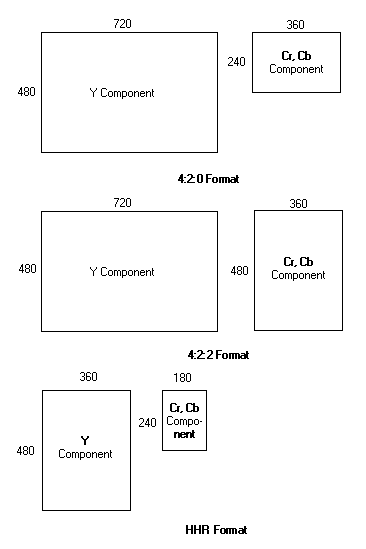
    What's 4:2:2 and HHR MPEG-2?
    When MPEG-2 encodes color and picture information, it samples the analog picture at certain resolution both as horizontal and vertical pixels, but seperately as color (chrominance/hue) and brighness (luminance). The DVB specification calls for 4:2:0 encoding which put simply means that the resolution of the color information is one quarter of the resolution of the video information.
    Since studios need better quality than DVB offers, an extension to MPEG-2 has come about that isn't part of the DVB spec but has its own specialized defintion within the MPEG-2 standard. This is called 4:2:2 format or MP@4:2:2SP meaning "Main Profile 4:2:2 Studio Profile". In this system, double the amount of vertical color information is transmitted.
    Another format exists that is in very common use today. Called HHR for half horizontal resolution, this part of the MPEG-2/DVB standard transmits only half of the normal 720 pixel horizontal resolution while maintaining normal vertical resolution of 480 pixels (although, since it's 4:2:0 format, the color information is only encoded at 240 pixels vertically and 176 pixels horizontally. A lot of the smaller DBS (like the ethnic packages on T5 etc) use HHR format since it dramatically reduces the bandwidth needed for channels - of course at the expense of picture quality. Special logic in the video decoder chip in the set top box, re-expands the picture to its normal horizontal size by interpolation prior to display.
    4:2:2 video at Standard Definition looks just as good as the NBC analog feeds on GE-1 Ku. High bandwidth 4:2:0 video like the NBC digital feeds on GE-1 Ku come very close to studio quality and the low bandwidth stuff encoded in HHR format, looks a lot like VHS quality.
    The following diagram shows the ratios of 4:2:0, 4:2:2 and HHR resolutions. I could explain why the ratio used for 4:2:0 is written as 4:2:0 but that gets mega-complex and is beyond the scope of this document.


    FOCUS SAT-UPC;RCS-digital cablu;ADSL;BAYERN MUNCHEN&AC MILAN;
    .de

  8. #8
    Standard RSP member gessle's Avatar
    Join Date
    31 Jan 2007
    Location
    tg ocna;jud. BACAU
    Posts
    719
    Mentioned
    0 Post(s)
    Rep Power
    74

    Default Re: ABC-ului receptiei prin satelit!

    MPEG-2 Sample Shots When using DVB2000 software on a Nokia Mediamaster receiver and a PC equipped with a SCSI bus and DVBEdit, it's possible to capture the recontstructed video directly out of the MPEG-2 decoder's buffer memory. In the following screen shots from Dish Network, you can see how each of the individual components of the picture are transmitted and how pan/scan is used to interpolate both the base video and chroma information.


    What you see But as you can see, the horizontal resolution isn't full frame. Dish Network uses 480x480 resolution. The luminance is sent at the same 480x480 resolution. But the resolution of the blue signal is much lower As is the red component The MPEG-2 Transport Stream
    As mentioned above, MPEG-2 transmissions are either transmitted as SCPC or MCPC feeds. However, at an individual channel level, both techniques use the same method for building a data stream containing the video, audio and timing information. In this section, I'll concentrate on MCPC because once this is understood, SCPC becomes obvious. This combination of compressed video and audio is called the PES or Packet Elementary Stream and is built as follows:
    FOCUS SAT-UPC;RCS-digital cablu;ADSL;BAYERN MUNCHEN&AC MILAN;
    .de

  9. #9
    Standard RSP member gessle's Avatar
    Join Date
    31 Jan 2007
    Location
    tg ocna;jud. BACAU
    Posts
    719
    Mentioned
    0 Post(s)
    Rep Power
    74

    Default Re: ABC-ului receptiei prin satelit!

    The time field isn't the actual time that the encoding was done, but timing information to allow the audio and video to stay synchronized together. This part of the PES is called the PCR (Program Clock Reference) and may be sent either as part of the video stream or as a seperate stream (hence the reason that some MPEG-2 receivers like the d-box have a seperate field for the PCR).
    Multiple PES streams get multiplexed together into a faster stream and the System Information or SI stream gets added, resulting in the final MPEG-2/DVB multiplex that gets uplinked to a transponder on the satellite:
    The SI is responsible for telling the receiver all kinds of useful information about the data stream, so that the receiver can write the appropriate data into its program guide. The first part of the SI is called the Program Association Table or PAT. The PAT is always transmitted on PID 0000 and contains a list of Program Map Tables or PMTs that are part of the data stream. For example:
    PAT (PID 0000) = 0100, 0200, 0300, 0400
    PMT 1 (PID 0100) = Video PID 0101, Audio PID 0102, Audio PID 0103, PCR 01FF
    PMT 2 (PID 0200) = Video PID 0201, Audio PID 0202, PCR 01FF
    PMT 3 (PID 0300) = Video PID 0301, Audio PID 0302, PCR 02FF
    PMT 4 (PID 0400) = Video PID 0401, Audio PID 0402, PCR 0401
    Given this information, the receiver knows that the DVB transport on the current frequency contains four programs. The first channel contains two audio services (perhaps for multiple languages) and all of them except for the fourth program contain seperate timing information - the fourth has the PCR timing embedded into its video stream.
    The reason that the PCR might be transmitted seperately from the video stream is in the case of multiplexed channels which were encoded with a common clock reference. In this case, it would be redundant to send the PCR again, since the reciver would always use the same clock refernece for all the signals within the multiplex. In the above example, one might assume that the first three video channels came from a common encoder and the fourth stream was multiplexed in, perhaps after being received from an SCPC feed or line-line and not re-encoded prior to multiplexation.
    Thanks to Scott Bidstrup at Vyvx for his contributions relating to the above.
    Obviously, the PMT contains other information, such as pointers to the name of the channel in the SDT table and things like information about data services that might be mutliplexed in as part of the PES. But in addition to the PAT and PMT, there are a few more interesting ones. The Network Information Table (NIT) on PID 0010 contains a list of associated transponders that make up the package along with their SR and FEC values, which can be different.
    When doing a search on a single channel on the Echostar DBS service, most smart MPEG-2 receivers (like the d-box) will automatically go off and search the other frequencies used by Echostar since the NIT on each transponder points to all the other transponders. The NIT can also point to transponders on other satellites, so that in the case of Echostar, the receiver would know to switch to another dish to receive programming from the Echostar 3 DBS satellite at 61.5 degrees when you tune the receiver to a channel carried on this satellite. In its own strange and totally non-standard way, Digicipher 2, uses a similar technique to allow the 4DTV receiver to know where other satellites are and turn to them when a particular channel is chosen.
    Now the receiver knows all the frequencies associated with a package, there are few other PIDs that make a DVB receiver work the way it does. The optional BAT or Boquet Association Table tells the receiver about programs of the same type (such as sporting events, movies, news etc.) that are part of the package. Echostar uses this part of DVB for their "Themes" menu. The EIT or Event Information Table on PID 0012 contains a list of the programs (or events) that when interpreted by the receiver's firmware, make the program guide. The EIT allows for up to two weeks worth of programming to be sent ahead of time.
    And finally, if you wondered how MPEG-2/DVB receivers know what the time is, the TDT (Time and Date Table) tells the receiver what the date and time is in Universal Time - the smartcard or non-volatile memory in the receiver contains the UTC offset, so that you see local time on the screen.
    SCPC signals are transmitted pretty much the same way as MCPC, but obviously only contain one PES since they occupy less bandwidth. Because SCPC channels are normally feeds, they typically do not carry many of the DVB SI streams such as the NIT, BAT and EIT.
    What about moving MPEG-2 transport streams around facilities?
    At sites where MPEG-2 transport streams are processed, there are a number of different interfaces used to move transport streams between devices. It's worth mentioning some of them since they come up from time in discussions about professional-level equipment.
    DVB-ASI: This is a local area (300 metres) serial interface is based on coaxial cable. The data is simplex (i.e. from one device to another - not the other way around) and runs at 270 Mbps, although due to overhead the actual data rate is around 240 Mbps.
    DVB-SPI: Again, a local network typically used to interconnect professional MPEG-2 equipment. Data is sent in parallel using LVDS (Low-Voltage Differential Signaling) balanced transmission. Data rates up to 40 MBps (B = bytes b = bits) can be used with this interface over short distances (a few metres).
    ATM: ATM networks are WAN, MAN or LAN (Wide, Metropolitain and Local Area) networks used by communications companies as the protocol on fibre (and other) high speed networks. ATM has 53 byte packets, 48 of which are available for payload. When using AAL1 (one of the possible standards for transmitting MPEG-2 over ATM networks), the payload for data is 47 bytes, so one 188-byte MPEG-2 packet can fit exactly in four ATM cells. This is the main reason for the 188 byte packet length used in MPEG-2. As a side-note, frequently another standard called AAL5 is used to encapsulate DVB packets over ATM networks - in this mode, two MPEG-2 packets plus 8 bytes of overhead adds up to 384 bytes which fits nicely into the payload of eight ATM cells.
    Thanks to Michael Clawson and Paolo Bevilacqua for info about the AAL5 encapsulation
    Time Division versus Statistical Multiplexing
    When MPEG-2/DVB carriers broadcast Multiple Channels Per Carrier (MCPC), packets for each of the channels within the transponder are mixed into the higher rate stream that's carried on the transponder. This process is called multiplexing and can be done two different ways. Before we get into how the two work, it's good to have an understanding of how the uplink works.
    At the uplink, signals that are to be carried on the service are first received. This can be via a number of different methods such as from another satellite, off air antenna or via a leased line circuit. As an example, many of the DISH Network local channels are sent back to Cheyene in MPEG-2/DVB format using 45Mbs T-3 leased lines.
    The signals are then converted back to composite video by decoding incoming any digital inputs which may be either in MPEG-1, MPEG-2, Digicipher 1 or Digicipher 2 - obviously the analog video is already in composite format.

    Next, the analog video and audio is re-encoded using very expensive encoders which generate an MPEG-2/DVB video and audio stream. This stream along with the other streams that will make the channels on the transponder and then multiplexed together and the System Information and Conditional Access streams are inserted before the resulting stream is modulated onto QPSK DVB-complaint carrier and transmitted up to the satellite.
    At first, you may think that it's rather wasteful to decoded and then re-encode the signals that are already in digital format. However, this is done to allow the uplinker control of how much bandwidth his system has allocated fo the particular channel.
    Also keep in mind that the DVB-SI and CA streams are transmitted in parallel across all transponders within the system (even across multiple satellites at different orbital locations). Obviously, this is wasteful from a bandwidth perspective, but it's a necessary evil to keep the EPG and authorization of the receiver working.
    Graphically, the resulting stream looks something like the diagram below.
    Time Division Multiplexing
    In the TDM system the bandwidth is divided up at a fixed rate for each of the streams on a particular transponder. The uplinker has to make some decisions about how much bandwidth to allocate to each channel taking into consideration the type of programming that will be carried on each channel. For example, the DISH Network system uses SR 20.000 MS/s FEC 3/4 on its transponders. This results an available bitrate on each transponder of about 28Mb/s:
    20.000MS/s = 40.000Mb/s
    Minus 3/4 convolutional coding = 30.000Mb/s
    Minus 188:204 Reed-Solomon coding = 27.647Mb/s
    FOCUS SAT-UPC;RCS-digital cablu;ADSL;BAYERN MUNCHEN&AC MILAN;
    .de

  10. #10
    Standard RSP member gessle's Avatar
    Join Date
    31 Jan 2007
    Location
    tg ocna;jud. BACAU
    Posts
    719
    Mentioned
    0 Post(s)
    Rep Power
    74

    Default Re: ABC-ului receptiei prin satelit!

    Given that the uplinker wants to make a certain number of channels on this transponder, he might choose a scheme like:
    Movie Preview Channel 3Mb Cable Channel 3.5Mb Sport Channel 4Mb Sport Channel 4Mb Movie Channel 4.5Mb PPV Channel 4.5Mb News Channel 3Mb Audio Channel 128Kb Audio Channel 128Kb Audio Channel 128Kb Audio Channel 128Kb Audio Channel 64Kb Audio Channel 64Kb Audio Channel 64Kb Low-speed Data Service 19.2Kb High-speed Data Service 512Kb DVB-SI (EPG, authorization etc) 630Kb Firmware Update 128Kb Total 27.993Mb Unused (null PID) 7Kb
    The problem with TDM is that channels that are given low bandwidth tend to contain lots of overcompression artifacts when there is too much motion, many frame changes or huge differences in luminosity. Additionally, when high bandwidth channels contain very compressable video, their bandwith is lost.
    Statistical Multiplexing
    Statmux in MPEG-2/DVB systems is very new - the second generation encoders only hit the streets a few months ago. The only service known in North America to be using statmux at this time is DISH Network, where it has made a huge difference to the quality of the video and at the same time allowed all the transponders FEC to be backed down to 3/4, therefore improving rain fade performance.
    Statmux encoders in-effect "talk" to each other about the amount of bandwidth required for the video they are currently compressing and they share this information with a central processor that talks to the other encoders and knows some basic rules, like the amount of space to allocate for fixed rate services, like the DVB-SI etc.
    The end result is that a particular channel's bandwidth utilization might be 6Mb one second and 2Mb the next, depending on how much bandwidth that particular channel needs at that time. Obviously, there is still an upper limit to the number of channels that can be transmitted on each transponder, but the number is generally increased by going to statmux encoders since the bandwidth is now shared.


    When buying an MPEG-2 receiver from Europe, there are a number of terms used there that need to be understood in order to use a receiver designed for that market.
    Ku-Band is King
    In Europe, the most common way of transmitting feeds and video programming is via Ku-Band and not C-Band as it is here in North America. The reason for this simple - a) Ku-Band dishes are smaller and therefore easier to install b) the geographical distances there are much smaller than in North America c) if a signal is targeted towards say the Balkan states (Bulgaria, Romania, Albania etc.), a beam can be used for these services because generally no-one outside of these areas will want to receive the signals. The beam results in a stronger signal on the ground, which improves signal quality and therefore can also reduce the size of the receiving dish.
    C-Band is used in Europe, however, it's typically used for Arabic feeds (again a large geographical area) and for hemispheric feeds (for example, the Deutche Welle feed on Intelsat at 1 west that covers all of Europe and Africa).
    Because Ku-band is so popular in Europe, most people use an offset-style dish with a combined LNB and feedhorn (an LNBF). The LNBF uses variation of the supply voltage to switch between horizontal and vertical polarity (14v = vertical, 18v = horizontal). In the US, Echostar and DSS use the same technique to switch between left-hand and right-hand circular polarization.
    Frequency Bands
    In North America, Ku-Band is split into two bands. The FSS band covers 11.7-12.2 GHz and is used for some DBS services (ex-AlphaStar and Primestar), but also for video feeds between TV stations and data services. The DBS band is designed only for direct to home applications and uses 12.2-12.7GHz.
    When DBS started in the Europe, the initial band was 11.2-11.7 GHz, however, this has now been expanded to cover from 10.7 to 12.7 GHz, all for direct to home services.
    Intermediate Frequencies and LOs
    Initial satellite receivers available in Europe received in the range 950-1450MHz. This meant that the LNB contained a local oscillator frequency of 10.25 GHz (10.25 GHz + 950 MHz = 11.2GHz). When the band was extended down to 10.7GHz, this meant that the receivers had to change in order to receive all the programming. This meant that the IF was extended with the range 950-2100MHz with an LO frequency of 9.75 GHz.
    Next, along comes digital TV, which occupies the 11.7 to 12.7 GHz band. Trying build a tuner and LNB that handles the entire range of 10.7 to 12.7 is impossible, so therefore the LNB contains two LOs - one at 9.75GHz and the other at 10.6GHz. This type of LNB is called a Universal and it is switched between the two LO frequencies by the receiver modulating a 22KHz tone onto the power supply for the LNB.
    Diseqc and Hot Bird
    In Europe, the major orbital location for DBS services (both analog and digital) has always been the Astra slot at 19.2 east. The Astra fleet currently comprises six co-located satellites with more planned. All the satellites are owned by Astra, based in Luxembourg, who then lease the transponder time to programmers.
    The other major European satellite consortium is Eutelsat (based in Paris) and they recently decided to also get into the direct to home market, much like Astra has. They currently have three high power satellites (called Hotbird) co-located at 13 east with more on the way.
    Because of only a difference of 6.2 degrees between the two satellites, many Europeans that want to receive from both satellites use two LNBs pointed at the same dish with an adaptor to point each at the correct satellite. Obviously, switching between the two LNBs requires either a manual switch or something a bit more high-tech.
    Diseqc (DIgital Satellite EQuipment Control) fills this gap by modulating digital commands onto the 22KHz signal that is used to switch between bands. With a Diseqc compatible receiver (like the d-box with its latest version of software), it is possible to have the receiver send a command to a switching device mounted at the dish to switch between the Astra and Hotbird LNBs without the effort of running an extra cable. With the correct external 12v switchbox and a 4 to 1 Diseqc switch box, it's possible to connect up to eight LNB inputs to many modern receivers. In the future, Diseqc will offer bi-directional communications between the receiver and equipment at the dish for features such as dish motorization and switching into circular modes.
    The Astra 1D Frequency Extender (ADX)
    When Astra 1D launched, it had sixteen transponders that were below the regular direct to home band, i.e. in the 10.2-10.7 GHz range. Because most receivers that were already in use couldn't tune the band, the ADX was invented. It shifts the IF frequency up or down by 500MHz.
    In North America, most people use Ku-Band LNBs with a local oscillator frequency of 10.750GHz, which results in the tuning of 11.7-12.2 GHz with an IF frequency of 950-1450MHz. A few satellites (Intelsat K for example) have Ku-Band transponders below the normal North American range, so by using an ADX, the transponders below 11.2 GHz can be received by shifting the 11.2-11.7 GHz band up by 500MHz.
    Typically, the maximum extra range that can be reached with a regular LNB is about 150MHz. You can tune down to about 11.55GHz, but that's enough for the transponders on Intelsat K, which include a few SCPC MPEG-2 signals.
    Another North American use for ADXes is if you use a wide band LNB for Ku-Band that has a standard LO of 10.75GHz, but an output range of 950-2100 MHz. Here, you use an ADX to shift down the 11.7 to 12.2 GHz band by 500MHz to make it match the 950-1450MHz IF of most North American receivers.
    The ADX does cause a couple of band edge spurious signals at the bottom of the band, but generally works very well. I've heard of people using it with a wide band Ku-band LNB on a big dish and getting a signal lock on Echostar 1/2 by shifting down the DBS band at 119 degrees. It's rather weak because of the mismatch of circular versus linear polarization though.
    What can be received with Echostar and AlphaStar receivers
    Not too much really. Both receivers are package receivers and therefore have fixed SR and FEC values. However, if you peruse Lyngesat, you'll most probably find something that matches.
    Info about the Echostar Receiver
    The Echostar receiver uses SR 20.000 with automatic FEC. Because it was designed to operate in the DBS band (12.2 to 12.7 GHz), it uses a local oscillator frequency of 11.25 GHz in the LNBF. Remember that the Echostar DBS satellites use circular polarity and uses the 14v and 18v technique to switch between right and left hand.
    There are a few signals (other than Echostar's own) that will work with Echostar receivers.
    One is the Microspace package on GE-1. Hook the receiver up to an LNB pointing at GE-1 Ku and tune to transponder 16. If you're using an LNB with a feedhorn, set for horizontal polarity. If you're using an LNBF, physically rotate the feedhorn by 90 degrees. You'll get a lock and the program guide will show lots of channels. Sad to say, there are all scrambled.
    Echostar receivers will also lock onto ExpressVu on Nimiq Ku-Band. This isn't surprising as ExpressVu buys their receivers and LNB's from Echostar - the hardware is identical. Unfortunately, ExpressVu is scrambled, with the exception of the 30 "Galaxie" music channels. Unfortunately, you won't be able to see the music channels on the channel map unless you subscribe (or use an FTA MPEG2 receiver).
    The third option is the SkyVista programming package on Telstar 5. The SkyVista programming package is a joint venture by Loral Skynet and Echostar, using EchoStar hardware. SkyVista requires the use of a KU Band LNB rather than the circular polarity FSS LNB's used by ExpressVu and EchoStar.. Like Microspace and ExpressVu, SkyVista is scrambled, with the exception of a few arabic channels.
    Info about the AlphaStar Receiver
    This receiver was initially made by Tee-Comm for the AlphaStar DBS service which used a symbol rate of 23.000 and FEC 2/3. Software upgrades since the demise of AlphaStar have made it work with a package uplinked by Spacecom Systems on T5 using the same SR/FEC, but this receiver is also being used for a Chineese package on T5 with SR 20.000 FEC 3/4, so obviously someone knows how to change the SR/FEC on this box by changing the firmware.
    It was also used very briefly in Europe where a Dutch distributor re-wrote the firmware to use variable SR/FEC, along with making the menus in Dutch. Since the Tee-Comm 1000 uses the Nokia tuner, it can actually handle SR from 1-45MS/s. It was never sold though, since Multichoice (now Canal+) wouldn't license the CA to the distributor, which does seem rather odd, since AlphaStar used the same IRDETO CA as Multichoice.
    Conditional Access - The Key to Private and Pay-TV Systems
    Conditional Access (CA) is used to prevent unauthorized access to either private or pay-TV systems.
    Note: As you will have read at the start of this document, this site does not provide any information relating to compromising scrambled signals. We do explain how CA systems work in general, but don't expect to find hacking information here.
    How is Conditional Access on DVB-systems performed?
    In the DVB specification, there are only a few of the stream types that must be transmitted without scrambling. Obviously, these only include some of the Systems Information streams such as the Program Association Tables (points to more info about each channel) and the Network Information Table (points to the other transponders used by the service). These streams must be transmitted without scrambling so that any DVB compliant receiver can at least tell "what's there". However, everything else (including the program guide streams in the EIT) can be scrambled.
    Scrambling of the appropriate streams is performed at the uplink site. The MPEG-2 packets are encrypted by the usual techniques, based on a common key known to both the scrambling and decryption devices. The actual scrambling technique, i.e. how the bits are rearranged to make them nonsensical, is obviously kept a secret, as are the keys contained in both the scrambling computer and the decryption device (typically, a smartcard in DBS applications).
    When a scrambled packet arrives, before it passed through to the demultiplexor, it's first sent through the CAM or Conditional Access Module. The CAM is the descrambling engine and can be either built directly into the receiver or inserted into the receiver via a PC Card (aka PCMCIA) connector. At the start of each MPEG-2 packet is a 2-bit field called the TSF or Transport Scrambling Flags - if zero or one, the packet is passed through the CAM onto the demux for display since this value indicates an un-scrambled stream. If the TSF is set to either two or three, then the packet is passed through to the CAM, which takes the key obtained from the smartcard and uses it to turn the packet packet back into an MPEG-2/DVB transport packet which can then be processed by the rest of the system.
    Many people think the smartcard and CAM are the same thing. These are two different entities - the DVB transport cannot be sent through the serial card - the serial interface it way too slow! Instead, based on the card receiving authorization from the service provider (using the DVB EMM and ECM tables), the card will emit the keys required by the CAM which are in turn used to descrambled the program stream. Most smartcard's serial interfaces operate in the 9,600 to 38,400 bps range.
    Obviously, the key used to scramble the channel changes over time. If you look at the serial communications between the CAM and the smart card with an oscilliscope, you will see a burst of data every few seconds. This is the CAM asking the smart card for the next set of decryption keys for the next few second's worth of video. This also explains why, on most systems, if you pull out the smart card, you'll often see a second or two worth of programming before the picture blanks out.
    FOCUS SAT-UPC;RCS-digital cablu;ADSL;BAYERN MUNCHEN&AC MILAN;
    .de

  11. #11
    Standard RSP member gessle's Avatar
    Join Date
    31 Jan 2007
    Location
    tg ocna;jud. BACAU
    Posts
    719
    Mentioned
    0 Post(s)
    Rep Power
    74

    Default Re: ABC-ului receptiei prin satelit!

    Why is some signal scrambled and yet another isn't?
    Mostly to protect distribution rights. For example, RTPi and Deutche Welle on PAS5 (58 west) are unscrambled since both of these are public information channels transmitted for worldwide distribution and for use by pretty much anyone without fee, much like in the way that NASA TV is a free channel that anyone can redistribute without cost nor license.
    Dish Network transmits their "Dish Information" barker channel without scrambling - that way, even if a card swap has occurred due to a hack on their security system, when an out of the box receiver powers up for the first time, it gets the barker channel, therefore verifying the correct operation of the receiver.
    However, Dish Network also transmits many other interesting streams without scrambling, such as their audio channels. Despite the lack of scrambling, they do actually charge for these channels since the Nagravision security system has the ability to "hide" channels from the user if they are not subscribed. With an "official" receiver, the channels can't be received without a subscription and it obviously saves a lot of hardware for scrambling these streams that really are "low value". In effect, this is "Poor Man's" scrambling.
    How can I subscribe to a certain signal?
    Generally, unless it's a signal from an established Pay-TV provider, you can't. Many signals are encrypted for private or exclusive cable distribution and as a result cannot be subscribed to even if you have the right hardware. Many feeds in Canada use the Scientific Atlanta PowerVu scrambling system and even with the right receiver and an address in Canada, you still can't subscribe to many of the channels which are available on cable.
    DCII - The "other" MPEG-2 satellite standard
    Well, OK, there's DSS in North and South America along with ISDB in Japan, but one of the major video distribution methods in North America is Motorola's Digicipher II standard.
    What's Digicipher?
    Digicipher is Motorola's proprietary video distribution system. The first version was a totally non-standard system called Digicipher I and was one of the first digital video compression systems available in the market. The largest Digicipher I user was the Primestar direct-to-home system which closed down in 2000 after the company was purchased by DirecTV. There are two or three other DCI multiplexes available in North America - mostly feeds for South America that are receivable on global beams.
    Digicipher II is Morotola's MPEG-2 based distribution system. It's used by about 70% of "cable" channels in North America to distribute their video to cable headends, other satellite companies like DirecTV and Dish Network and also available to backyard dish owners via Motorola's 4DTV satellite receiver products. DCII is also used by Canada's StarChoice direct-to-home service.
    DCII includes an uncompromized encryption and authorization system.
    What's different between DVB and DCII?
    Both systems are based on the MPEG-2 standard. Both use the MPEG-2 transport stream format, so both have a Program Association Table (PAT) and Program Map Tables (PMTs) along with elementary data multiplexed onto various PIDs.
    The video format used by DCII can be just as varied as DVB - 720x480, 480x480, 576x480 and so on. DCII also supports 4:2:2 video and HDTV like DVB.
    Moving onto audio, DVB's primary audio format is MPEG-1 Level 2, also called Musicam. DVB optionally supports the AC3 standard from Dolby (otherwise known as Dolby Digital) but DCII requires AC3 for all audio streams. This doesn't mean that all DCII channels are using 5.1 surround - most channels transmit "2.0" format encoded with analog Dolby Suround.
    Where DVB and DCII are really different is in how the channel definitions get into the receiver. DCII was designed before the DVB standard was ratified and General Instrument (now a part of Motorola) designed their own scheme without any interfacing to the work being done by the DVB team was doing and as a result, we have two totally different standards to deal with. This part of a digital TV system is called the SI or System Information.
    What SI differences are there between DCII and DVB?
    During this discussion, keep in mind the two major places where DCII and DVB are used: DCII in the consumer realm where a receiver is hooked up to a motorized dish and DVB in the Dish Network model where an electronic switch is used to switch between stationary dishes pointed at differental orbital locations.
    So, the fresh receiver gets turned on and due to factory programming and correct installation, is able to receive a "homing" channel. The homing channel contains all the info needed by the receiver to tune any one of the channels that the receiver can receive.
    In the case of DVB, this means a Network Information Table (NIT - used to tell the receiver about other transport streams - contains frequency, symbol rate, orbital location etc), the Service Description Table (SDT - used to tell the receiver the names and types of programming available on each channel) along with the Time and Date Table (TDT - tells the receiver about programming events on the channels - used to build the electronic program guide).
    DCII is a little more complicated. First, there's a thing called the Satellite Definition Table (SDT - tells the receiver about the name and orbital locations of satellites), next there's the Modulation Mode Table (MMT - lists the different symbol rate, FEC and modulation types used by DCII) and then the Carrier Definition Table (CDT - this just lists the L-Band frequencies required to tune a channel) followed by the Transponder Defintion Table (TDT - lists the polarity and CDT table index). Finally, the Virtual Channel Table (VCT) is the thing that ties everything together. This lists each channel on the entire DCII system across multiple satellites and contains an index the appropriate TDT, SDT, MMT and CDT tables so that the receiver can select the correct channel analog or digital. If the channel is digital, the VCT also contains the MPEG-2 Program Number (although it's called Service Number in Motorola parlence) so the receiver can process the MPEG-2 PAT and PMT to acutally display the program. Whew!
    A simpler way to look at the differences is that DVB uses a flat list (much like a comma seperated file with lots of repetition) whereas DCII uses a very relational table structure (much like a SQL database over satellite).
    What are these DCII modulation types?
    DVB is pretty straight forward - it's pretty much always QPSK modulation at variable symbol rates and FEC coding. There have been enhancements to the DVB standard to support BPSK, 8PSK and 16QAM modulation modes. BPSK is like QPSK but only transports one bit per time period and is therefore more robust on degraded links. 8PSK and 16QAM increase the data rate by using more than two bits per time period but require a much more robust link than QPSK.
    DCII has a number of different modes. First, there's regular-QPSK and Offset-QPSK. Offset-QPSK is quite similar to normal QPSK but one of the bits in the symbol is delayed by one bit period and phase changes are limited to 90 degrees, making performance in a non-linear environment much better than QPSK. All DCII signals with a symbol rate less than 19.51 MSps use OQPSK - anything above uses QPSK. In the DCII system, the encoders and receivers have pre-programmed symbol rates. For example, the 3.25 MSps rate supports one 576x480 video stream and one audio stream; the 4.88 MSps rate supports two 352x480 video streams and associated audio streams and so on.
    There's one other variable for a DCII signal - it's mux mode. As you probably know from reading this document, the higher the symbol rate, the higher the actual bitrate that can be carried across the channel but this also depends on the FEC coding rate - the less fraction of the datarate used for error correction, the higher still the bitrate, so a 19.51 MSps 3/4 stream carries less data per second than a 19.51 MSps 7/8 stream.
    In regular QPSK, the data is recovered from both the I and Q phases that make up a QPSK symbol, i.e. each bit on the I and Q phases ends up as a serial bit in the transport stream. Because of limitations in either the QPSK demodulator or the transport stream demultiplexor, most DCII streams with a rate above 19.51 MSps 4/5 FEC coding operate in "split" mode. In split mode, the I phase contains a transport stream and the Q phase contains another different transport stream. It's not really true QPSK but more like dual-BPSK. The Mode Modulation Table sent as part of the DCII SI contains an indication as to whether the transmission is using QPSK or OQPSK and whether it's the regular "combo" mode or split mode.
    Thanks to Mark Hemstad for info about OQPSK.
    There is one exception to this rule. Some DCII signals use a symbol rate of 29.27 MSps and yet operate in combo mode. One assumes that Motorola was able to correct the limitations that caused them to invent split mode, however, the bad news is that the only receiver that can do this high-speed mode (Motorola calls it MegaStream) is the DSR-4800 which is an expensive commercial receiver. It's worth pointing out that CBS uses MegaStream for it's HDTV network feeds which explains why they can't be received by consumer DCII receivers and the 4DTV HD decoder.
    What's the "channel map" issue with DCII?
    Remember when you first turn on a new DCII consumer receiver, it needs to be tuned to a homing transponder so it can download all the appropriate tables that allow it to tune channels. Because 4DTV receivers don't allow manual control of the tuning and video parameters, the only way for a receiver to get told what channels are out there is for Motorola to include them in the channel maps they send on the homing transponders.
    Motorola used to be quite friendly towards the 4DTV receiver owner and included many channels such as PBS's PBS You and PBS Kids as part of the 4DTV channel maps. However, despite their unscrambled transmission on satellite, PBS insisted that Motorola remove them from the maps being sent to 4DTV receivers and as a result, 4DTV receivers can only tune one of the many PBS feeds that are available and free-to-air.


    Why is some signal scrambled and yet another isn't?
    Mostly to protect distribution rights. For example, RTPi and Deutche Welle on PAS5 (58 west) are unscrambled since both of these are public information channels transmitted for worldwide distribution and for use by pretty much anyone without fee, much like in the way that NASA TV is a free channel that anyone can redistribute without cost nor license.
    Dish Network transmits their "Dish Information" barker channel without scrambling - that way, even if a card swap has occurred due to a hack on their security system, when an out of the box receiver powers up for the first time, it gets the barker channel, therefore verifying the correct operation of the receiver.
    However, Dish Network also transmits many other interesting streams without scrambling, such as their audio channels. Despite the lack of scrambling, they do actually charge for these channels since the Nagravision security system has the ability to "hide" channels from the user if they are not subscribed. With an "official" receiver, the channels can't be received without a subscription and it obviously saves a lot of hardware for scrambling these streams that really are "low value". In effect, this is "Poor Man's" scrambling.
    How can I subscribe to a certain signal?
    Generally, unless it's a signal from an established Pay-TV provider, you can't. Many signals are encrypted for private or exclusive cable distribution and as a result cannot be subscribed to even if you have the right hardware. Many feeds in Canada use the Scientific Atlanta PowerVu scrambling system and even with the right receiver and an address in Canada, you still can't subscribe to many of the channels which are available on cable.
    DCII - The "other" MPEG-2 satellite standard
    Well, OK, there's DSS in North and South America along with ISDB in Japan, but one of the major video distribution methods in North America is Motorola's Digicipher II standard.
    What's Digicipher?
    Digicipher is Motorola's proprietary video distribution system. The first version was a totally non-standard system called Digicipher I and was one of the first digital video compression systems available in the market. The largest Digicipher I user was the Primestar direct-to-home system which closed down in 2000 after the company was purchased by DirecTV. There are two or three other DCI multiplexes available in North America - mostly feeds for South America that are receivable on global beams.
    Digicipher II is Morotola's MPEG-2 based distribution system. It's used by about 70% of "cable" channels in North America to distribute their video to cable headends, other satellite companies like DirecTV and Dish Network and also available to backyard dish owners via Motorola's 4DTV satellite receiver products. DCII is also used by Canada's StarChoice direct-to-home service.
    DCII includes an uncompromized encryption and authorization system.
    What's different between DVB and DCII?
    Both systems are based on the MPEG-2 standard. Both use the MPEG-2 transport stream format, so both have a Program Association Table (PAT) and Program Map Tables (PMTs) along with elementary data multiplexed onto various PIDs.
    The video format used by DCII can be just as varied as DVB - 720x480, 480x480, 576x480 and so on. DCII also supports 4:2:2 video and HDTV like DVB.
    Moving onto audio, DVB's primary audio format is MPEG-1 Level 2, also called Musicam. DVB optionally supports the AC3 standard from Dolby (otherwise known as Dolby Digital) but DCII requires AC3 for all audio streams. This doesn't mean that all DCII channels are using 5.1 surround - most channels transmit "2.0" format encoded with analog Dolby Suround.
    Where DVB and DCII are really different is in how the channel definitions get into the receiver. DCII was designed before the DVB standard was ratified and General Instrument (now a part of Motorola) designed their own scheme without any interfacing to the work being done by the DVB team was doing and as a result, we have two totally different standards to deal with. This part of a digital TV system is called the SI or System Information.
    What SI differences are there between DCII and DVB?
    During this discussion, keep in mind the two major places where DCII and DVB are used: DCII in the consumer realm where a receiver is hooked up to a motorized dish and DVB in the Dish Network model where an electronic switch is used to switch between stationary dishes pointed at differental orbital locations.
    So, the fresh receiver gets turned on and due to factory programming and correct installation, is able to receive a "homing" channel. The homing channel contains all the info needed by the receiver to tune any one of the channels that the receiver can receive.
    In the case of DVB, this means a Network Information Table (NIT - used to tell the receiver about other transport streams - contains frequency, symbol rate, orbital location etc), the Service Description Table (SDT - used to tell the receiver the names and types of programming available on each channel) along with the Time and Date Table (TDT - tells the receiver about programming events on the channels - used to build the electronic program guide).
    DCII is a little more complicated. First, there's a thing called the Satellite Definition Table (SDT - tells the receiver about the name and orbital locations of satellites), next there's the Modulation Mode Table (MMT - lists the different symbol rate, FEC and modulation types used by DCII) and then the Carrier Definition Table (CDT - this just lists the L-Band frequencies required to tune a channel) followed by the Transponder Defintion Table (TDT - lists the polarity and CDT table index). Finally, the Virtual Channel Table (VCT) is the thing that ties everything together. This lists each channel on the entire DCII system across multiple satellites and contains an index the appropriate TDT, SDT, MMT and CDT tables so that the receiver can select the correct channel analog or digital. If the channel is digital, the VCT also contains the MPEG-2 Program Number (although it's called Service Number in Motorola parlence) so the receiver can process the MPEG-2 PAT and PMT to acutally display the program. Whew!
    A simpler way to look at the differences is that DVB uses a flat list (much like a comma seperated file with lots of repetition) whereas DCII uses a very relational table structure (much like a SQL database over satellite).
    What are these DCII modulation types?
    DVB is pretty straight forward - it's pretty much always QPSK modulation at variable symbol rates and FEC coding. There have been enhancements to the DVB standard to support BPSK, 8PSK and 16QAM modulation modes. BPSK is like QPSK but only transports one bit per time period and is therefore more robust on degraded links. 8PSK and 16QAM increase the data rate by using more than two bits per time period but require a much more robust link than QPSK.
    DCII has a number of different modes. First, there's regular-QPSK and Offset-QPSK. Offset-QPSK is quite similar to normal QPSK but one of the bits in the symbol is delayed by one bit period and phase changes are limited to 90 degrees, making performance in a non-linear environment much better than QPSK. All DCII signals with a symbol rate less than 19.51 MSps use OQPSK - anything above uses QPSK. In the DCII system, the encoders and receivers have pre-programmed symbol rates. For example, the 3.25 MSps rate supports one 576x480 video stream and one audio stream; the 4.88 MSps rate supports two 352x480 video streams and associated audio streams and so on.
    There's one other variable for a DCII signal - it's mux mode. As you probably know from reading this document, the higher the symbol rate, the higher the actual bitrate that can be carried across the channel but this also depends on the FEC coding rate - the less fraction of the datarate used for error correction, the higher still the bitrate, so a 19.51 MSps 3/4 stream carries less data per second than a 19.51 MSps 7/8 stream.
    In regular QPSK, the data is recovered from both the I and Q phases that make up a QPSK symbol, i.e. each bit on the I and Q phases ends up as a serial bit in the transport stream. Because of limitations in either the QPSK demodulator or the transport stream demultiplexor, most DCII streams with a rate above 19.51 MSps 4/5 FEC coding operate in "split" mode. In split mode, the I phase contains a transport stream and the Q phase contains another different transport stream. It's not really true QPSK but more like dual-BPSK. The Mode Modulation Table sent as part of the DCII SI contains an indication as to whether the transmission is using QPSK or OQPSK and whether it's the regular "combo" mode or split mode.
    Thanks to Mark Hemstad for info about OQPSK.
    There is one exception to this rule. Some DCII signals use a symbol rate of 29.27 MSps and yet operate in combo mode. One assumes that Motorola was able to correct the limitations that caused them to invent split mode, however, the bad news is that the only receiver that can do this high-speed mode (Motorola calls it MegaStream) is the DSR-4800 which is an expensive commercial receiver. It's worth pointing out that CBS uses MegaStream for it's HDTV network feeds which explains why they can't be received by consumer DCII receivers and the 4DTV HD decoder.
    What's the "channel map" issue with DCII?
    Remember when you first turn on a new DCII consumer receiver, it needs to be tuned to a homing transponder so it can download all the appropriate tables that allow it to tune channels. Because 4DTV receivers don't allow manual control of the tuning and video parameters, the only way for a receiver to get told what channels are out there is for Motorola to include them in the channel maps they send on the homing transponders.
    Motorola used to be quite friendly towards the 4DTV receiver owner and included many channels such as PBS's PBS You and PBS Kids as part of the 4DTV channel maps. However, despite their unscrambled transmission on satellite, PBS insisted that Motorola remove them from the maps being sent to 4DTV receivers and as a result, 4DTV receivers can only tune one of the many PBS feeds that are available and free-to-air.
    FOCUS SAT-UPC;RCS-digital cablu;ADSL;BAYERN MUNCHEN&AC MILAN;
    .de

  12. #12
    Standard RSP member gessle's Avatar
    Join Date
    31 Jan 2007
    Location
    tg ocna;jud. BACAU
    Posts
    719
    Mentioned
    0 Post(s)
    Rep Power
    74

    Default Re: ABC-ului receptiei prin satelit!

    How does DSS handle things like the program guide, network tables etc?
    The DSS system uses a thing called the Master Program Guide (MPG). This stream has all of the information found in the EIT, SDT, NIT, etc. in the DVB system. It tells the IRD what satellite transponders are available and what code rates they have (like DVB's NIT), it tells the IRD which virtual channels exist ("viewer channels") and which PIDs and PID types comprise each channel (rather like the DVB SDT).
    The single MPG gives all of the PID and transponder assignments for all channels and all transponders, and so the MPG is a "one-stop shop" vs. the DVB approach of many smaller tables. The MPG also has two hours worth of programs and program titles, and then "points" to extension guides for data out to two days in the future. New US DIRECTV IRDs also have a feature called "Advanced Program Guide", which works a little more like the DVB EIT and allows program info out to weeks in the future.
    What are the technical differences between DSS and DVB transmissions?
    DSS DVB Transmission Format QPSK QPSK Viterbi Code Rates 1/2, 2/3, 6/7 1/2, 2/3, 3/4, 5/6, 7/8 Multiplex Proprietary - MPEG-2 like (has PIDs) MPEG-2 standard System Information Proprietary DVB Audio Musicam (MPEG-1 layer 2) or AC3 Musicam (MPEG-1 layer 2) or AC3 Video MPEG-2 standard 4:2:0 (MP@ML) MPEG-2 standard 4:2:0 (MP@ML)
    FOCUS SAT-UPC;RCS-digital cablu;ADSL;BAYERN MUNCHEN&AC MILAN;
    .de

  13. #13
    Standard RSP member gessle's Avatar
    Join Date
    31 Jan 2007
    Location
    tg ocna;jud. BACAU
    Posts
    719
    Mentioned
    0 Post(s)
    Rep Power
    74

    Default Re: ABC-ului receptiei prin satelit!

    1) MPEG

    stands for Moving (or Motion) Picture Experts Group & is an organisation of interested parties.It's run in similar manner to JPEG (Joint Picture Expert Group) -JPEG being for still images;there is also a standard known as M-JPEG (Moving JPEG) but this is intended more for the needs of the security industry. How about the fact that discservers, and corresponding high-end editing suites are only just moving from Motion Jpeg to MPEG (4:2:2). As an intra coding only system it has been and still is widely used in these types of video applications.
    MPEG describes a form of compression for digital data where the data represents moving images of a TV like-nature.The standard also allows for audio datastreams sync'd with the video.MPEG1 is common on IBM PC's (& other platforms) using *.mpg files. Xing, Mediamatics & others supply software players for these and all but the cheapest PC VGA cards seem to have some hardware support for MPEG1 files; normally you need a Pentium PC to have much chance of playing mpeg1 files at reasonable speeds (25 frames per second or more). Anyway,mpeg1 isn't used for satellite TV;the industry needed a faster,more flexible & efficient method. For broadcast use, less tendency to pixellation or "blockiness" was desired with fewer "artefacts" -technical/marketing term for unwanted material on the screen (that's a bit like calling a software bug an "anomaly" !!). Now what the satellite industry wanted was to squeeze more channels into the bandwidth taken up by a satellite transponder. Analogue satellite TV uses around 27-36 MHz of bandwidth for its FM video + audio FM subcarriers; this is for each channel. So the operators want to put 5,10 or more separate channels, via a digital datastream into a similar bandwidth. This allows many more channels or needs fewer transponders to transmit a given number of channels. To give flexibility,the actual compression ratio can be varied between "Studio Quality" and "Video recorder quality". Studio needs 12 MBits/second data,broadcast needs 8 MBits, VHS needs 2 MBits/s.I don't want this faq to become too technical but read DVBFAQ.TXT from Markus Kuhn for technical info. Just remember that the compression ratio can be varied to cope with the needs of the supplier of the video information. The digital data from several channels can be multiplexed into an MPEG Transport Stream,along with various (compressed) audio channels (which can include digital surround sound & multiple languages). A package with several channels modulated onto 1 carrier is often referred to as a "bouquet" which is, I guess, a marketing term for such a multiplex or package. The compression ratio used can be different for different channels within the multiplex and can vary over time. The lowest compression ratio will occupy the highest bandwidth but will be needed when the video content requires much detail with lots of changes & movement occurring. A good example might be an athletics event ; you would have people running around the track , people throwing javelins and others just walking slowly or sitting down. Consequently there will not be a lot of redundancy in the whole scene so if too much compression is applied, some movement could easily be displayed jerkily. A studio news broadcast, when they are simply showing the newsreader and his desk, will compress very efficiently & occupy a relatively small bandwidth. So the newscast will be allocated a lower bit-rate & compressed more. The whole process of dynamically allocating bandwidth per channel in a multiplex is known as Statistical Multiplexing & uses quite advanced mathematical algorithms to do its allocation processing.
    Incidentally MPEG1.5 is a hybrid (falling between 1 & 2) but any mpeg2 receiver SHOULD be backwards compatible with older MPEG revisions. Actually MPEG1.5 isn't a real (ratified) standard but covers several proprietary systems which tend to improve on MPEG1 . Examples include "System2000" from NTL & "Orbit" from Scientific Atlanta.
    1 interesting point is that you can't compress "noise" with current MPEG schemes.Imagine watching a film via digital (mpeg) satellite TV where,within the plot of the film,the camera zooms in to show a TV screen switched on but with no antenna connected. You expect to see nothing but noise ("snow)" on the picture.This signal is entirely random & so can't be compressed -there's no repeating pattern/redundancy in the signal. Apparently a future MPEG version (mpeg4 ?) will have some kind of algorithm built in to get around this problem. It looks like the next "official" (ratified) standard will be MPEG4.
    Mpeg2 is also used for DVD (digital video disk or digital versatile disc) & other digital video delivery systems including cable,fibre & digital terrestrial TV.
    MPEG4, when it comes, is a scalable encoding/compression system so that mini versions could output to the tiny screens on mobile phones and PDAs whilst higher resolutions & larger object sizes would output to televisions. It's more flexible than MPEG2 to allow this object-based scalability as well as interactivity where desired. It introduces its own new acronyms like AVO (Audio/Visual Object) & DMIF (Delivery Multimedia Integration Framework). MPEG4 allows for 2D & 3D images & user selection (or ungrouping) of parts of the whole scene - where the originator has permitted this. It will require more powerful processors to implement these procedures in satellite receivers. The picture below attempts to illustrate the concept.


    Modulation & Error Coding

    The real world is analogue so we have to find a way of transmitting our mpeg2 transport stream as information on a (non-digital) carrier wave.A traditional analogue satellite transmission varies a carrier FREQUENCY in sympathy with the video signal -"frequency modulation" or FM. Similar to this ,one can vary the PHASE instead of the frequency - "Phase Modulation".Now we could code our digital signal (which consists of simply binary or "ones & zeros") directly as phase modulation in which case 0 degrees (our carrier reference frequency) could represent a binary 0,whilst 180 degrees phase shift=binary 1; there would be a practical difficulty in keeping track & always changing 180 degrees as there will be natural phase variations over the transmission path. To solve this we can instead make the phase changes cumulative -i.e. make the phase changes refer to the previously signalled state rather than 0/180 degrees absolute. This is known as DPSK -differential phase shift keying. Now those of you who know of schemes used for digital transmission, in modems for example,will know that DPSK is somewhat inefficient. There are various schemes that allow the data rate to be doubled,quadrupled (or more) whilst maintaining the original signalling rate.Thus Quaternary (or Quadrature) phase shift keying uses a 2-bit symbol (instead of previously described 1-bit) based on 4 possible phases. At the same time,0 degrees is avoided to prevent long periods of unmodulated carrier which could cause problems in part of the circuitry -too complex to discuss here. So we use typically 45,135,225 & 315 degrees.We now have a greater data rate in bits per second than our actual baud (signalling) rate. This can ,in fact be further extended by using a constellation of 8 or 16 phases & beyond -although tolerance to noise (required signal to noise ratio for a suitably low bit error rate) & to interference increases as the data rate rises. [This is one reason why computer modems have trouble at high data rates on a poor line & your 56K modem ends up communicating at 31,200 or less]. Other digital transmission media can still use mpeg2 but change from qpsk to a different modulation scheme.Normally this is QAM for cable (although qpsk can be used for the return path back to the operator) whilst digital terrestrial TV uses CODFM -coded orthoganal digital frequency modulation -with either 2048 or 8192 individual carriers each seperately modulated.The choice of type of modulation is made based on the sort of problems most prevalent for the medium,e.g.terrestrial is more subject to multipath interference ("ghosting" in analogue TV) & CODFM is fairly resistant to this.The same type of modulation is also used for DAB (Digital Audio Broadcast). The main figure of merit for a qpsk demodulator is the minimum Eb/No that the receiver can tolerate to deliver a specified BER (Bit Error Rate) to the MPEG section. Eb/No is the ratio of energy per bit to the noise available at the demodulator. So since satellite signals are inherently noisy,a low order modulation scheme is used with lots of error correction. In fact the DVB adopted what is known as a "concatenated FEC" scheme which means that multiple error correction types are used together - in this case "convolutional" & "block" coding are both used. Viterbi coding is a form of convolutional coding (also used in modems) & the "code rate" refers to the ratio of the number of bits coming out for a given number of bits going in. So 3/4 means 3 bits come out for every 4 bits going into the decoder. The DVB uses 1/2 code rate for channels with lots of noise (low Eb/No). The error correction comes from the redundant coding data that is transmitted. The constraint length (k) is the number of bits over which the code is computed ; for DVB K=7. The operator decides which code rate to use & the receiver must either scan for the right rate or be told by the user (manual entry). The block coding scheme used is called Reed-Solomon usually abbreviated to R/S, with additional coding by interleaving blocks of bytes. 204/188 code is used which means 188 bytes come out for 204 in - the remainder being parity bytes.
    FOCUS SAT-UPC;RCS-digital cablu;ADSL;BAYERN MUNCHEN&AC MILAN;
    .de

  14. #14
    Standard RSP member gessle's Avatar
    Join Date
    31 Jan 2007
    Location
    tg ocna;jud. BACAU
    Posts
    719
    Mentioned
    0 Post(s)
    Rep Power
    74

    Default Re: ABC-ului receptiei prin satelit!

    D2MAC :- I am sometimes asked whether D2MAC transmissions (still used by Nordic countries)are digital. In fact the "A" in MAC stands for "Analogue" - MAC = Multiplexed Analogue Component. The (analogue) video luminance & chrominance signals are sent at separate times which avoids the interference seen when they are all sent at the same time in PAL. So the 2 signals cannot mix with each other to generate false alias signals which can show up in PAL - like flashes or stripes of colour often seen on a newsreader's (plain grey or checked) suit or tie. Howebver, there IS a digital part to D2MAC - the sound & the video synchronisation information is sent in digital packets. For the audiophiles, note that the audio is only 14 bit so it isn't quite CD-quality. So a D2MAC signal is a "hybrid", part digital & partly analogue.


    3) DVB

    Like MPEG groups there is a DVB group -Digital Video Broadcast, made up of interested parties, sharing information & setting the standards.It's somewhat like the VESA group for PC graphics. DVB was set up by the EBU (European Broadcast Union) to set the standards for digital video transmission.They have published these via ETSI (European Telecommunications Standards Institute) who also set standards for devices such as GSM telephones. In fact there are several DVB standards for different transmission media.Some of these are : DVB-S Satellite DVB-C Cable DVB-T Terrestrial DVB-SI Specification for Service Information DVB-CI Common Interface for conditional access They've settled on using a subset of MPEG2 for their compression of the video & audio. I've pasted in below a definition of the requirements to be met to claim that your IRD (Integrated Receiver Decoder i.e. satellite box) is DVB compatible :-

    To be DVB compliant a Satellite or a Cable receiver must, according to DVB Document A001-revision 1, at least fulfill the following key features:

    • Systems
      • MPEG-2 Transport Stream is used
      • Service information is based on MPEG-2 Program Specific Information
      • Scrambling is as defined by CA Technical Group
      • Conditional Access uses the MPEG-2 CA_descriptor

    • Video
      • MPEG-2 Main Profile at Main Level is used (1.5-15 Mbits/s)
      • The frame rate is 25 Hz
      • Encoded pictures may have either 4:3, 16:9 or 2.21:1 aspect ratio (4:3 is the normal TV format, 16:9 is the widescreen format and 2.21:1 is the cinemascope format that is use in the movie theaters)
      • IRDs will support 4:3 and 16:9 and optionally 2.21:1 aspect ratios
      • IRDs must support the use of pan and scan vectors to allow a 4:3 monitor to give a full-screen display of a 16:9 coded picture
      • IRDs must support a full screen display of 720 x 576 pixels (and a nominal full-screen display of 704 x 576)
      • IRDs must provide appropriate up conversion to produce a full-screen display of 544 x 576 and 480 x 576 and a nominal full-screen display of 352 x 576 and 352 x 288 pixels.

    • Audio
      • MPEG-2 Layer I and Layer II must be supported by the IRD
      • The use of Layer II is recommended for the encoded bitstream
      • IRDs must support single channel, dual channel, joint stereo and the extraction of at least a stereo pair from MPEG-2 compatible multichannel audio
      • IRDs must support sampling rates of 32 kHz, 44.1 kHz and 48 kHz
      • The encoded bitstream will not use emphasis

    Note that American DSS,DirecTV etc. systems are NOT DVB-compliant & won't work in Europe.I do know of an attempt by someone in the USA to modify a European Nokia digital receiver to decode DigiiCypher2 transmissions -but,at the time of writing,this has not been successful. EPG (Electronic Programme Guide) :- A feature of most digital satellite receivers. Essentially a programmable guide to what's on each channel with further program information when supplied by the channel. Many include some quite useful information like what's on next in addition to what's on now and a brief description of the programme content. There's specific provision within the Mpeg2 structure for this information to be transmitted ; however not all operators make use of it.


    4) Block Diagram (simplified)

    Some observations on the afforementioned diagram : DAC = Digital-to-analogue converter ADC = Analogue-to-digital converter The video encoder typically contains 4 or more DACs which run at video rates & quality. This infers 8 bit video DAC's (not cheap). 3 are needed for RGB; another is needed for composite video out (PAL or SECAM). Some use 10 bit DAC's & the difference *may* be visible by viewing sharp transitions like black to white -hint : have a look at the On Screen Display if you want to try to spot this effect. I have not included the conditional access module for simplicity. See section 5 for more detail on this (including a digram). Complex IC's are needed for many of these blocks. A qpsk demodulator/ADC/Viterbi decoder can easily cost around $7-$13 in manufacturers volumes! The mpeg transport demultiplexer & decoders cost even more!I haven't included the CPU & memory (usually around 1-3Meg. is needed & some of this may be fast,expensive SRAM). Perhaps you can now see why the digital receivers cost a lot more than the analogue ones!!! It's worth noting that on Astra,a Network Information Table (NIT) is transmitted every 10 seconds on every DVB/mpeg transponder. The information sent includes the FEC,S/R,frequencies etc.


    5) Equipment Needed

    First of all, a universal lnb is recommended as digital receivers for Europe are optimised for these. A universal lnb will have low phase noise (required so as not to confuse the qpsk modulator) & 2 local oscillators,1 at 9.75 GHz & 1 at 10.6 GHz. The default is to enable the 9.75 GHz oscillator whilst a 22KHz tone generated by the receiver enables 10.6 GHz. Any receiver made for European digital reception may work up to a point **BUT** (big problem) many receivers are sold for use on a particular operator's "bouquet" (multiplex) of channels & often have internal software that prevents you receiving anything else!!!! All Pace receivers up to late 1997 seem to suffer from this and,according to a recent French magazine report,so do Sagem boxes sold for the French TPS (Television Par Satellit) bouquet. You also need the relevant Conditional Access Module (CAM) for any subscription channel along with appropriate smartcard (which could include a pirate card -these started to appear in summer 1997 although many were knocked out via ECM's from the operators). There are several different conditional access schemes in use by the different operators & each system needs the relevant CAM (as well as the smartcard for subscription channels). IRDETO was the commonest in Europe but now SECA seems to have overtaken it. (See diagram of a generic CA (conditional access) system as used in an IRD)


    See diagram of a generic CA (conditional access) system as used in an IRD)
    Just to explain a some of the acronyms used in the diagram :-
    ACS = Access Control System
    ECM = Entitlement Control Message
    EMM = Entitlement Management Message
    CW = Control Word
    MMI = Man-Machine Interface (smartcard reader in this case).
    DVB-CI was a "cop-out" in that they could have specified that all DVB receivers used the same form of conditional access.
    FOCUS SAT-UPC;RCS-digital cablu;ADSL;BAYERN MUNCHEN&AC MILAN;
    .de

  15. #15
    Standard RSP member gessle's Avatar
    Join Date
    31 Jan 2007
    Location
    tg ocna;jud. BACAU
    Posts
    719
    Mentioned
    0 Post(s)
    Rep Power
    74

    Default Re: ABC-ului receptiei prin satelit!

    Normal CAM modules use PCMCIA connections -a technology borrowed from laptop computers. This should allow you to unplug one module & insert another to switch from, for example, IRDETO to Viaccess.However this isn't a simple 5-minute task & the internal software isn't guaranteed to support the change!!Add to that the difficulty in easily obtaining CAM modules other than the one supplied within the IRD ,so this isn't going to be an easy option for many people. Of course,it gets easier with receivers that have 2 CI CAM slots. There is a group known as OKAPI trying to cut through the Conditional Access mess! OKAPI = Open Kernel for Access to Protected Interoperable interactive services). They consider : a)Simulcrypt -proprietary systems & common scrambling algorithm = interoperabilty.
    b) Multicrypt -proprietary systems,common scrambling algorithm & DVB CI = openness & equitabilty
    c) Equicrypt (from OKAPI) -TTP (Trusted Third Party),Public Key Cryptography,common smartcard DVB CI = openness, equitability AND interoperabilty.
    Multicrypt and Simulcrypt
    Multicrypt transmissions allow two different encryption systems to co-exist in the same receiver.The MPEG transport stream is sent sequentially through different modules that are inserted into the CI & each CAM will receive its entitlement messages.
    Simulcrypt,on the other hand,allows different decoders with different CAMs (not necessarily CI compatible) to decrypt valid entitled channels (i.e. channels for which a valid smartcard is present in the CAM). This adds complexity to the service provider's equipment but allows the use of existing receivers without modification.Any individual IRD selects the entitlement information it requires whilst ignoring entitlement messages that are destined for other IRDs that use a different decryption system.Therefore,a CI compatible IRD is NOT required.However,global security is necessarily weaker.


    6) DiSEqC

    This stands for DIgital Satellite EQuipment Controller. DiSEqC was an idea dreamed up by the Eutelsat satellite team in order to make it easier for users in Europe to watch multiple satellites. In particular, they wanted more people to watch the Hotbird group of satellites at 13 degrees east whilst, at that time, Astra at 19.2 degrees east had the largest audience. Many people used 1 dish & 2 LNBs carefully positioned at the dish feed ; this worked and required some form of LNB switch at the dish end but controlled from indoors. Otherwise 2 separate lengths of IF cable were needed to run from the dish to the indoor receiver. So Eutelsat, based in Paris, successfully demonstrated the DiSEqc system. Normally the receiver acts as the DiSEqC controller sending commands to switches or even intelligent LNBs via the same coaxial cable that provides LNB power and acts as the IF downlead. It was a logical progression as Universal LNBs using the absence or presence of a 22KHz tone to select between 2 local oscillators were already proving a great commercial success. DiSeqC modulates the (existing) 22KHz tone with digital code words ; in other words, the coaxial feed is used as a digital communication bus with DiSEqC commands superimposed on the tone. The idea was presented by Eutelsat in 1996 & test units shipped to interested manufacturers that year. A low cost microcontroller was used and a UK firm built the original evaluation boards as well as providing technical support to triallists. The hardware cost of designing DiSEqC into a receiver turned out to be minimal - about 1 US dollar. Simple Master/Slave implementation does not even need full 2-way communication as this uses a simple "receive only" LNB or switcher at the dish end. Some flavours of DiSEqC are:
    • Mini DiSEqC - for simple control of block LNBs.
    • DiSEqC V1.0 - One-way signal only, no detection/acknowledgment normally used.
    • DiSEqC V1.2 - Allows positioner/motor control of a DiSEqC-compatible motor. For these rotators, the settings are stored within the motor unit - the receiver is just the means for setting up the motor in the first place by sending the right DiSEqc information to the (outdoor) motor unit.
    • DiSEqC V2.0 - This will allow full 2-way communication which will allow auto setup, diagnostics & other switching functions to be implemented.

    Eventually, the self-installing intelligent LNB could become a reality using DiSEqC 2.x. There's more information and specifications on Eutelsat's website (www.eutelsat.org) as well as some on Philips Semiconductor website concerning compatible ICs.

    7) Some receiver information

    Some of this info I have collected from others , info on the Pace DVR500 ,D-Box, Nokia 9200, Seleco & RSD is from my own personal experience. The latest receivers do now have teletext -although not all operators or channels send teletext data. Also look out for receivers with a "MacroVision" video encoder fitted. MacroVision is a form of copy protection which prevents recording on a VCR.Macrovison Corporation have managed to get this implemented for DVD (Digital Video Disc) & it's also likely to appear on Digital IRD's. It will help protect PPV screenings of films possibly screened before they appear in the video hire shops!! As usual ,Hollywood is again exerting its influence. Most manufacturers now have Macrovision licences. Successive versions of Macrovision have each added more complexity (and so are harder to hack). Macrovision V 7 uses 3 processes that exploit differences between TV and VCR architectures ... AGC (Automatic Gain Control) pulses in the VBI (Vertical Blanking Interval)
    Back Porch pulses (to upset synchronisation) -i.e. pseudo-sync and agc pulses are inserted onto the video output.
    Colour Striping using phase reversal of the colourburst signal.
    FOCUS SAT-UPC;RCS-digital cablu;ADSL;BAYERN MUNCHEN&AC MILAN;
    .de

Page 1 of 3 123 LastLast

Posting Permissions

  • You may not post new threads
  • You may not post replies
  • You may not post attachments
  • You may not edit your posts
  •